


South Korean business giants braced for disruptions to their exports yesterday after the country's worst typhoon on record ravaged its main port and left 115 people dead or missing.
At least 87 people were killed and 28 others were missing and feared dead from Typhoon Maemi, which slammed into South Korea's biggest port Busan on Friday with such intensity that it tossed shipping containers into the air and toppled gigantic cranes.
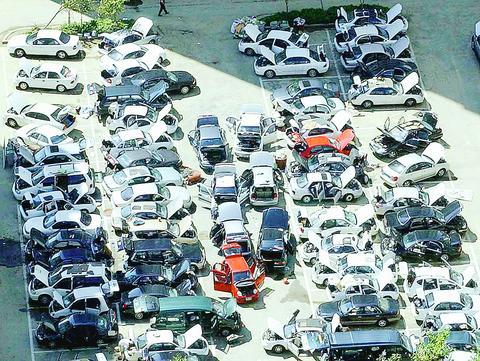
PHOTO: AFP
The government has allocated 1.4 trillion won (US$1.2 billion) for recovery efforts and estimated property damage alone at about 1.1 trillion won (US$996 million).
Losses from export slowdowns, disruptions and lost business opportunities were expected to amount to millions of dollars more. Busan normally handles 80 percent of the country's container shipping.
"Typhoon Maemi damaged exports in Busan port and it may postpone the economic recovery expected in the fourth quarter," said Daishin Securities analyst Kim Dong-Uk.
The government may struggle to achieve even 3 percent growth this year and is unlikely to meet its target of 3.5 percent because of the typhoon, the Korea Times reported.
The Ministry of Commerce Industry and Energy said the typhoon caused a temporary halt to operations at some 20 major companies on the southeastern coast.
On Monday, shares of major export-dependent electronics companies, property insurers, shipbuilding, oil refining and petrochemical companies fell on the Korea Stock Exchange, opening for the first time since Tuesday after a five-day thanksgiving holiday.
Among companies expected to be hit are LG Electronics, South Korea's second-largest mobile phone handset maker, Hyundai Heavy Industries, the world's largest shipbuilder, and Samsung, the world's biggest computer memory chipmaker.
Busan port handles 90 percent of LG's exports such as televisions, refrigerators, and computer monitors. LG Electronics said it is considering switching deliveries from Busan, to other ports to meet export deadlines.
"We report no damage so far, but plan to switch some 25 percent of our export to Gwangyang Port and Masan Port," said an LG spokesman, speaking on condition of anonymity.
The typhoon toppled eight container-lifting cranes and damaged three others in Busan. Government officials said it would take at least 15 months to restore the cranes.
Samsung Electronics Co said its semiconductor goods and mobile phones, which account for 60 percent of its exports, are shipped out by air. But the remaining 40 percent of its exports go through Busan, comprising television sets, computer monitors and other electronic goods.
Hyundai Heavy Industries said one of its vessels collided with a chemical tanker being built at Hyundai Mipo Dockyard, damaging both ships. The damage was estimated to be between 5 billion won (US$4.2 million) and 7 billion won (US$5.9 million), the company said, adding that insurance should cover the cost.

The National Chungshan Institute of Science and Technology yesterday showcased its locally developed variants of the Vision 60 robotic patrol dog, which it plans to deploy on the nation’s outlying territories in the South China Sea. The variants were produced under the Joint Lab project — created by the institute and domestic companies — and assembled with domestically produced motors, lenses and artificial intelligence (AI) systems alongside licensed tech from the US, Missile and Rocket Systems Research Division deputy director Jen Kuo-kang (任國光) told the media event at a military base in Taipei’s Dazhi (大直) area. Taiwan has built up its strengths

RIGHT DIRECTION: Taiwan’s efforts to prevent forced labor include a proposal to ‘fully prohibit’ employers from withholding workers’ documents, an official said Taiwan is to establish a mechanism to restrict imports of goods linked to forced labor, the Executive Yuan said yesterday, after the US proposed imposing additional tariffs on Taiwanese goods over labor concerns. “The Ministry of Labor and the Ministry of Economic Affairs are to establish an interministerial review procedure,” Executive Yuan spokesperson Michelle Lee (李慧芝) said at a news briefing in Taipei. “The government is to use the Foreign Trade Act [貿易法] as the legal basis to restrict imports of goods produced with forced labor” and bring its supply chain governance more in line with international standards on human rights, resilience
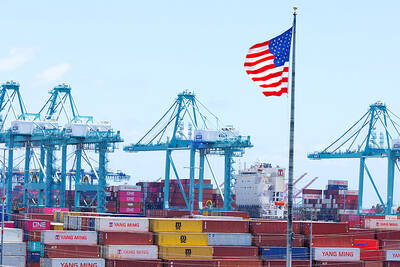
NOT IMMEDIATE: Taiwan has a chance to appeal the proposed 10 percent tariff before it starts, while other countries face a 12.5 percent tariff from the trade office Taiwan is among 60 economies determined by the US to have failed to impose or enforce a ban on the importation of goods produced with forced labor, according to a notice released on Tuesday by the Office of the US Trade Representative (USTR), which proposed imposing an additional 10 percent or more tariff on them. The USTR in a statement said that following an investigation, it had determined under Section 301 of the Trade Act of 1974 that the failure of the 60 economies to impose and effectively enforce a prohibition on the importation of goods produced with forced labor is

TIT-FOR-TAT: The US allegedly revoked the visa of a Chinese national working at Xinhua News Agency in the US in response to Beijing’s expulsion of Vivian Wang The Presidential Office yesterday condemned China for expelling a New York Times correspondent from Beijing following the newspaper’s interview with President William Lai (賴清德), saying the move highlighted Beijing’s suppression of press freedom and its threat to international news media. Taiwan has noted a series of recent incidents in which Beijing used similar tactics to “threaten and pressure international media outlets and journalists,” Presidential Office spokeswoman Karen Kuo (郭雅慧) said in a statement. “This concerns not only press freedom and freedom of expression, but also the safety of journalists, and Taiwan and relevant partners are paying close attention to the situation,” she


 RSS
RSS