


The shadowy Chinese weapons exporter hit by US sanctions over alleged exports of ballistic missile technology to Iran barely resembles its former self.
Norinco has diversified since 1980 into everything from tourism and hotels to forklifts and finance. One of its dozens of subsidiaries boasts of being China's top motorcycle producer, keen to learn from and compete with Japan's Honda.
But China North Industries Corp (Norinco), set up 23 years ago by the State Council, China's cabinet, has hardly forsaken its roots -- at home it is a top civilian weapons supplier to the People's Liberation Army (PLA). Abroad, it is a competitive arms merchant.
Defense analysts say in recent years it sold howitzers to Kuwait and armored vehicles and artillery systems to Iran and Iraq. It also has close ties with Pakistan and has assisted in domestic production of its tanks.
"Probably the most-well known Chinese company in the Middle East is Norinco," Jane's Defence Weekly says.
Norinco officials contacted since the sanctions, which will deprive the company of US$200 million in exports to the US over the next two years, say nothing about the arms business.
"Everything is normal here. We are executing our orders as usual," said one official. "We are trading in military products. Our business is confidential."
Another official said Norinco exported products used in construction projects to the Middle East, but declined to comment on US allegations it exported ballistic missile technology to Iran. "It's my duty to observe the company secrets," she said.
China's foreign ministry denied the US allegations, called the sanctions "unreasonable" and said China was enforcing a law passed last year to curb missile-related exports.
Norinco is no stranger to US scrutiny. In the mid-1990s, it was implicated in the smuggling of the largest cache of automatic weapons in US history.
Norinco denied involvement in the case, in which federal agents seized 2,000 AK-47 rifles and 4,000 ammunition magazines with a street value of US$4 million.
In May 1997, a Chinese court jailed four people, including Norinco employees, for up to 14 years for smuggling the weapons.
The spotlight has done little to dampen business.
Since 1980, Norinco has evolved into one of China's top 20 import and export firms, recording trade volume of US$27 billion by last year.
Its corporate motto calls for being "faithful and honest, striving for development and keeping high efficiency."
China North Industries Corp's portfolio includes vehicles, real estate, finance and trade, as well as chemicals, explosives, civil firearms, light industrial and "special" products.
Its state-owned parent China North Industries Group, launched as part of economic reforms by paramount leader Deng Xiaoping, is a sprawling empire of 131 subsidiaries with 85 billion yuan (US$10 billion) in assets, 420,000 employees and 100 overseas branches.
The group, on its Web site, www.norincogroup.com.cn, makes little effort to hide its role as one of China's largest weapons manufacturers and stresses its role in national defense and modernization of the PLA.
A gallery of its products displays a range of weaponry from tanks to artillery to missiles. Many of its wares are showcased at October 1 National Day military parades.
"During military parades at the anniversaries marking the founding of the People's Republic, the high-tech military weaponry developed and produced by the group has successfully shown the world state-of-the-art of Chinese weapons," it said.
Since the US move, officials have been less forthcoming. At the gates of its 20-story Beijing headquarters of brown granite and blue glass, guards monitor cars and turn away visitors.
"You can't come in now because of SARS. No outsiders are allowed in," said a company official reached by a phone at the gate kiosk, referring to the deadly flu-like virus that has infected thousands in China.
"And we are not accepting interviews anyway," he said.
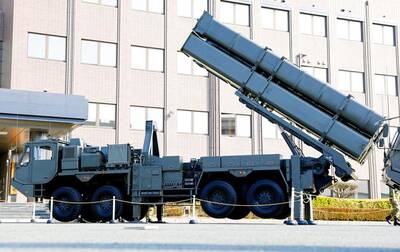
Japan has deployed long-range missiles in a southwestern region near China, the Japanese defense minister said yesterday, at a time when ties with Beijing are at their lowest in recent years. The missiles were installed in Kumamoto in the southern region of Kyushu, as Japan is attempting to shore up its military capacity as China steps up naval activity in the East China Sea. “Standoff defense capabilities enable us to counter the threat of enemy forces attempting to invade our country ... while ensuring the safety of our personnel,” Japanese Minister of Defense Shinjiro Koizumi said. “This is an extremely important initiative for
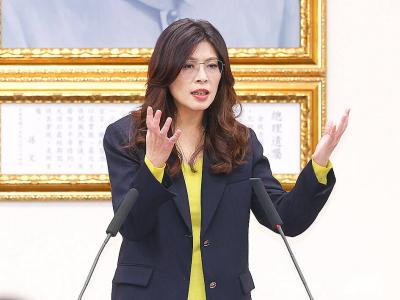
Chinese Nationalist Party (KMT) Chairwoman Cheng Li-wun (鄭麗文) today accepted an invitation from Chinese President Xi Jinping (習近平) to lead a delegation to China next month, saying she hopes to promote the peaceful development of cross-strait relations and bring stability to the Taiwan Strait. “I am grateful and happy to accept this invitation,” Cheng said in a statement from the KMT chairperson’s office. Cheng said she hopes both sides can work together to promote the peaceful development of cross-strait relations, enhance exchange and cooperation, bring stability to the Taiwan Strait and improve people’s livelihoods. At today's news conference, Cheng said any efforts to
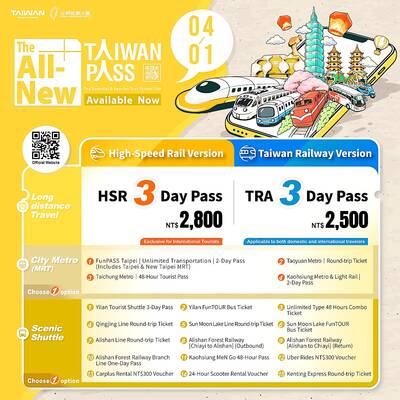
MORE POPULAR: Taiwan Pass sales increased by 59 percent during the first quarter compared with the same period last year, the Tourism Administration said The Tourism Administration yesterday said that it has streamlined the Taiwan Pass, with two versions available for purchase beginning today. The tourism agency has made the pass available to international tourists since 2024, allowing them to access the high-speed rail, Taiwan Railway Corp services, four MRT systems and four Taiwan Tourist Shuttles. Previously, five types of Taiwan Pass were available, but some tourists have said that the offerings were too complicated. The agency said only two types of Taiwan Pass would be available, starting from a three-day pass with the high-speed rail and a three-day pass with Taiwan Railway Corp. The former costs NT$2,800
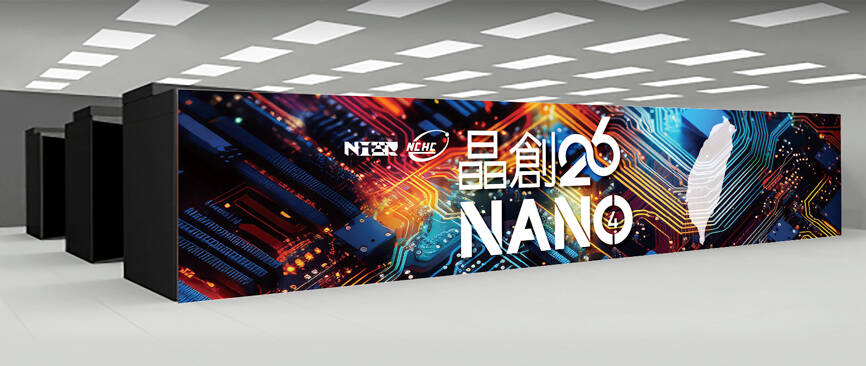
The nation’s fastest supercomputer, Nano 4 (晶創26), is scheduled to be launched in the third quarter, and would be used to train large language models in finance and national defense sectors, the National Center for High-Performance Computing (NCHC) said. The supercomputer, which would operate at about 86.05 petaflops, is being tested at a new cloud computing center in the Southern Taiwan Science Park in Tainan. The exterior of the server cabinet features chip circuitry patterns overlaid with a map of Taiwan, highlighting the nation’s central position in the semiconductor industry. The center also houses Taiwania 2, Taiwania 3, Forerunner 1 and


 RSS
RSS