


Hong Kong will raise taxes on profits and salaries, the first increase in almost two decades, as the government tries to plug a record budget deficit.
Taxes on company profits will be raised by 1.5 percentage points to 17.5 percent and taxes on personal income by 1 point to 16 percent, Financial Secretary Antony Leung (
The tax increases may hamper efforts to lure financial companies and multinationals to Hong Kong, where inward investment fell by almost two-fifths in the first nine months of last year.
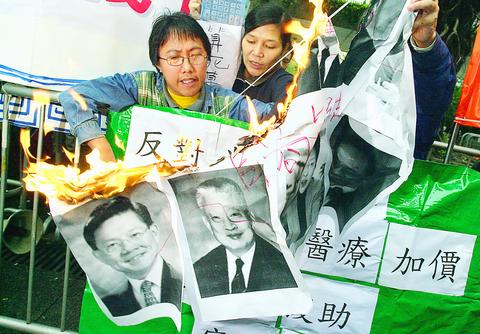
PHOTO: AP
Tax rates remain below those of Singapore, a rival center for companies' regional headquarters, which taxes both profits and personal income at 22 percent.
"I don't think the market is going to like higher taxes very much but there's an air of realism," said Percy Weatherall, managing director of Jardine Matheson Holdings Ltd.
"I applaud low taxes and a simple tax system, but I also recognize that the government has an issue," Weatherall said.
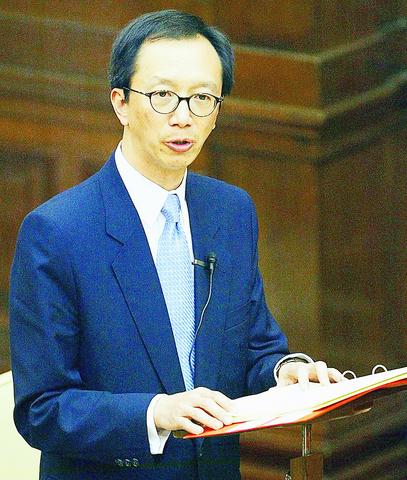
PHOTO: REUTERS
Today's tax increases won't come as a shock to investors, having been flagged by Chief Executive Tung Chee-hwa (
GDP expanded 2.3 percent last year, compared with 0.6 percent growth in 2001, and may expand 3 percent this year, Leung said.
"I don't think the tax increase will be high enough at this stage to cause a change in investors' sentiment," said Lloyd Deverall, the partner in charge of taxation services at KPMG.
"People come to Hong Kong because it's a good place to do business," he said.
Mostly, that reflects the city's links with China, whose economy grew 8 percent last year, according to the Beijing government.
Hong Kong's economy, by contrast, has suffered two recessions since the Asian financial crisis of 1997 to 1998. Property prices have dropped by almost two-thirds and the city's jobless rate has more than tripled, eroding consumer confidence and spending.
Leung also said the government will raise property tax to 16 percent. It will increase airport taxes to HK$120 from HK$80, raising HK$400 million.
The government will also lower the threshold for salaries tax to HK$100,000 a year from HK$108,000 per person, adding about 90,000 taxpayers. Leung said a sales tax may need to be introduced, though it won't be levied now. The government will exempt offshore funds from the profit tax.
Leung said the tax changes will generate HK$6.8 billion in revenue.
Until the late 1990s, Hong Kong managed to maintain low taxes and a budget surplus because of sales of government land.
That revenue has shriveled during the property slump. The government predicts the budget deficit in the financial year ending March 31 will be as high as HK$70 billion (US$9 billion), up from last year's HK$63.3 billion, 5.5 percent of GDP.
The Basic Law, Hong Kong's mini-Constitution, requires the government to balance the budget.

A signaling system malfunction disrupted high-speed rail (HSR) services beginning at 8am today, with trains temporarily reduced to three northbound and three southbound trains per hour as authorities conduct inspections. The malfunction occurred on a section of track in Miaoli County during pre-operation checks early this morning, forcing northbound and southbound trains to use a single track, the HSR operator said. The regular schedule has been replaced with three hourly trains offering only nonreserved seating in each direction, stopping at every station, it said, adding that business class cars would still have reserved seating. Departures from terminal stations are scheduled at the top

Taiwan is still in the process of assessing the possibility of recruiting workers from Eswatini, the Ministry of Foreign Affairs said yesterday, adding that its goal is to help Eswatini upgrade its vocational training centers. If there are plans to recruit workers from Eswatini, safeguarding national security, protecting public health and ensuring the employment rights of Taiwanese would be prerequisites, Department of West Asian and African Affairs Director-General Yen Chia-liang (顏嘉良) told a news conference. Key considerations would also include filling labor shortages in specific industries, and fostering bilateral professional and technical exchanges, he said. Yen was asked about the progress of labor

A US uncrewed surface vessel (USV) encountered multiple Chinese warships during an autonomous transit of the Taiwan Strait, US defense company Seasats said in a statement on Wednesday. Seasats announced that a Lightfish USV had completed the first autonomous transit of the Taiwan Strait. Over five days, the USV traversed the entire length of the Strait while constantly monitoring surface vessel traffic, the company said. The Lightfish encountered multiple Chinese warships, one of which was a Chinese People’s Liberation Army Navy (PLAN) Type 056 corvette, it said. The Chinese vessels were operating “well within Taiwan’s exclusive economic zone without transmitting their identity via the

VERBOSE VESSELS: A CGA cutter and a China Coast Guard exchanged verbal barbs for more than a day in Taiwanese-controlled waters before the Chinese vessel left The Taiwanese and Chinese coast guards had a standoff near the strategically located Pratas Islands (Dongsha Islands, 東沙群島) in the north of the South China Sea, the Coast Guard Administration (CGA) said yesterday. The two sides engaged in intense radio exchanges over sovereignty claims during the 33-hour standoff. China Coast Guard vessel 3501 eventually left the restricted waters, 26.6 nautical miles (49.2km) west of the Pratas Islands, at 5pm yesterday, the CGA said. Lying approximately between southern Taiwan and Hong Kong, the Taiwan-controlled Pratas are seen by some security experts as vulnerable to Chinese attack due to their distance — more than


 RSS
RSS