


British Airways Plc, Europe's largest airline, posted a third-quarter profit, reversing a year-earlier loss, after the company cut one-sixth of its workforce, scrapped unprofitable routes and streamlined its fleet.
Net income in the three months ended Dec. 31 was UK Pound 13 million (US$21 million), or 1.2 pence a share, compared with a net loss of UK Pound 144 million, or 13.4 pence, in the year-ago period, the company said in a Regulatory News Service statement.
Analysts surveyed by Bloomberg expected a loss of 53 million pounds.
"The route to profitability in the short term is going to be through cost reduction," said Chris Tarry, an independent aviation analyst, in an interview. This year "is likely to be a much tougher year for the airline industry than 2002."
British Airways has cut 9,209 of its 56,500 employees and expects to reduce its workforce 23 percent by March 2004 as it tries to counter a slump in air travel after the Sept. 11 attacks in the US and a drop in business traffic amid a global economic slowdown.
It's also reorganized its European short-haul flights to compete with low-cost rivals such as EasyJet Plc.
"Our total costs in the last 12 months are UK Pound 1 billion lower than the previous year, which demonstrates the determination of our people to deliver," Chief Executive Officer Rod Eddington said in a Regulatory News Service statement.
The company said it expects to post a full-year profit, reversing a UK Pound 142 million loss in fiscal 2002, though it sees no growth in revenue in the next 12 months. Sales rose 1 percent to UK Pound 1.86 billion in the third quarter.
"In the absence of hostilities in the Middle East, we expect this financial year to be profitable," Chairman Lord Marshall said in the statement. "We expect the business environment to be tougher in 2003 than last year."
The carrier said it remains on target to reduce its workforce by 10,000 employees to 46,500 by the end of March.

FREEDOM OF NAVIGATION: The UK would continue to reinforce ties with Taiwan ‘in a wide range of areas’ as a part of a ‘strong unofficial relationship,’ a paper said The UK plans to conduct more freedom of navigation operations in the Taiwan Strait and the South China Sea, British Secretary of State for Foreign, Commonwealth and Development Affairs David Lammy told the British House of Commons on Tuesday. British Member of Parliament Desmond Swayne said that the Royal Navy’s HMS Spey had passed through the Taiwan Strait “in pursuit of vital international freedom of navigation in the South China Sea.” Swayne asked Lammy whether he agreed that it was “proper and lawful” to do so, and if the UK would continue to carry out similar operations. Lammy replied “yes” to both questions. The
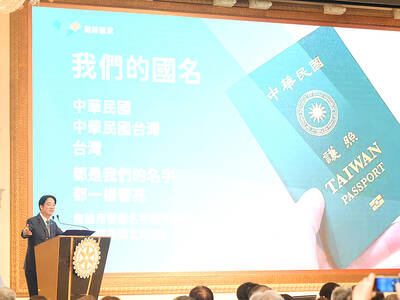
‘OF COURSE A COUNTRY’: The president outlined that Taiwan has all the necessary features of a nation, including citizens, land, government and sovereignty President William Lai (賴清德) discussed the meaning of “nation” during a speech in New Taipei City last night, emphasizing that Taiwan is a country as he condemned China’s misinterpretation of UN Resolution 2758. The speech was the first in a series of 10 that Lai is scheduled to give across Taiwan. It is the responsibility of Taiwanese citizens to stand united to defend their national sovereignty, democracy, liberty, way of life and the future of the next generation, Lai said. This is the most important legacy the people of this era could pass on to future generations, he said. Lai went on to discuss
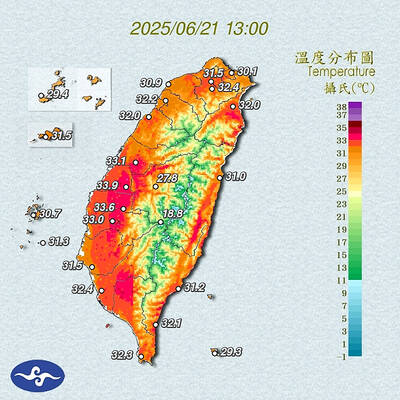
AMENDMENT: Climate change is expected to increase the frequency of high-temperature days, affecting economic productivity and public health, experts said The Central Weather Administration (CWA) is considering amending the Meteorological Act (氣象法) to classify “high temperatures” as “hazardous weather,” providing a legal basis for work or school closures due to extreme heat. CWA Administrator Lu Kuo-chen (呂國臣) yesterday said the agency plans to submit the proposed amendments to the Executive Yuan for review in the fourth quarter this year. The CWA has been monitoring high-temperature trends for an extended period, and the agency contributes scientific data to the recently established High Temperature Response Alliance led by the Ministry of Environment, Lu said. The data include temperature, humidity, radiation intensity and ambient wind,

SECOND SPEECH: All political parties should work together to defend democracy, protect Taiwan and resist the CCP, despite their differences, the president said President William Lai (賴清德) yesterday discussed how pro-Taiwan and pro-Republic of China (ROC) groups can agree to maintain solidarity on the issue of protecting Taiwan and resisting the Chinese Communist Party (CCP). The talk, delivered last night at Taoyuan’s Hakka Youth Association, was the second in a series of 10 that Lai is scheduled to give across Taiwan. Citing Taiwanese democracy pioneer Chiang Wei-shui’s (蔣渭水) slogan that solidarity brings strength, Lai said it was a call for political parties to find consensus amid disagreements on behalf of bettering the nation. All political parties should work together to defend democracy, protect Taiwan and resist


 RSS
RSS