


Makers of homemade Thai rice whiskey once plied their craft in jungle hideouts and farmyard shacks, concealed from the gaze of police officers threatening to arrest them and seize their makeshift stills.
But what was once a furtive -- and criminal -- enterprise has been legalized and even touted by the government as a source of revenue that could help lift Thailand from its economic doldrums and enrich poor villagers.
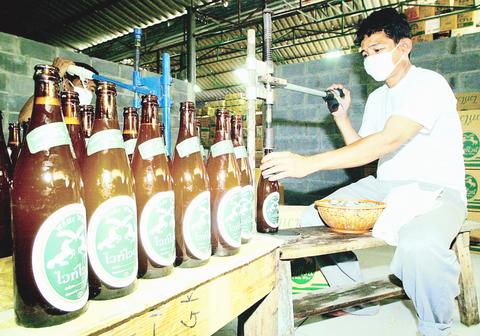
PHOTO: AP
Appealing to the entrepreneurial instincts of rural moonshine peddlers, the government of Prime Minister Thaksin Shinawatra legitimized the trade a year ago, urging fermented fruit and rice wine producers to apply for licenses.
Among them was Sawai Nuengsamphan, a 42-year-old former welder and gas station attendant whose family produced the sweet alcoholic tipple illegally for decades, suppling spirits for community weddings, funerals and ordinations.
Over the years, Sawai's grandfather was arrested several times for distilling "sato," the sweet and pungent brew very popular in rural Thailand.
But when the laws were relaxed last November, Sawai envisioned his family's cottage industry transforming into a runaway large-scale business with a clientele spanning the globe.
"I have a dream that foreigners will drink this," he said. "The first place is Japan because the taste is like sake. Also in Singapore and Taiwan because there are Thai workers there."
With a 2 million baht (US$45,700) loan, he founded Mahamit (Great Friend) Thai Wine. Producing only 120 bottles a day when it opened in April, it now turns out about 6,000 bottles in the tin-roof distillery in Rayong province, 145km south of Bangkok.
"We are pioneers, the first to sell legally in Rayong province," he said, removing the lid from a plastic tub of fermented rice and herb mash, sniffing its alcoholic aroma.
Nearby, workers balanced aluminum vats on a dozen gas burners to boil rice, the key ingredient in sato. Mixed with water and sugar and flavored with ginger and other herbs, the rice ferments for 20 days to become alcoholic.
"This liquor has been around for hundreds of years," Sawai said. "But it bothered me to see sato sold in plastic bags. I wanted to see it on the dining table."
Filled in sterilized beer bottles with hand-affixed labels, Sawai's hooch sells quickly across Thailand at 25 baht a bottle, particularly in the northeast, where drinking such firewater is an honored pastime.
"The first people who tried my sato said I was crazy because villagers can make this and why would they by it from me?" he said. "I told them everybody can make soup, so why do people buy it from the market?"
In legalizing the industry, the government has imposed a 25 percent to 30 percent tax on each bottle. Still, Sawai's profits have been rich enough to pay for a new Toyota pick-up truck and construction work on a second factory.
The government hopes that while some people continue to make hooch illegally to avoid taxes, many like Sawai will see the benefit of running a licensed business that will allow them to market their product more widely.
The earlier ban on local liquor production was meant to protect a monopoly on the whiskey market in Thailand held by Sura Maharas, for years the sole holder of a government concession to produce cheap rice whiskey.
Officials say the newly licensed producers are aiming for a different market -- the poorer rural residents and, eventually, overseas consumers. "So far we've made about 68 million baht (US$1.6 million), from January until now" in taxes and license fees, said Sujarit Patchimnun, the head of the Interior Ministry's community development department.
"The main thing is to help the economy, to make money. We don't want to lose resources we already have," he said.
Locally produced rice whiskey must contain less than 15 percent alcohol, according to the Ministry of Finance. Licensed whiskey makers are required to have their products examined regularly by the excise department.
So far, licenses have been given to about 450 producers, whom the government describes as "farm cooperatives," meaning they are certified village residents who have created a cottage industry and generated employment.
About 500 more individual hooch makers remain unlicensed and will continue to be targeted by authorities unless they form cooperatives. Until then, if convicted they face a fine of up to 5,000 baht (US$110) for each infraction and six months in jail.

Japan has deployed long-range missiles in a southwestern region near China, the Japanese defense minister said yesterday, at a time when ties with Beijing are at their lowest in recent years. The missiles were installed in Kumamoto in the southern region of Kyushu, as Japan is attempting to shore up its military capacity as China steps up naval activity in the East China Sea. “Standoff defense capabilities enable us to counter the threat of enemy forces attempting to invade our country ... while ensuring the safety of our personnel,” Japanese Minister of Defense Shinjiro Koizumi said. “This is an extremely important initiative for

Chinese Nationalist Party (KMT) Chairwoman Cheng Li-wun (鄭麗文) today accepted an invitation from Chinese President Xi Jinping (習近平) to lead a delegation to China next month, saying she hopes to promote the peaceful development of cross-strait relations and bring stability to the Taiwan Strait. “I am grateful and happy to accept this invitation,” Cheng said in a statement from the KMT chairperson’s office. Cheng said she hopes both sides can work together to promote the peaceful development of cross-strait relations, enhance exchange and cooperation, bring stability to the Taiwan Strait and improve people’s livelihoods. At today's news conference, Cheng said any efforts to

MORE POPULAR: Taiwan Pass sales increased by 59 percent during the first quarter compared with the same period last year, the Tourism Administration said The Tourism Administration yesterday said that it has streamlined the Taiwan Pass, with two versions available for purchase beginning today. The tourism agency has made the pass available to international tourists since 2024, allowing them to access the high-speed rail, Taiwan Railway Corp services, four MRT systems and four Taiwan Tourist Shuttles. Previously, five types of Taiwan Pass were available, but some tourists have said that the offerings were too complicated. The agency said only two types of Taiwan Pass would be available, starting from a three-day pass with the high-speed rail and a three-day pass with Taiwan Railway Corp. The former costs NT$2,800

The nation’s fastest supercomputer, Nano 4 (晶創26), is scheduled to be launched in the third quarter, and would be used to train large language models in finance and national defense sectors, the National Center for High-Performance Computing (NCHC) said. The supercomputer, which would operate at about 86.05 petaflops, is being tested at a new cloud computing center in the Southern Taiwan Science Park in Tainan. The exterior of the server cabinet features chip circuitry patterns overlaid with a map of Taiwan, highlighting the nation’s central position in the semiconductor industry. The center also houses Taiwania 2, Taiwania 3, Forerunner 1 and


 RSS
RSS