


The jet that its builders say will change the face of commercial aviation sits in an exhibition hall here, bold and sleek and bathed in a golden spotlight.
It is also about as ready for flight as an ostrich.
PHOTO: NY TIMES
The plane, the futuristic Sonic Cruiser, is Boeing's centerpiece display at the Farnborough International Air Show, the largest aerospace trade conference of 2002. But what Boeing has in its exhibit is nothing more than a slim 2m plastic replica that looks as if it came from the prop shop of Star Trek. The actual airplane exists mostly in the minds of its designers.
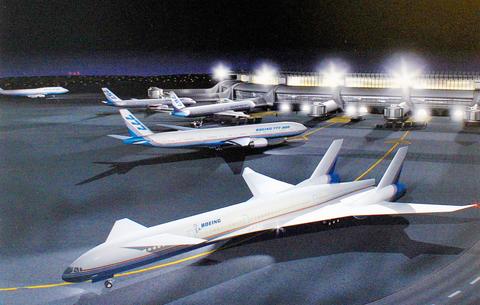
PHOTO: NY TIMES
Airbus, Boeing's only rival, flew four commercial aircraft into the show, including the new A340-600, called "the flying sausage" by local journalists because it is the longest jet in the world. Sir Richard Branson, the founder of Virgin Atlantic Airways, snatched one of the first ones off the assembly line and brought it here after having it christened by the model Claudia Schiffer.
Those contrasting approaches point to the way the two largest commercial airplane manufacturers are positioning themselves in the slackening aerospace industry. Boeing is in a holding pattern, cutting back on production, laying off workers and fielding tough questions about the shaky future of the Sonic Cruiser. Airbus, based in Toulouse, France, is swaggering around with ever larger planes, a steady assembly rate and a rising market share. All this is happening amid one of the airline industry's worst economic downturns, with American carriers losing more than US$1.4 billion in the second quarter.
"We are now a large, powerful, global and unified single company," said Noel Forgeard, chief executive of Airbus.
Philip Condit, chief executive of Boeing, was more somber. "We think this is a huge downturn," he said. "We think there's a tremendous overhang of capacity in the market." His comments were part of a 15-minute speech that avoided specific mention of Boeing's commercial production until an audience member said that no leader of Boeing had ever talked so long without addressing that side of the business.
Condit replied sharply: "Absolutely we're interested in commercial airplanes. It's important to our business."
Military orders
But Boeing is banking on the military and space side of its company as its biggest growth area, and it has retreated somewhat on commercial production. Though it had a second-quarter profit of US$779 million, it had a first-quarter loss of US$1.25 billion, its first loss in more than four years. It has cut production in half this year and has eliminated 26,000 jobs.
It has also allowed customers like Delta Air Lines to defer orders this year and next, and expects to deliver 380 planes this year, down from 527 last year. To cope with the downturn and "the evolution of a formidable competitor," Boeing still needs to cut costs 20 to 30 percent, said Nicole Piasecki, vice president for business strategy and marketing.
That could include renegotiating contracts with suppliers and closing parts of Boeing's manufacturing plants, Piasecki said. Boeing has been keeping surplus equipment and buildings in hopes of an economic upswing. But if Airbus captures half of the market in the next couple of years, then that surplus becomes unnecessary, she said. Measured by the number of planes ordered, Airbus now has 46 percent of the market, more than double its share in 1995.
"I think they have done a marvelous job of building an enterprise from scratch," Howard Rubel, an analyst at Goldman Sachs, said of Airbus. "They have constantly challenged Boeing and in some cases established a very compelling beachhead and product line."
Last year, Boeing's commercial unit had revenue of US$30.1 billion, compared with Airbus' 20.5 billion euros, or US$18.2 billion.
World's largest jet
Executives at Airbus are quick to point out numbers that they say show it is reaching parity with Boeing. The company says it expects to deliver 300 planes next year, while Boeing expects delivery of 275 to 300. Airbus has a backlog of 1,519 orders versus Boeing's 1,200.
Two weeks ago, President Jacques Chirac of France attended a ribbon-cutting ceremony for the factory where Airbus will assemble its first A380, the 555-seat behemoth that will be the world's largest jetliner once it enters service with its first customer, Singapore Airlines, in 2006.
Airbus already has 95 firm orders for that plane and an agreement from Qatar Airways for two more. That means the company has made 40 percent of the sales needed to break even on the project, Forgeard said. FedEx was the first North American company to place an order, signing a contract this month for 10 planes.
"It's a long-range aircraft with a lot of operational efficiencies," said Edwin Coleman, a spokesman for FedEx, which expects to take delivery of its first three in 2008. The new aircraft will allow the company to fly from the US to Asia without stopping in Alaska, as it does now. On some routes, it will replace two Boeing MD-11s with one A380.
Branson had his own take on Airbus' jet design. "In the airline industry, I believe that big is beautiful," he said. "To build smaller planes that fly long distances today is admirable, but you can't get slots at the airports."
Airbus was created as a European consortium in 1970, when it began production of its first wide-body twin-engine jet, the A300. But its growth did not accelerate until the mid-1990s, when it began offering a wider range of aircraft with features that sharply distinguished its planes from Boeing's. For example, its cockpit designs are fairly similar from jet to jet, so pilots need only a few days of extra training to fly another model.
Airbus has had much recent success winning over customers who were once Boeing devotees. One such carrier, KLM, the Dutch airline, announced here that it had signed up for six Airbus jets. Air New Zealand is another recent convert. Airbus and Boeing are also fighting for a pending order of up to 120 jets from EasyJet, the British no-frills carrier.
The US market could be more troublesome. Airbus sells small jets to the fast-growing JetBlue Airways, but it has made more money with larger aircraft to United Airlines and US Airways, which have some of the largest losses among domestic carriers. They are each seeking federal loan guarantees.
Flooding the market
Boeing executives are criticizing the production numbers that Airbus has been promoting, contending that they show Airbus is not following sensible business practices. Condit argues that Airbus' high production rate is adding too much capacity to the market, unnecessarily bringing down the price of planes. Airbus has been particularly aggressive in selling to lessors -- financial companies like the American International Group that lend planes to airlines -- because it is easier to flood the market by dealing with them, said Piasecki, the Boeing executive. Nearly 40 percent of Airbus' backlog is for lessors, versus 27 percent of Boeing's.
But Airbus disputes those arguments. "There is no question of oversupply," Forgeard said. "For us, we just deliver the airplanes that have been ordered."
Piasecki acknowledges that Airbus has been more aggressive than Boeing in its advertising campaigns. For example, it put up billboards here promoting the fact that its A340 has four engines, and many people are interpreting that as saying the model is safer than Boeing's twin-engine equivalent. There is no evidence to prove that, and Boeing executives are fuming.
With Airbus aiming to match Boeing's commercial market share, Boeing is looking to other avenues of growth. The one commercial jet it flew here, a 737-400, is being used to demonstrate Connexion, a wireless broadband project that could bring Internet access to planes. The company is also screening a trailer for the latest Star Wars movie to show off digital transmission technology it wants to sell to Hollywood studios and theater owners. Boeing has said it wants to remake itself into a company that provides a wide range of services, including training commercial pilots to fly, even on Airbus planes.
Those projects have less promise right now than Boeing's attempts to strengthen its military manufacturing unit. Two weeks ago, the company said it was merging its satellite and communications business with that unit, creating an operation equal in size to its commercial airplane division. On Tuesday, Boeing said it had reached agreements with three of Europe's largest military contractors to research a global missile defense system, although terms of those arrangements will be dictated by several governments. Interestingly, two of the partner companies are BAE Systems, which owns 20 percent of Airbus, and the European Aeronautic Defense and Space Co, which owns the remaining 80 percent.
"Clearly, that's a top priority for Boeing," Jonathan Schrader, an analyst at Morningstar Inc, said of the company's push for military contracts. "As we continue to see weakness in the commercial business, that will continue to increase."
Rubel, the analyst at Goldman Sachs, said that there were "enormous synergies in terms of people, in terms of technical sharing, even in terms of cross-selling that exist by being the leader in both defense and civil aviation."
Lockheed challenge
But to be the No. 1 military manufacturer, Boeing will have to unseat Lockheed Martin, which last year beat out Boeing for a lucrative contract to help build the Joint Strike Fighter for the US government.
Despite Boeing's talk about military production, most of the speculation about the company's future revolves around the Sonic Cruiser, which some people in the industry call a public relations ploy to hide the fact that Boeing has nothing in the works to rival the stature of the A380. Boeing, which announced the project in March 2001, says the Sonic Cruiser embodies the future of air travel. While the success of Airbus' A380 depends on airlines' continuing to transport passengers through hubs, Boeing's plane rests on the idea that travelers want to fly point to point in a 250-seat jet that goes 15 to 20 percent faster than an aircraft of its size today.
But Condit said at this air show that Boeing would build "what the market wants," meaning that his company might scrap plans for the Sonic Cruiser if the beleaguered airlines do not want to risk such a purchase. Instead, Boeing might use the findings from its research to build an improved version of a conventional 200 to 250-seat plane.
If it does that, then Airbus could build its own competitive model by 2012, said John Leahy, chief commercial officer at Airbus. "I absolutely guarantee that ours will not look like any starship," he said. "And neither will theirs."
Of course, the real winners in this 12-round slugfest are the airlines, which need all the options they can get right now. "You would be very unwise in the airline industry to have just one bride," said Branson, the founder of Virgin. "You need two brides."

FREEDOM OF NAVIGATION: The UK would continue to reinforce ties with Taiwan ‘in a wide range of areas’ as a part of a ‘strong unofficial relationship,’ a paper said The UK plans to conduct more freedom of navigation operations in the Taiwan Strait and the South China Sea, British Secretary of State for Foreign, Commonwealth and Development Affairs David Lammy told the British House of Commons on Tuesday. British Member of Parliament Desmond Swayne said that the Royal Navy’s HMS Spey had passed through the Taiwan Strait “in pursuit of vital international freedom of navigation in the South China Sea.” Swayne asked Lammy whether he agreed that it was “proper and lawful” to do so, and if the UK would continue to carry out similar operations. Lammy replied “yes” to both questions. The
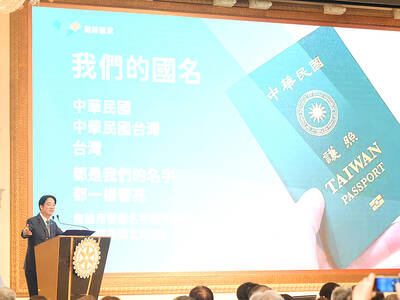
‘OF COURSE A COUNTRY’: The president outlined that Taiwan has all the necessary features of a nation, including citizens, land, government and sovereignty President William Lai (賴清德) discussed the meaning of “nation” during a speech in New Taipei City last night, emphasizing that Taiwan is a country as he condemned China’s misinterpretation of UN Resolution 2758. The speech was the first in a series of 10 that Lai is scheduled to give across Taiwan. It is the responsibility of Taiwanese citizens to stand united to defend their national sovereignty, democracy, liberty, way of life and the future of the next generation, Lai said. This is the most important legacy the people of this era could pass on to future generations, he said. Lai went on to discuss

AMENDMENT: Climate change is expected to increase the frequency of high-temperature days, affecting economic productivity and public health, experts said The Central Weather Administration (CWA) is considering amending the Meteorological Act (氣象法) to classify “high temperatures” as “hazardous weather,” providing a legal basis for work or school closures due to extreme heat. CWA Administrator Lu Kuo-chen (呂國臣) yesterday said the agency plans to submit the proposed amendments to the Executive Yuan for review in the fourth quarter this year. The CWA has been monitoring high-temperature trends for an extended period, and the agency contributes scientific data to the recently established High Temperature Response Alliance led by the Ministry of Environment, Lu said. The data include temperature, humidity, radiation intensity and ambient wind,
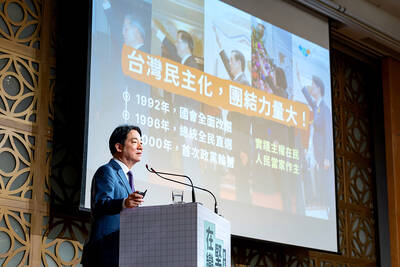
SECOND SPEECH: All political parties should work together to defend democracy, protect Taiwan and resist the CCP, despite their differences, the president said President William Lai (賴清德) yesterday discussed how pro-Taiwan and pro-Republic of China (ROC) groups can agree to maintain solidarity on the issue of protecting Taiwan and resisting the Chinese Communist Party (CCP). The talk, delivered last night at Taoyuan’s Hakka Youth Association, was the second in a series of 10 that Lai is scheduled to give across Taiwan. Citing Taiwanese democracy pioneer Chiang Wei-shui’s (蔣渭水) slogan that solidarity brings strength, Lai said it was a call for political parties to find consensus amid disagreements on behalf of bettering the nation. All political parties should work together to defend democracy, protect Taiwan and resist


 RSS
RSS