


The town they call "the sweetest place on Earth" has turned sour. For a century, the factory community that makes the Hershey Bar, Mr. Goodbar and Hershey's Chocolate Kisses -- American icons long before Coca-Cola or McDonald's -- has been celebrated as an emblem of enlightened, harmonious, paternalistic capitalism.
But now the model town that nestles in the rolling hills of Pennsylvania's Bible belt has been turned into an industrial battleground by a brazen new management facing bitter strike action.
Hundreds of thousands of tourists come every year to pay homage to Chocolate World -- Hershey's candy Disneyland. There is unlikely to be a single American who has not eaten a Hershey bar, stuffed into schoolchildren's pockets since 1903. But now placards and pickets line the factory gates along Old West Chocolate Avenue, hailed by hooting horns.
Union organizer Bruce Hummel of Chocolate Local 464 said: "The smell of solidarity is stronger than the smell of chocolate."
The strike, by 2,800 employees, is over a wrangle involving back pay and heaping the burden of health care on workers. But the real source of strife is a chill wind of change at an unusual factory in an unusual town.
Like its English counterparts, the origins of Hershey chocolate lie in the philanthropic tradition of capitalistic paternalism, and specifically the stalwart Mennonite puritan who broke the ground to build his factory, Milton Hershey.
Hershey, born in 1857, was father figure to the company and community he built in 1903 as a model town -- which it remains -- to manufacture America's first chocolate, hitherto a luxury sweetmeat, for the working class.
For decades, the management of his firm was nurtured and recruited from the family and from a private orphanage and school founded by Hershey himself in 1916 -- as was the union which organised its workers.
"I was an orphan," said Bruce Hummel, from his office on Cocoa Avenue, "and grew up as one of Milton Hershey's orphans, just like many of the chief executives. He was a philanthropist who instilled a work ethic in everyone and owned everything in town and put everything he made back into the town -- the drug store, the gas station. It was in his interest to have people well-paid and looked after."
Last year, after five years of flat profit margins, the family tradition was dramatically ended with the appointment of Rick Lenny as CEO.
Lenny came from different stock -- a veteran of Nabisco Foods which had integrated the company into the Philip Morris tobacco giant, with a famed track record for cutting costs and jobs. Since his arrival at Hershey he has chopped the workforce by 800.
While Wall Street is delighted, Hershey is outraged, "even if this is a conservative town," said Hummel. "It's four-to-one Republican and a lot of people won't picket for religious reasons -- they make sandwiches instead. Personally I don't understand why, because so far as I'm concerned Jesus was the first union activist."
In the basement of strike headquarters, one table is given over to Bibles and "religious support"; the neighbouring towns are called Lebanon and Bethel; many of the local visitors taking factory tours are Amish. More hardline pickets hand out free M&Ms to passers-by -- "manufactured by Mars."
There are pictures of a flying rat called Bin Lenny crashing into two twin towers labelled Hershey Foods. "He's a different kind of terrorist," said a striker called Karl. "He's not out to kill people, just wreck lives."
The gas station refuses to sell Hershey bars and local doctors give their services free. Meanwhile, above the factory at the Hotel Hershey, long-faced executives from New York banks lock themselves in deluxe suites.
The average wage, says the union, is a handsome US$17 an hour, with many earning less, and skilled trades more.
With the union holding shares in the company, the annual stockholders' meeting at Hershey Theatre on Wednesday, third day of the strike, turned into a shouting match never before seen in Hershey's history, while hundreds demonstrated.
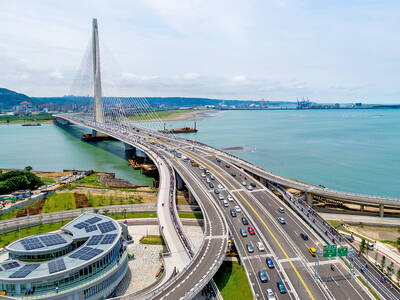
The Ministry of Transportation and Communications yesterday inaugurated the Danjiang Bridge across the Tamsui River in New Taipei City, saying that the structure would be an architectural icon and traffic artery for Taiwan. Feted as a major engineering achievement, the Danjiang Bridge is 920m long, 211m tall at the top of its pylon, and is the longest single-pylon asymmetric cable-stayed bridge in the world, the government’s Web site for the structure said. It was designed by late Iraqi-British architect Zaha Hadid. The structure, with a maximum deck of 70m, accommodates road and light rail traffic, and affords a 200m navigation channel for boats,
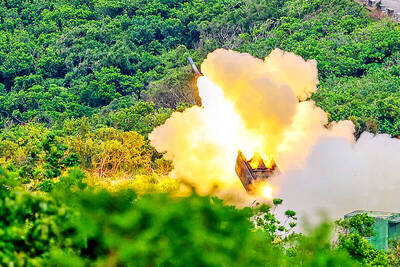
PRECISION STRIKES: The most significant reason to deploy HIMARS to outlying islands is to establish a ‘dead zone’ that the PLA would not dare enter, a source said A High Mobility Artillery Rocket System (HIMARS) would be deployed to Penghu County and Dongyin Island (東引) in Lienchiang County (Matsu) to force the Chinese military to retreat at least 100km from the coastline, a military source said yesterday. Taiwan has been procuring HIMARS and Army Tactical Missile Systems (ATACMS) from the US in batches. Once all batches have been delivered, Taiwan would possess 111 HIMARS units and 504 ATACMS, which have a range of 300km. Considering that “offense is the best defense,” the military plans to forward-deploy the systems to outlying islands such as Penghu and Dongyin so that
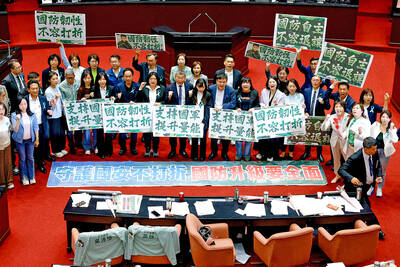
WHAT WAS ALL THAT FOR? Jaw Shaw-kong said that Cheng Li-wen had pushed for more drastic cuts and attacked him, just for the outcome to be nearly identical to his bill The legislature yesterday passed a supplementary budget bill to fund the purchase of separate packages of US military equipment, with the combined amount of spending capped at NT$780 billion (US$24.8 billion). The Chinese Nationalist Party (KMT) and Taiwan People’s Party (TPP) used their legislative majority to pass the bill, which runs until 2033 and has two main funding provisions. One was for NT$300 billion of arms sales already approved by the US for Taiwan on Dec. 17 last year, the other was for NT$480 billion for another arms package expected to be announced by Washington. The bill, which fell short of the NT$1.25
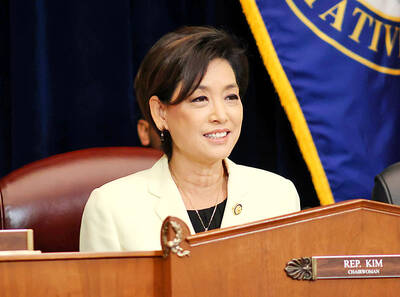
‘CLEAR MESSAGE’: The bill would set up an interagency ‘tiger team’ to review sanctions tools and other economic options to help deter any Chinese aggression toward Taiwan US Representative Young Kim has introduced a bill to deter Chinese aggression against Taiwan, calling for an interagency “tiger team” to preplan coordinated sanctions and economic measures in response to possible Chinese military or political action against Taiwan. “[Chinese President] Xi Jinping [習近平] has directed the People’s Liberation Army to be ready to invade Taiwan by 2027. China has a plan. America should have one too,” Kim said in a news release on Thursday last week. She introduced the “Deter PRC [People’s Republic of China] aggression against Taiwan act” to “ensure the US has a coordinated sanctions strategy ready should


 RSS
RSS