


A rash of new day spas has erupted in New York recently, each promising new attractions to catch the eye of jaded beauty consumers.
In the last year alone there have been Ajune, a spa opened by a plastic surgeon, and Skin Care Lab, opened by dermatologists. Cleo II, a chain of nail salons, is expanding into spas that offer late-night services. The Greenhouse spa offers Indian-inspired treatments like chickpea powder foot exfoliation. The Stone spa specializes in hot stone massage. Even the 92nd Street Y opened a spa featuring beauty treatments early this summer. And there's no end in sight. Maximus, an ultra-design 6,000-square-foot hair salon and spa in SoHo, opened about two weeks ago. The Brigitte Mansfield European Spa, in Union Square, began dispensing caviar-laced treatments last April. There is the Eden Day Spa, in TriBeCa, which opened in June, and in a few weeks, John Masters, a hairdresser who specializes in organic beauty treatments, will offer spa services at his new salon, also in SoHo.

PHOTO: NY TIMES
Until 1996, when Marcia Kilgore opened Bliss, on Broadway near Prince Street, most of the so-called day spas were uptown, in semi-dotty places like Elizabeth Arden, where they generally excelled at providing decent service in an atmosphere of hushed Hungarian-magic-creme mystery. Who knew what those hair-netted European ladies were dabbing on your face? Just the notion of having a facial seemed exotic.
Of the nearly 5,700 spas in the US, including well-known resort spas like Golden Door and Canyon Ranch, more than 75 percent are day spas, according to the International Spa Association. Since 1994, the number of new day spas across the country has increased 127 percent, making it one of the fastest growing segments of the spa industry, which had revenue last year of $5 billion.
Even in stressed-out New York, is there enough demand to keep all the loofah scrubbers happy?
Naturally, the owners of the newest day spas think there is. "What Bliss did for the entire industry is put the word `day spa' on everybody's Rolodex," said Calcasola, who also owns spa-salons in Merrick and Westbury, on Long Island. "There is demand if you are professional and you don't treat spa as an ancillary service. It is a business. You can't just jump on the bandwagon and suddenly become Mary Jane's Beauty Box and Spa."
Amy Astley, the beauty director of Vogue, thinks there's plenty of demand, and points to the continued popularity of Bliss, where a Saturday appointment for a facial is a two-to-three-month wait. ( Kilgore plans to open a London spa in early November and expects to open three or four spas around this country in the next few years, as well as 150 QuickBliss locations, for manicures and pedicures.)
Day spas now have to come up with slicker packaging and elaborately creative treatments to distinguish themselves. They must compete for talented technicians.
Last week, I tried three of the latest additions to sample some of the new tricks in state-of-the-art pampering.
Maximus seems well run, with a slight high-tech advantage over the other new rivals. The big leather chairs in the shampoo area of the salon have motorized massage features, and I noticed that a toilet seat in the spa locker room offered this function, too. Calcasola has set up a marble "steam bar," so patrons embarking on facials can pause for a few minutes to have their pores opened by a mild blast of steam and oxygen while an attendant mixes a suitable "face cocktail" of cleansers and toners. The spa itself looked spotless, and the design was sterile chic: concrete floors and white-curtained glass walls.
Simona Rusu, who has performed facials and various water therapies for 20 years, took me into the water room at Maximus for Calcasola's piece de resistance -- the water journey. This is a three-part excursion, beginning with a full-body salt scrub, then a hose-down with warm water from overhead jets. This is followed by soaking for 10 minutes in a tub of furiously bubbling water. The third phase -- a shower room where water falls on you at the rate of 300 liters a minute was not operational yet. Maximus has a straightforward menu of spa services, including a deep-treatment facial (US$90) and the all-in-one water journey and full body massage (US$140).
Both the Eden and Brigitte Mansfield spas offered service that seemed to be no more than adequate. Eden is spacious, decorated with long billowing curtains dividing a lounge area where customers can have pedicures and reflexology treatments (US$75) while watching projection television.
At Brigitte Mansfield, the masseuse who gave me a hot-stone massage was competent, but, with only two years of massage experience, she lacked Hathaway's know-how and sense of confidence. The spa itself, on a fourth floor overlooking Union Square, is all-white, thickly carpeted and has large treatment rooms.
Mansfield, a former model who developed her own line of caviar-based skincare products, said she wanted a spa that emphasized traditional European recipes, like a creme-fraiche body wrap or a mustard powder foot bath. She agreed that Lower Manhattan, particularly SoHo, was now saturated with spas, but said she believed that by offering a soothing atmosphere and extra-large rooms, she can offer an alternative to places like Bliss.
Kilgore said she was not concerned about a glut of spas. "I worry about myself and my own business, and not really about everyone else," she said. Still, she finds it intriguing that so many new spas are emphasizing space and relaxation, and such things as nature music, waterfalls and light therapies. "I just can't get into that," Kilgore said. "We're a little more tongue in cheek than that. People don't come to a spa expecting to have an ephiphany."

CHAOS: Iranians took to the streets playing celebratory music after reports of Khamenei’s death on Saturday, while mourners also gathered in Tehran yesterday Iranian Supreme Leader Ayatollah Ali Khamenei was killed in a major attack on Iran launched by Israel and the US, throwing the future of the Islamic republic into doubt and raising the risk of regional instability. Iranian state television and the state-run IRNA news agency announced the 86-year-old’s death early yesterday. US President Donald Trump said it gave Iranians their “greatest chance” to “take back” their country. The announcements came after a joint US and Israeli aerial bombardment that targeted Iranian military and governmental sites. Trump said the “heavy and pinpoint bombing” would continue through the week or as long

TRUST: The KMT said it respected the US’ timing and considerations, and hoped it would continue to honor its commitments to helping Taiwan bolster its defenses and deterrence US President Donald Trump is delaying a multibillion-dollar arms sale to Taiwan to ensure his visit to Beijing is successful, a New York Times report said. The weapons sales package has stalled in the US Department of State, the report said, citing US officials it did not identify. The White House has told agencies not to push forward ahead of Trump’s meeting with Chinese President Xi Jinping (習近平), it said. The two last month held a phone call to discuss trade and geopolitical flashpoints ahead of the summit. Xi raised the Taiwan issue and urged the US to handle arms sales to

State-run CPC Corp, Taiwan (CPC, 台灣中油) yesterday said that it had confirmed on Saturday night with its liquefied natural gas (LNG) and crude oil suppliers that shipments are proceeding as scheduled and that domestic supplies remain unaffected. The CPC yesterday announced the gasoline and diesel prices will rise by NT$0.2 and NT$0.4 per liter, respectively, starting Monday, citing Middle East tensions and blizzards in the eastern United States. CPC also iterated it has been reducing the proportion of crude oil imports from the Middle East and diversifying its supply sources in the past few years in response to geopolitical risks, expanding
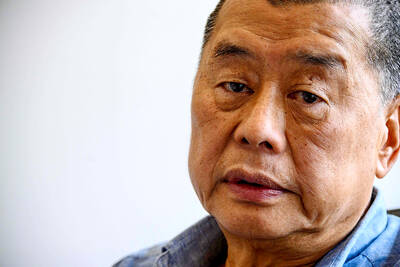
Pro-democracy media tycoon Jimmy Lai’s (黎智英) fraud conviction and prison sentence were yesterday overturned by a Hong Kong court, in a surprise legal decision that comes soon after Lai was jailed for 20 years on a separate national security charge. Judges Jeremy Poon (潘兆初), Anthea Pang (彭寶琴) and Derek Pang (彭偉昌) said in the judgement that they allowed the appeal from Lai, and another defendant in the case, to proceed, as a lower court judge had “erred.” “The Court of Appeal gave them leave to appeal against their conviction, allowed their appeals, quashed the convictions and set aside the sentences,” the judges


 RSS
RSS