


In many of Ken Follett's blockbuster thrillers, men with seedy pasts are prepared to kill, often to serve their governments. Beautiful women, seduced by these men, escape from their sexual hold only when they face almost certain -- and painful -- death. Danger lurks everywhere.
The tales are played out on a global stage -- a storm-whipped, nearly deserted Scottish island, or maybe in Afghanistan or Iran.
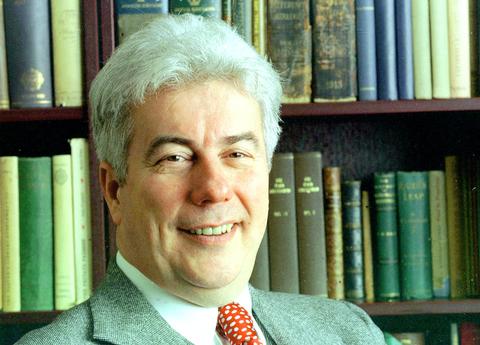
PHOTO: NY TIMES
It is not just Follett's stories that are unfettered by national boundaries. Follett, who has lived in Britain most of his life, is himself something of a multinational enterprise. The author of 13 bestsellers -- including Eye of the Needle, The Man from St Petersburg and The Key to Rebecca -- that have been translated into more than a dozen languages, he figures that sales of his books last year "were probably 50 percent in [US] dollars, 30 percent in euros and 20 percent in everything from sterling to yen."
"My home market is very small," he said during a recent interview here on the terrace of Parliament, where his wife, Barbara, is a member of the House of Commons. "The bulk of my income comes from exports."
So Follett, 52, who sometimes acts more like a chief executive than a master storyteller, watches foreign economies and stock markets closely for their effects on his revenue streams. "If the American stock market is down, and I mean big movements in the stock market, it affects the American economy," said the dapper Follett. "Ultimately, that affects how much money people have to buy books."
His many loyal readers have enabled him to reach a net worth that he puts at more than US$17 million. It is money he has amassed with the same care to details that he gives to the murders his villains commit in, say, their third-rate hotel rooms.
Unlike his protagonists, Follett adheres to strict limits on the risks he is willing to take -- at least financially. For the most part, he shies away from buying stocks, an endeavor he considers pure gambling. Even Warren Buffett, the legendary American investor, "is just lucky," Follett said.
"He doesn't know any more than anyone else," he added.
Instead, Follett has most of his money in real estate and cash or in short-term instruments like bank certificates or Eurodollars, which are US dollars held by banks outside the US. He spends freely. He is intent on preserving, rather than vastly enlarging, what he earns, and on enjoying the fruits of his labor. Experts aren't for him. He is the one who monitors his fortune, using off-the-shelf personal finance software, and who does most of the investing.
Millions per book
Follett tends his income carefully by striking publishing deals that have brought him as much as US$6 million just for the American rights to a single book -- more than all but a handful of authors receive, though not in the league of Tom Clancy or Michael Crichton, who get several times that. He likes to negotiate payments in monthly installments -- a rare demand for authors, who usually receive several payments as a book is completed and published.
"It's a comfort," he said. "It's pleasant to know how much money is coming in every month."
Although he has had no formal financial training, Follett worked with his bankers to hedge his income from the fluctuations in value of the currencies in which he is paid. That way, when almost all of his income was in dollars, and they were declining against the pound, his income did not suffer.
But he also enjoys living luxuriously. Follett owns three homes, and just sold a fourth one, in France. His airplane of choice is the Concorde, he hobnobs with celebrities and he used to be a highly visible fund-raiser for the Labor Party.
He may be a socialist, but "I am not St Augustine," he said, laughing. "I am not interested in wearing a hair shirt," he added.
His associates say he is generous to others as well as to himself. "He doesn't skimp," said Albert Zuckerman, Follett's longtime agent and the chairman of Writer's House, a group of American literary agents. "He takes suites in first-class hotels and flies first class. He doesn't sit on his money."
Until Follett's first best seller, Eye of the Needle, was published when he was 29, he had no money to sit on. He grew up, first in Cardiff, Wales, then in London, the oldest of three children in what he calls a perfectly typical family. His parents "were not desperately poor, but they had no disposable income," he recalled.
"We almost never went to restaurants," he added. "My father began as a clerk for the Inland Revenue. But he worked very hard. Before too long he passed his accountancy exam and he became an inspector," a lesson to his son in the value of hard work.
The family was also deeply religious and belonged to the Plymouth Brethren, a fundamentalist Protestant sect. His mother kept house.
When he was 18, Ken Follett married for the first time, to his girlfriend, Mary, "because we got pregnant," he said. Still, he attended University College London, majoring in philosophy, then became a reporter for The South Wales Echo, in part because of his interest in politics.
Humble start
His book-writing career began for a most practical reason. His car, a Vauxhall Ventora, needed a ?200 repair, and he had seen a television show on which a guest talked of receiving a ?200 advance for a first book.
Soon, Follett sealed himself in the bedroom after work and began writing The Big Needle, a novel about drug dealers that was published by Everest Books, a small company in London that hired him shortly after the book came out.
Ten more followed, many with working-class British backdrops. "None of those books were successful," Follett said. "But my advances started to go up. I got ?500. You could take the family on holiday to Spain for two weeks for ?250 in those days, so it was real money."
But it was not real success until he followed some advice from Zuckerman, the agent he met in 1973 and who began representing him. "Al told me, the American book buyer is not interested in the details of English working-class life; people are not interested in the humdrum."
Follett paid heed, producing Eye of the Needle. An outline for the book, a taut World War II thriller, earned a ?1,500 advance in England in 1977, about US$2,600 at that time.
He then sold hardcover rights in the US for US$20,000. When the paperback rights were auctioned, based on a second draft, "the floor was US$50,000 and someone had told me it would never go for more than that," he remembered.
"I was sitting in my little tract house," he added. "At about 4 o'clock, I called New York and Al told me that it had reached US$500,000, of which two-thirds would have been mine because there was a share for the hardcover publisher.
"Then around 8 o'clock that night, Al called me and told me the bidding had stopped at US$800,000. I calculated that if I had stayed in my job -- though I had recently quit the publishing position -- until I was 65, the amount of money I would have earned was about the same as the amount of money that phone call gave me."
That night, Follett did what he always did when he sold a book: he bought champagne. The ritual began with his first book deal, because "I had a check in my hand for ?150 that I hadn't budgeted for and a bottle of champagne cost ?5." Now, he said, he has champagne every night.
The book sold by the cartload in the US, and still sells 100,000 copies a year around the world, he estimated. Within a year, Follett had saved US$1 million. He opened a bank account in Switzerland and soon moved to France, where the taxes and the elements were less oppressive than in England.
"Suddenly, you make all this money," Follett said. "My immediate thought was the south of France. I had been there. I liked it. I liked sunny weather."
The Folletts and their two children moved to Grasse. Though he had an account at a Swiss bank, generally he did not do much investing. After two or three years, however, he missed England, so he returned despite the heavy tax burden.
Focus on real estate
Guided by a conservative investing bent, Follett estimates that about half of his fortune is in real estate. His three homes include a town house, built in 1732, in the Soho district of London. Then there is a nine-bedroom former rectory, complete with a tunnel from the living room to an indoor swimming pool, in Stevenage, the constituency north of London that Barbara Follett represents. A two-bedroom house on Antigua in the Caribbean has its own pool and tennis court. Most of the rest of his assets are in highly liquid investments.
Though his bankers make some equity investments -- which he declines to name -- Follett generally dismisses the market. (He does, however, have a healthy respect for people who run companies well. "That is not luck at all," he said. "It is character, brains, determination and imagination." Ross Perot, he said, "did not get this rich because he knows computers; he got rich because he can get other people to work their socks off for him.")
In investing, it is not the risk that bothers Follett. "It is all that effort I made on the book going up in smoke," he said. "That's what I hate."
Protecting his assets, rather than scoring big, was also the reason he took to hedging. In the 1980s and early 1990s, when most of his income was in dollars, he hedged, he said, to help reduce the risk that a slump in the dollar would mean trading it for fewer pounds. Now, he said, his royalty income comes in so many currencies that they effectively hedge one another.
The author says that after all these years of work, "I kind of feel entitled" to the financial rewards.
Besides, he said, he is having too much fun to hide it. "How could you hide it?" he asked.
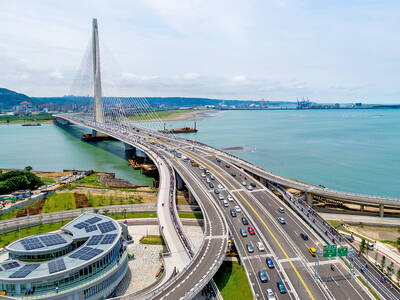
The Ministry of Transportation and Communications yesterday inaugurated the Danjiang Bridge across the Tamsui River in New Taipei City, saying that the structure would be an architectural icon and traffic artery for Taiwan. Feted as a major engineering achievement, the Danjiang Bridge is 920m long, 211m tall at the top of its pylon, and is the longest single-pylon asymmetric cable-stayed bridge in the world, the government’s Web site for the structure said. It was designed by late Iraqi-British architect Zaha Hadid. The structure, with a maximum deck of 70m, accommodates road and light rail traffic, and affords a 200m navigation channel for boats,

PRECISION STRIKES: The most significant reason to deploy HIMARS to outlying islands is to establish a ‘dead zone’ that the PLA would not dare enter, a source said A High Mobility Artillery Rocket System (HIMARS) would be deployed to Penghu County and Dongyin Island (東引) in Lienchiang County (Matsu) to force the Chinese military to retreat at least 100km from the coastline, a military source said yesterday. Taiwan has been procuring HIMARS and Army Tactical Missile Systems (ATACMS) from the US in batches. Once all batches have been delivered, Taiwan would possess 111 HIMARS units and 504 ATACMS, which have a range of 300km. Considering that “offense is the best defense,” the military plans to forward-deploy the systems to outlying islands such as Penghu and Dongyin so that
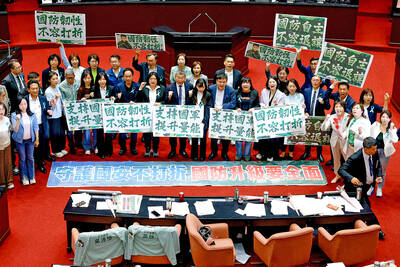
WHAT WAS ALL THAT FOR? Jaw Shaw-kong said that Cheng Li-wen had pushed for more drastic cuts and attacked him, just for the outcome to be nearly identical to his bill The legislature yesterday passed a supplementary budget bill to fund the purchase of separate packages of US military equipment, with the combined amount of spending capped at NT$780 billion (US$24.8 billion). The Chinese Nationalist Party (KMT) and Taiwan People’s Party (TPP) used their legislative majority to pass the bill, which runs until 2033 and has two main funding provisions. One was for NT$300 billion of arms sales already approved by the US for Taiwan on Dec. 17 last year, the other was for NT$480 billion for another arms package expected to be announced by Washington. The bill, which fell short of the NT$1.25

‘CLEAR MESSAGE’: The bill would set up an interagency ‘tiger team’ to review sanctions tools and other economic options to help deter any Chinese aggression toward Taiwan US Representative Young Kim has introduced a bill to deter Chinese aggression against Taiwan, calling for an interagency “tiger team” to preplan coordinated sanctions and economic measures in response to possible Chinese military or political action against Taiwan. “[Chinese President] Xi Jinping [習近平] has directed the People’s Liberation Army to be ready to invade Taiwan by 2027. China has a plan. America should have one too,” Kim said in a news release on Thursday last week. She introduced the “Deter PRC [People’s Republic of China] aggression against Taiwan act” to “ensure the US has a coordinated sanctions strategy ready should


 RSS
RSS