


In the months before Pret A Manger's first New York sandwich shop opened last July, the chief executive, Andrew Rolfe, walked the streets of Manhattan, timing how long it took to get lunch at various potential competitors, from the upmarket sandwich bar Xando Cosi (15 minutes), to the average deli (12 minutes).
"You're in a queue waiting while some bloke in front of you is going `no, no, no, a little bit of this, a little bit of that,'" said Rolfe, a 34-year-old South African and former PepsiCo executive.
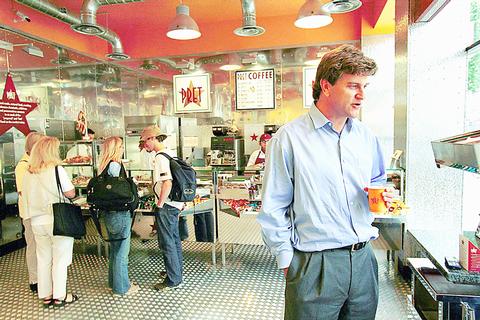
PHOTO: NY TIMES
Lunch at Pret A Manger, he said, is much quicker (90 seconds). That is because its sandwiches are made at dawn in the shop's basement, then packed so they are ready on shelves when customers arrive.
Pret A Manger, a 15-year-old British chain with a French name that means "ready to eat" (but without the accents), says it uses fresh ingredients with no additives or preservatives. Even so, such assembly-line food seems anathema in New York, its first overseas expansion market, where an "everything" bagel with low-fat tofu vegetable cream cheese can be had at almost any corner deli.
Although New Yorkers like to have it their way, Rolfe contends that they like speed more.
Against the odds
Defying skeptics who said prepackaged sandwiches would never make it in New York, Pret A Manger's first store, on Broad Street in Lower Manhattan, is expecting to record US$1.6 million in sales its first year, on par with an average British shop, Rolfe said.
The company opened its second store, on Seventh Avenue near 39th Street, last week. And 30 more are scheduled to dot Manhattan over the next two years, selling sandwiches for US$3.25 to US$5.55. As if taking a bite out of the Big Apple were not enough, Pret A Manger is preparing to open its first shop in Hong Kong in early 2002, with Continental Europe next on the list.
Such an expansion, costing roughly US$25 million, is big for a company whose 115 British stores generated around ?4 million (about US$5.7 million) in pretax profit on ?120 million in sales last year, according to industry consultants. Pret A Manger, privately held, does not disclose financial figures.
Financing part of that growth is McDonald's, which bought 33 percent of Pret A Manger for an undisclosed sum in January. The deal raised an outcry from Britons, who feared that McDonald's, king of processed fast food, would swallow up what many of them consider a national treasure and a champion of wholesome, natural eating.
It took Rolfe 14 months to negotiate the deal; one of his conditions was that Pret A Manger retain control for now, although McDonald's has the option to increase its stake. "We don't want their help in food, but we do want their expertise buying real estate in Hong Kong," Rolfe said.
For McDonald's, Pret A Manger fits into an ever-expanding stable of restaurants that also includes Donatos Pizza and Chipotle Mexican Grill. "There are times when people want something other than a burger and fries," said Brad Trask, a McDonald's spokesman.
Pret a Manger may be thinking big, but, in many ways, it is still run as a small, close-knit business. The entryway of its London headquarters on Palace Street is papered with testimonials from customers. The night before the deal with McDonald's was to be announced, most of its 2,200 employees gathered at Fabric, a London nightclub, where they learned details of the agreement and peppered executives with questions.
Attention to detail
Pret A Manger started in 1986, when two aspiring property developers, Julian Metcalfe and Sinclair Beecham, who had met while studying at London Polytechnic, decided that they could do better than the greasy spoons that sometimes seemed the only option for a quick, inexpensive lunch.
Financed with a ?17,000 bank loan (they are now estimated to be worth roughly ?35 million each), they opened their first shop near Victoria Station, determined to use wholesome food with no additives or preservatives. To this day, the company says, the eggs are from free-range hens, and the ham from pigs reared on a vegetarian diet.
Each store receives a delivery of produce, meats and cheeses nightly, and the sandwiches are made on the premises -- not in some centralized industrial commissary. Food is prepared in shifts throughout the day, and whatever does not sell by day's end is given to charity.
Sometimes the attention to detail seems excessive for a company that sold 25 million sandwiches last year. Pret A Manger says the oats and fruit used in its snack bar, for instance, are stirred by hand with a four-foot paddle, and its brownie recipe has been modified 33 times. Metcalfe's phone number is printed on its bags in Britain (in New York, it's that of Jay Willoughby, head of US operations) so customers can call directly with complaints or suggestions.
The going was tough at first. Metcalfe would often arrive at a store on Sunday evening to cook 25 chickens for the next day's sandwich stuffing.
But by 1995, the company was earning a profit and well on its way to achieving cult status in Britain, where specialties like fish and chips and the Scotch egg -- a fried sausage with a hard-boiled egg stuffed inside -- long made British food the butt of bad jokes.
"They got it right on so many angles," said Jeffrey Young, director of Allegra Strategies, a consulting firm in London.
Employees of Buckingham Palace order roughly
By 1998, Metcalfe and Beecham were looking for a more experienced executive to help them expand the business. Rolfe, who was running the London operations of KFC, then owned by PepsiCo, and is married to Fabiola Arredondo, the former head of Yahoo Europe, was in the market for a more entrepreneurial venture.
Daunting challenges
Rolfe said he decided to take the job after he saw one of the company's recruitment advertisements, which were blunt about the hard work and long hours but also the "good opportunities" and "legendary summer and Christmas parties." (The company spends ?250,000 on twice-a-year staff parties and pays for drinks at a local pub for its staff on Friday nights.) The placard, now framed, sits on his office windowsill.
Preserving that collegial culture will be difficult as the company grows, industry experts predict, a challenge all the more daunting because relatively few modern-day British companies have successfully expanded abroad. Although Pret A Manger's healthful-styled fast food is unusual, competition is heating up. Briazz, a Seattle-based sandwich chain in which the Starbucks chairman, Howard Schultz, is an investor, is making a grab-and-go name for itself. And 7-Eleven, while not as upscale as Pret A Manger, is looking to expand its take-away food selection.
Those challenges are especially acute in New York, where "it's harder to keep a reputation than to make one," said Dennis Lombardi, vice president of Technomic, a consulting firm in Chicago. "If you are not up to consumer expectations there are lots of other options."
So far, Pret A Manger has had some surprise hits, like the Coronation Chicken sandwich, slathered in a mango chutney sauce, which sells for US$5.25. But not everything crosses the Atlantic with equal ease. Its all-day breakfast of sausage, bacon, egg salad, tomato and lettuce on granary bread, a best seller in London, fell flat in New York.
And some potential customers remain relatively unimpressed. Peter Baracskai, a 34-year-old property manager, said he stopped by the Broad Street store but did not buy because the food looked too "foo foo" and not hearty enough to fill him up.
But Colin Macintosh, 34, a New Jersey native who now lives in London, said he routinely grabs a Pret A Manger sandwich for lunch, especially since Commerzbank Securities, where he sells convertible bonds, stopped picking up the bill for employee lunches as part of a cost-cutting measure.
"I can't be out of the office too long," Macintosh said. "For something quick, there's nothing like it."
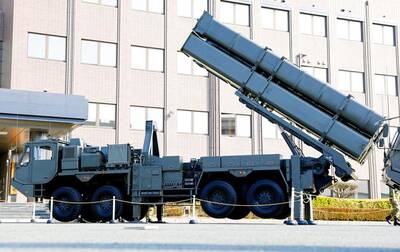
Japan has deployed long-range missiles in a southwestern region near China, the Japanese defense minister said yesterday, at a time when ties with Beijing are at their lowest in recent years. The missiles were installed in Kumamoto in the southern region of Kyushu, as Japan is attempting to shore up its military capacity as China steps up naval activity in the East China Sea. “Standoff defense capabilities enable us to counter the threat of enemy forces attempting to invade our country ... while ensuring the safety of our personnel,” Japanese Minister of Defense Shinjiro Koizumi said. “This is an extremely important initiative for

Chinese Nationalist Party (KMT) Chairwoman Cheng Li-wun (鄭麗文) today accepted an invitation from Chinese President Xi Jinping (習近平) to lead a delegation to China next month, saying she hopes to promote the peaceful development of cross-strait relations and bring stability to the Taiwan Strait. “I am grateful and happy to accept this invitation,” Cheng said in a statement from the KMT chairperson’s office. Cheng said she hopes both sides can work together to promote the peaceful development of cross-strait relations, enhance exchange and cooperation, bring stability to the Taiwan Strait and improve people’s livelihoods. At today's news conference, Cheng said any efforts to
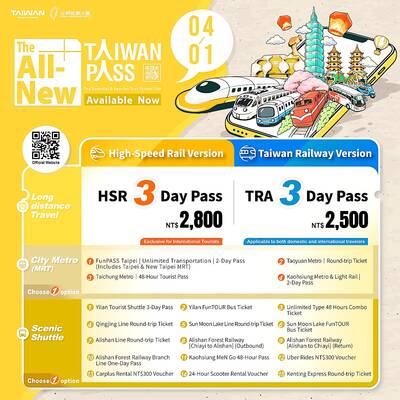
MORE POPULAR: Taiwan Pass sales increased by 59 percent during the first quarter compared with the same period last year, the Tourism Administration said The Tourism Administration yesterday said that it has streamlined the Taiwan Pass, with two versions available for purchase beginning today. The tourism agency has made the pass available to international tourists since 2024, allowing them to access the high-speed rail, Taiwan Railway Corp services, four MRT systems and four Taiwan Tourist Shuttles. Previously, five types of Taiwan Pass were available, but some tourists have said that the offerings were too complicated. The agency said only two types of Taiwan Pass would be available, starting from a three-day pass with the high-speed rail and a three-day pass with Taiwan Railway Corp. The former costs NT$2,800

The nation’s fastest supercomputer, Nano 4 (晶創26), is scheduled to be launched in the third quarter, and would be used to train large language models in finance and national defense sectors, the National Center for High-Performance Computing (NCHC) said. The supercomputer, which would operate at about 86.05 petaflops, is being tested at a new cloud computing center in the Southern Taiwan Science Park in Tainan. The exterior of the server cabinet features chip circuitry patterns overlaid with a map of Taiwan, highlighting the nation’s central position in the semiconductor industry. The center also houses Taiwania 2, Taiwania 3, Forerunner 1 and


 RSS
RSS