


Text messaging on mobile phones is all thumbs. A British company believes the best way to get the other eight fingers involved is by going soft.
After sneak peeks at New York's Museum of Modern Art and the IT Expo in France, ElectroTextiles Co Ltd is marketing a flexible, plug-in keyboard this year for mobile phones and personal digital assistants.
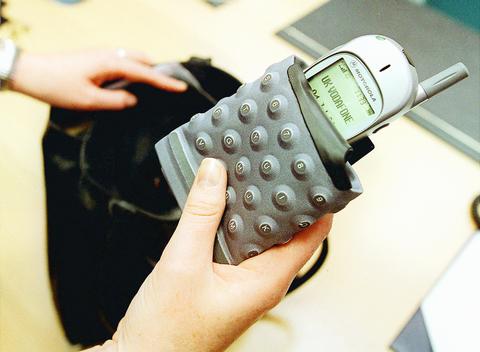
PHOTO: AP
Although similar devices are already on the market, this one uses the company's ElekTex fabric, a soft, water-resistant material that can receive and transmit electronic impulses without traditional wiring or circuitry.
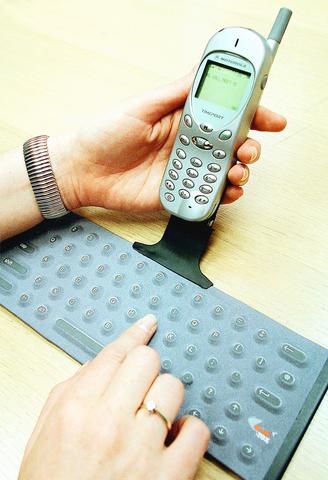
PHOTO: AP
The fabric turns keyboards into bumpy placemats that can be folded up and slipped into a pocket, or act as a wraparound cover for the device they're attached to.
The soft keyboard is the first in a line of products that will use ElekTex. Also on tap: squishy mobile phones that conform to a pocket and survive a drop onto the sidewalk, and a smart car seat that automatically adjusts to the proportions of its occupant.
Chris Chapman, co-founder of ElectroTextiles, isn't worried about debuting ElekTex in a niche already crowded with keyboard attachments made by Palm Inc, LM Ericsson and Motorola Inc.
He's confident his device will be embraced by mobile phone users tired of pecking away at a telephone pad. At about 28 grams, it's light -- and it's flexible.
"You pull the cover off, drop it down and start typing," he said. "People's first impressions are, `Whoa, it's fabric, it must be a little flimsy.' But it's very durable. ... It takes a good whack, it rolls up, it scrunches up."
But "texters" -- mostly teen-agers and 20-somethings who can bang out 100-character messages in a flurry of thumbs -- are less enthusiastic about such keyboards.
"Personally I don't have a problem using the standard phone keypad to type messages," said Daniel Thornton, a 20-year-old student from Peterborough, England, about 160km north of London.
"Right now I send upwards of 200 text messages a month, but I don't think it's worth the expense of buying a keyboard for the purpose of text messages. Having an extra piece of equipment would also reduce the portability aspect."
Chapman would give no details on price or compatibility with specific devices. The keyboards will be manufactured by an undisclosed partner.
For new or less-skilled text messengers, typing on phone keypads can be frustrating, even with the growing lexicon of shorthand text lingo.
To illustrate, one must press the "7" key four times to get the letter "s." Typing the word "difficult" requires 22 keystrokes, and symbols such as question marks and hyphens must be ferreted out of a separate menu.
By comparison, typing "difficult" requires nine keystrokes on a standard keyboard, and a question mark is a shift key away.
The ElekTex device is about the size of the top of a tissue box. It's slightly thicker than a mouse pad. Keys -- they are more like bubbly buttons -- are smaller than those on a typical keyboard.
Accomplished typists will find the keyboard a bit clumsy. Its creators say users can type about 75 percent as fast as they could on a desktop computer keyboard -- but that's still seven times faster than a phone keypad.
The company hopes to persuade wireless service providers to package the keyboards with phones given to new customers.
Although text messaging hasn't caught on in the US, it's highly popular in Europe and Asia.
With Britain's mobile phone users already sending nearly 1 billion text messages a month, the company says faster data entry could boost revenues for wireless service providers, which generally charge by the message.
But some industry analysts question the revolutionary zeal espoused by ElekTex's creators. Newer phones come with "predictive" text messaging, where software tries to help automatically complete words. And the keyboard's product life could be brief if voice-recognition technology becomes widely available, as anticipated.
Alex Rogers, a telecommunications consultant at Unisys Corp, said that although standard keyboards are already available for personal digital assistants, "the majority of users are happy using the traditional stylus as a way of entering information."
"I expect that this trend will continue when mobile-enabled PDAs hit the mass market," he said.
More futuristic ElekTex product ideas -- experimental devices have included a Dick Tracy-like wrist phone and a necktie phone -- have sparked more excitement among proponents of "wearable" devices.
A soft keyboard could quickly solve data-entry problems for wearable computer manufacturers like the Los Angeles-based Charmed Technology Inc.
"You want a full keyboard so you can make use of an operating system like Windows," said Charmed founder Alex Lightman.
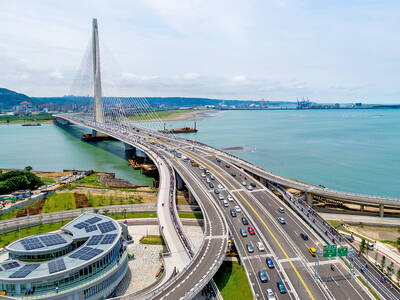
The Ministry of Transportation and Communications yesterday inaugurated the Danjiang Bridge across the Tamsui River in New Taipei City, saying that the structure would be an architectural icon and traffic artery for Taiwan. Feted as a major engineering achievement, the Danjiang Bridge is 920m long, 211m tall at the top of its pylon, and is the longest single-pylon asymmetric cable-stayed bridge in the world, the government’s Web site for the structure said. It was designed by late Iraqi-British architect Zaha Hadid. The structure, with a maximum deck of 70m, accommodates road and light rail traffic, and affords a 200m navigation channel for boats,
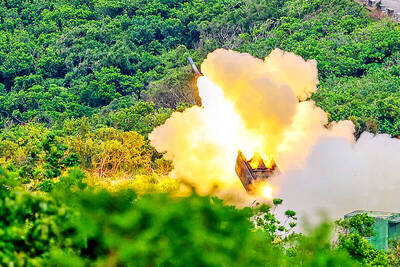
PRECISION STRIKES: The most significant reason to deploy HIMARS to outlying islands is to establish a ‘dead zone’ that the PLA would not dare enter, a source said A High Mobility Artillery Rocket System (HIMARS) would be deployed to Penghu County and Dongyin Island (東引) in Lienchiang County (Matsu) to force the Chinese military to retreat at least 100km from the coastline, a military source said yesterday. Taiwan has been procuring HIMARS and Army Tactical Missile Systems (ATACMS) from the US in batches. Once all batches have been delivered, Taiwan would possess 111 HIMARS units and 504 ATACMS, which have a range of 300km. Considering that “offense is the best defense,” the military plans to forward-deploy the systems to outlying islands such as Penghu and Dongyin so that
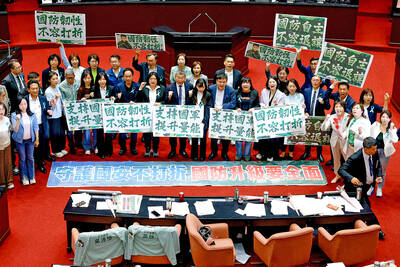
WHAT WAS ALL THAT FOR? Jaw Shaw-kong said that Cheng Li-wen had pushed for more drastic cuts and attacked him, just for the outcome to be nearly identical to his bill The legislature yesterday passed a supplementary budget bill to fund the purchase of separate packages of US military equipment, with the combined amount of spending capped at NT$780 billion (US$24.8 billion). The Chinese Nationalist Party (KMT) and Taiwan People’s Party (TPP) used their legislative majority to pass the bill, which runs until 2033 and has two main funding provisions. One was for NT$300 billion of arms sales already approved by the US for Taiwan on Dec. 17 last year, the other was for NT$480 billion for another arms package expected to be announced by Washington. The bill, which fell short of the NT$1.25
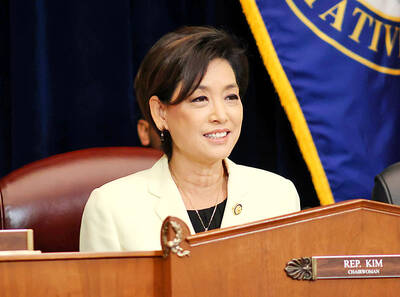
‘CLEAR MESSAGE’: The bill would set up an interagency ‘tiger team’ to review sanctions tools and other economic options to help deter any Chinese aggression toward Taiwan US Representative Young Kim has introduced a bill to deter Chinese aggression against Taiwan, calling for an interagency “tiger team” to preplan coordinated sanctions and economic measures in response to possible Chinese military or political action against Taiwan. “[Chinese President] Xi Jinping [習近平] has directed the People’s Liberation Army to be ready to invade Taiwan by 2027. China has a plan. America should have one too,” Kim said in a news release on Thursday last week. She introduced the “Deter PRC [People’s Republic of China] aggression against Taiwan act” to “ensure the US has a coordinated sanctions strategy ready should


 RSS
RSS