


Chris Barrett and Luke McCabe emerge from the surf, studded with the logos of a credit card company, and begin to work their way across the beach toward a coterie of publicists and a photographer there to capture the moment.
Two bikini-clad young women step in their path and ask about all the attention. The young men, 18 and freshly graduated from high school, lean with tanned arms slung around their surfboards and chat for a few minutes before continuing their saunter across the sand.
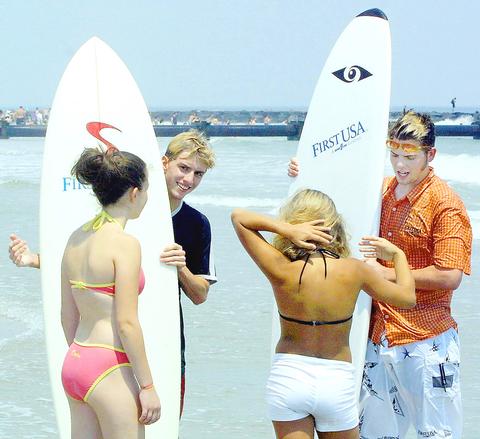
PHOTO: NY TIMES
"They thought it was really cool," Barrett says, eyes bright. McCabe pumps a thumbs-up in the air.
A publicity representative beams. Another hit in the media whirl of Chris and Luke.
Last year, the two men, seniors at Haddonfield Memorial High School, offered corporate America a deal: you pay our way to college, and we'll be your "spokesguys."
After entertaining offers from more than a dozen companies, they chose First USA, one of the nation's largest credit card companies, which agreed to pay each US$40,000 in tuition, room, board and books for the academic year when they enter college next month. In return, Barrett and McCabe will spread the First USA-sponsored message of smart budgeting and financial responsibility.
They will make campus appearances, serve on a student advisory board and publicize financial tips for students on their Web site. In the meantime, of course, they are also attracting millions of dollars in free publicity with an image that is cool, blond and young.
In a world where kindergartners learn to count with books created by Cheerios, where Channel One beams commercials into classrooms and where Coke and Pepsi compete for turf alongside hall lockers, this is the latest frontier, a perfect synergy between media- and marketing-savvy teen-agers and companies desperate to capture the lucrative, yet elusive, youth market.
Critics bemoan creeping commercialism in education, but Barrett and McCabe show how far it has already encroached. Students are not just surrounded by marketing tactics; they are adopting them.
Among their peers, and First USA's competitors, there is neither shock nor accusations of selling out, but only, "Why didn't I think of that first?"
"They are smart, smart kids," said Doug Filak, the vice president for marketing at First USA, a division of Bank One. He often accompanies the young men on interviews, watching with a smile that is half envy, half cat that ate the canary.
Barrett and McCabe have the First USA logo on their surfboards, surf shorts, camp shirts, indeed, an entire wardrobe's worth of clothing, blurring the line between their life as average college students and their role as pitchmen. And that is just how the company wants it.
"We thought we had a powerful message, and we were looking for the best way to spread it," Filak said.
"What better way than to have two cool students, two normal guys, spread it for us?"
When the First USA people refer to Chris and Luke, it comes out Chrisnluke, and in some ways, the two have become one. "They complement each other well," Filak said, "and they know it."
Barrett, who will attend Pepperdine University in Malibu, California, is the chattier and more clean cut of the two. He was a former class president and winner of the prize for the highest grade point average in the business courses.
McCabe, who will attend the University of Southern California, plays in a band called Big Fat Huge, has sideburns tracing the curve of his face, and started a student group to fight racism. They have been friends since sixth grade.
They thought of the idea on a tour of campuses in California, as they became anxious about how much college would cost.
They retreated to a hotel room, where the television clicker happened on Tiger Woods, sporting his usual Nike swoosh gear.
Wouldn't it be cool, Barrett asked, if we could get someone to sponsor us?
They put up a Web site, posting pictures of themselves toting surfboards: "Your logo here!" Smiling and blond, they offered their services pitching anything from sneakers to cell phone service. "We will drink your soda and eat your chips! Where we go, you go!"
After Yahoo made it "site of the day," the offers started coming in, a few to pitch cell phone service, another to sell caffeinated mints. Barrett and McCabe chose First USA, they said, because the company did not want them to sell a product.
In exchange for the US$40,000 for the first academic year, they are expected to wear their First USA clothing whenever they make public appearances.
Each has to maintain at least a C average and live up to the terms of a moral clause -- if they misbehave, the deal is off. But Filak said he expected to "re-sign" them for the full four years of college.
The deal, marketing experts say, represents the evolution of The Sell, with companies analyzing how best to reach their target audiences.
"If you want to talk to college students about financial issues, it's better than some guy in a suit to have kids you see every day saying, `Make sure you manage your beer money,"' said Barbara Coulon, vice president for trends at Youth Intelligence, a youth marketing company in New York.
"With credit card companies in general, college students have this view that they just want you to spend, spend, spend; they're all over the place on campuses, just to make money off you. First USA seems like the credit card that students can trust if it's coming from college students themselves."
Not everyone, though, sees this as a good idea.
"We've gotten to the point where students don't mind being used," said Andrew Hagelshaw, executive director of the Center for Commercial Free Public Education. He does not necessarily blame Barrett and McCabe.
"There's advertising in the hallways, in lunchrooms, in the curriculum," Hagelshaw said.
"After a while, it becomes invisible: you don't understand how it's happening or how they're using you."

Japan has deployed long-range missiles in a southwestern region near China, the Japanese defense minister said yesterday, at a time when ties with Beijing are at their lowest in recent years. The missiles were installed in Kumamoto in the southern region of Kyushu, as Japan is attempting to shore up its military capacity as China steps up naval activity in the East China Sea. “Standoff defense capabilities enable us to counter the threat of enemy forces attempting to invade our country ... while ensuring the safety of our personnel,” Japanese Minister of Defense Shinjiro Koizumi said. “This is an extremely important initiative for

Chinese Nationalist Party (KMT) Chairwoman Cheng Li-wun (鄭麗文) today accepted an invitation from Chinese President Xi Jinping (習近平) to lead a delegation to China next month, saying she hopes to promote the peaceful development of cross-strait relations and bring stability to the Taiwan Strait. “I am grateful and happy to accept this invitation,” Cheng said in a statement from the KMT chairperson’s office. Cheng said she hopes both sides can work together to promote the peaceful development of cross-strait relations, enhance exchange and cooperation, bring stability to the Taiwan Strait and improve people’s livelihoods. At today's news conference, Cheng said any efforts to

MORE POPULAR: Taiwan Pass sales increased by 59 percent during the first quarter compared with the same period last year, the Tourism Administration said The Tourism Administration yesterday said that it has streamlined the Taiwan Pass, with two versions available for purchase beginning today. The tourism agency has made the pass available to international tourists since 2024, allowing them to access the high-speed rail, Taiwan Railway Corp services, four MRT systems and four Taiwan Tourist Shuttles. Previously, five types of Taiwan Pass were available, but some tourists have said that the offerings were too complicated. The agency said only two types of Taiwan Pass would be available, starting from a three-day pass with the high-speed rail and a three-day pass with Taiwan Railway Corp. The former costs NT$2,800

The nation’s fastest supercomputer, Nano 4 (晶創26), is scheduled to be launched in the third quarter, and would be used to train large language models in finance and national defense sectors, the National Center for High-Performance Computing (NCHC) said. The supercomputer, which would operate at about 86.05 petaflops, is being tested at a new cloud computing center in the Southern Taiwan Science Park in Tainan. The exterior of the server cabinet features chip circuitry patterns overlaid with a map of Taiwan, highlighting the nation’s central position in the semiconductor industry. The center also houses Taiwania 2, Taiwania 3, Forerunner 1 and


 RSS
RSS