


The chicken wings at Yak-Zies bar in Chicago have been a money-making staple for owner Kenny Miller since the early 1980s. He sells 2,000 pounds of wings a week, 20 times more than the beef for his hamburgers.
While wings are as popular as ever at Yak-Zies, which fries and soaks them in spicy sauce, they are no longer profitable thanks to fast-food companies such as McDonalds Corp, Domino's Inc and the KFC unit of Tricon Global Restaurants Inc.
US demand for wings, worth about US$2.6 billion last year, has surged this spring as big restaurant chains began adding them to their burger and pizza menus. Prices have skyrocketed. Wings sell for twice what they did a year ago and now fetch more per pound at wholesale than chicken breasts, legs or whole birds.
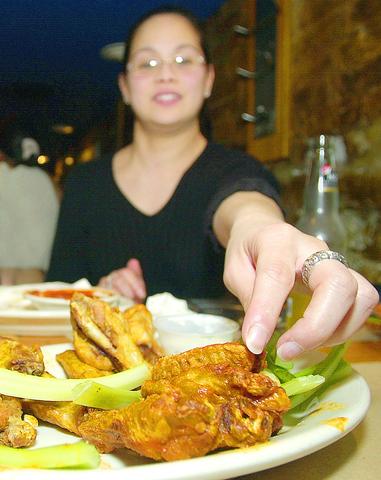
PHOTO: BLOOMBERG
"Fast-food companies are running the market," said the 66-year-old Miller, who started selling spicy wings shortly after eating his first one during a 1982 visit to Buffalo, New York, the birthplace of so-called Buffalo wings. "At normal prices, wings are reasonably profitable. Right now they are not." Miller hasn't increased the price of his wings to keep pace with the rise in his own costs. Wholesale wings are more than US$1 a pound, compared with US$0.50 a year ago. Yak-Zies sells 10 spicy wings for US$4.95, and Miller is mulling a 10 percent increase.
KFC, which sells mostly fried chicken, is preparing its second wing promotion this year, a company spokesman said. Last year, KFC only did one wing promotion. McDonald's added "Mighty Wings" to its 40-item menu of permanent promotions on Jan. 21, after test-marketing the product in several cities two years ago.
"When the fast-food corporations start to feature wings, it has a pretty big impact," said Joe Gilmore, vice president of food-service marketing at Perdue Farms Inc, a Salisbury, Maryland-based chicken producer. "You have an increasing demand on a somewhat reduced supply." While fast-food companies won't say how many wings they are selling, the chicken industry figures demand for hot, spicy wings is growing at an annual rate of 14 percent a year and accounts for about 35 percent of the 4.3 billion pounds of chicken wings produced in the US last year.
Wings weren't always such a hot item.
The triple-jointed chicken part is often more bone than meat. It was used mostly to flavor soups, though some bar owners figured they could serve them fried and heavily salted to make patrons thirstier.
The lowly wing became a national finger food during the past two decades, after the development of the Buffalo wing, which is marinated in hot, sticky sauce. Bars in western New York have sold them since the mid-1960s, and the popularity of wings spread with the expansion of pub-style restaurants, such as TGI Friday's Inc.
"That little spicy kick goes well with beer," said Joey Vartanian, general manager of Brother Jimmy's, a Carolina-style barbecue restaurant in Chicago. It sells wings for 15 cents each on Wednesday nights, when customers wait an hour to sit at a table compared with no wait on Tuesdays and Thursdays, Vartanian said.
In 1990, Kentucky Fried Chicken, now known as KFC, was among the first fast-food chains to promote wings. McDonald's and Domino's were among those who followed as they sought to boost sales and variety on their menus.
While wings in flavors such as honey-barbecue or oriental aren't as profitable as burgers or pizza, they are popular with customers as appetizers and don't erode sales of the main menu items, fast-food operators said.
"As a snack item they generate extra sales and they don't interfere with the full meal that you are selling your customer," said Tony Scherer, director of supply chain management with Wendy's International Inc.
Chicken wings also have become a big seller for grocers and restaurants during the US football season, when fans crowd around televisions at bars or homes to enjoy finger foods during weekend games.
Wing prices usually rise around the Super Bowl, the annual football championship game, and then fall as demand weakens in early spring.
This year, that didn't happen. Prices have actually risen more than 10 percent since then.
Chicken wing prices in January averaged 91 cents a pound and are currently about US$1.01 a pound, according to the US
Department of Agriculture. Yak-Zies' Miller said he is paying about US$1.10 a pound.
Compounding the surge in prices is a slowdown in US poultry production, which is down 0.7 percent in the first three months of this year, the first year-on-year quarterly decline since 1982.
Still, production is expected to rise 2 percent this year, down from an annual average gain of about 5 percent.
Tyson Foods Inc, the largest producer, is selling so many wings it has been unable to stockpile supplies in freezers, as the company normally does at this time of year to ensure adequate inventories for the seasonal surge in demand in the fall.
Pilgrim's Pride Corp, the third-largest producer, is boosting its production by buying wings from five competitors, something the Pittsburg, Texas-based company usually does only during the Super Bowl.
"We are buying wings from anybody that we can right now," said Dan Emery, Pilgrim's vice president of marketing.
With prices showing no sign of coming down, some restaurants have increased the price they charge customers.
Hooters Inc, which sells about 37 million pounds of wings a year at 300 restaurants, raised the price of 10 wings to US$5.75 from US$5.45 at the end of April.
"The market's going to remain strong for the rest of the year," said Chuck Riley, Hooters director of purchasing. Prices probably will average about US$0.90 to US$0.95 a pound this summer, double the US$0.46 a pound they averaged in July and August.
Prices probably won't stay below US$1 per pound very long if at all for the rest of the year, said Bill Roegnick, vice president of the National Chicken Council.
"There are other supermarket and restaurant chains that are waiting and ready to step in and do some featuring of Buffalo wings if there is some easing on wholesale prices," Roegnick said.
At Yak-Zies, Kenny Miller seems resigned to raising his prices, too. "I can't continue to suck up the costs," he said.
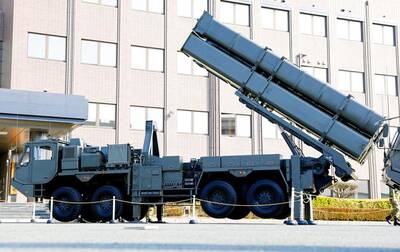
Japan has deployed long-range missiles in a southwestern region near China, the Japanese defense minister said yesterday, at a time when ties with Beijing are at their lowest in recent years. The missiles were installed in Kumamoto in the southern region of Kyushu, as Japan is attempting to shore up its military capacity as China steps up naval activity in the East China Sea. “Standoff defense capabilities enable us to counter the threat of enemy forces attempting to invade our country ... while ensuring the safety of our personnel,” Japanese Minister of Defense Shinjiro Koizumi said. “This is an extremely important initiative for

Chinese Nationalist Party (KMT) Chairwoman Cheng Li-wun (鄭麗文) today accepted an invitation from Chinese President Xi Jinping (習近平) to lead a delegation to China next month, saying she hopes to promote the peaceful development of cross-strait relations and bring stability to the Taiwan Strait. “I am grateful and happy to accept this invitation,” Cheng said in a statement from the KMT chairperson’s office. Cheng said she hopes both sides can work together to promote the peaceful development of cross-strait relations, enhance exchange and cooperation, bring stability to the Taiwan Strait and improve people’s livelihoods. At today's news conference, Cheng said any efforts to

MORE POPULAR: Taiwan Pass sales increased by 59 percent during the first quarter compared with the same period last year, the Tourism Administration said The Tourism Administration yesterday said that it has streamlined the Taiwan Pass, with two versions available for purchase beginning today. The tourism agency has made the pass available to international tourists since 2024, allowing them to access the high-speed rail, Taiwan Railway Corp services, four MRT systems and four Taiwan Tourist Shuttles. Previously, five types of Taiwan Pass were available, but some tourists have said that the offerings were too complicated. The agency said only two types of Taiwan Pass would be available, starting from a three-day pass with the high-speed rail and a three-day pass with Taiwan Railway Corp. The former costs NT$2,800

The nation’s fastest supercomputer, Nano 4 (晶創26), is scheduled to be launched in the third quarter, and would be used to train large language models in finance and national defense sectors, the National Center for High-Performance Computing (NCHC) said. The supercomputer, which would operate at about 86.05 petaflops, is being tested at a new cloud computing center in the Southern Taiwan Science Park in Tainan. The exterior of the server cabinet features chip circuitry patterns overlaid with a map of Taiwan, highlighting the nation’s central position in the semiconductor industry. The center also houses Taiwania 2, Taiwania 3, Forerunner 1 and


 RSS
RSS