


Claw machine lover Neiki Lee carefully lowered the metal jaws of a crane with a joystick into a pool of prizes, only to have the small toy slip from its clutches again and again.
Dozens of stores filled with claw machines have sprung up on streets and in malls across Hong Kong’s finance hub over the past few years, promising players a treasure trove of prizes and a sense of fulfilment.
The colorfully lit machines, often seen drawing people like moths to a flame, have come under regulatory scrutiny this month, as officials raised addiction concerns over the seemingly harmless games.
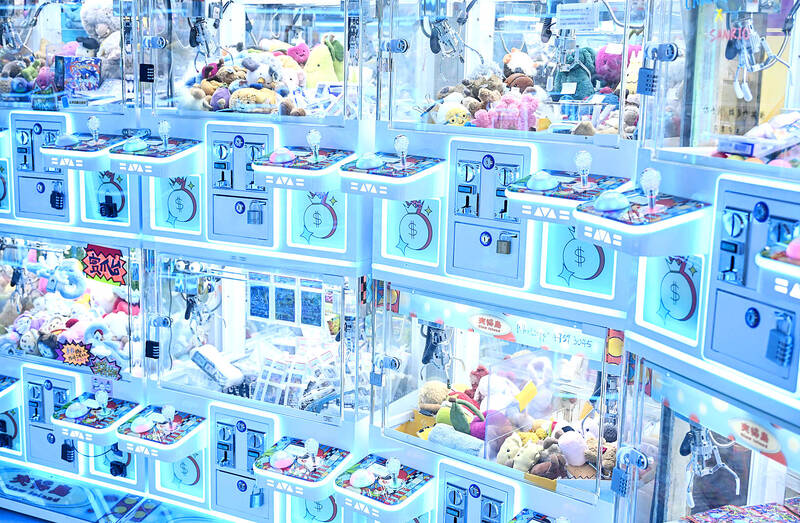
Photo: AFP
Lee, 48, admitted that she was “totally hooked” and that “this is definitely gambling,” adding that she bets at least HK$5 every time she attempts to win a higher-value plush toy.
An office clerk, Lee said she has spent about HK$100,000 (US$12,760) on claw machines over two years — roughly half her annual salary.
“For a HK$70 toy, you might eventually spend 700, or even 1,700, and still not be able to grab it,” Lee said. “I really want to give it up. Every day I scold myself and tell myself to quit: No more, no more.”
Player Tommy Yu, 23, said he sometimes spends hundreds of dollars a day on it despite saying some machines have “traps” built in.
“When you put money in, but don’t get anything back, you feel like you’ve lost out,” he said. “Yet it keeps driving you to play.”
Gambling counselor Chu Ho Ming said “the more [the players] invest, the harder it is to leave empty-handed and walk away.”
“This is the sunk cost fallacy,” he said, adding that “it keeps the addictive behavior loop.”
Chu said his team have noticed an increase in youth playing games with “gambling elements.”
Claw machine operators have been able to expand and operate largely unrestricted, after a court ruled in 2022 they are not required to possess public entertainment licenses.
However, after a sharp rise in the number of public complaints related to so-called claw machine gambling over the past two years, Hong Kong authorities proposed this month to tighten regulations over prize-based arcades, calling the situation after the 2022 ruling “not ideal.”
The design and business models of such gaming machines are “extremely diverse,” officials said, adding that they were committed to tackling the “deep-seated issues.”
Some Hong Kong lawmakers have suggested capping the prize value at HK$300 or below, in line with countries such as the UK and Singapore.
Matthew Chan, who owns three claw machine shops, said tighter regulation was needed as the industry “was heading in the wrong direction.”
Chan bemoaned the government’s slowness to act, saying Taiwan’s machines must offer a “guaranteed prize” if a certain amount of money is spent.
“The market already saw a downsize... [Hong Kong’s] consumers have lost confidence in it,” he said, adding that some machine operators were ramping up the difficulty and keeping players hooked.
However, Lee said she believed operators would find ways to evade any regulation enacted.
“It’s impossible that a law... can be applied in a way that is both flawless and fair [for the industry],” she said. “It is difficult to root out addiction problems simply by passing a law.”

SPEAKING OUT: After Siranudh Scott’s allegations surfaced, celebrities and public figures took to social media to share their own experiences of sexual misconduct and abuse A high-profile alleged sexual abuse case within a wealthy Thai beer brewing family has prompted a wave of painful accounts from survivors of unconnected abuse in the conservative nation. Siranudh Scott, a member of the billionaire Thai family that founded the ubiquitous Singha beer brand, posted an emotional video this month accusing his elder brother Sunit of repeatedly abusing him when he was a teenager. Sunit, who is in his 30s, later denied the allegations in a video posted online, but Singha parent Boonrawd dismissed him from his executive role with the company on Tuesday last week. “I felt I needed to speak

SEEKING ORDER: Rodrigo Paz said that ‘anyone who wants to destroy the nation will have to deal with this president and the full force of the constitution’ Bolivian President Rodrigo Paz on Wednesday said that the nation was at a “breaking point” after nearly a month of protests that have caused shortages of food, fuel and medicine. Paz, who took office six months ago amid the worst economic crisis there in four decades, is battling a groundswell of fury over his policies. The political capital, La Paz, has been besieged by low-income workers and members of the indigenous majority calling for his resignation. “The country needs order and is reaching breaking point,” the 58-year-old said at a public event in La Paz, renewing his appeal for dialogue. On Tuesday, the Bolivian

‘CROSSING THE LINE’: China’s embassy in Seoul criticized US Forces Korea Commander General Xavier Brunson, asking if his ‘hostile’ remarks were authorized by Washington South Korea and the US are in talks over recent public remarks by the commander of US Forces Korea, Seoul’s presidential office said yesterday, after the comments drew sharp criticism from China. In a recent podcast interview, US Forces Korea Commander General Xavier Brunson described South Korea as “the dagger in the heart of Asia” from China’s east coast, prompting the Chinese embassy in Seoul to say that he had “truly crossed the line.” The interview came amid growing speculation that Washington might seek to expand the role of US Forces Korea in countering the growing regional influence of China, a key

Forecasters in Europe yesterday warned of exceptional heat as record temperatures driven by a “heat dome” push temperatures well above seasonal norms across the continent. The surge follows a record-breaking Monday, with France logging its hottest day in the month of May on record, its weather agency said, and the UK also posting unprecedented highs. A so-called “heat dome” of warm air from northern Africa trapped under a high-pressure system over western Europe is behind the high temperatures not usually seen until high summer. Restrictions on outdoor work were imposed in parts of Italy, beaches in southwest France filled earlier than usual and


 RSS
RSS