


Kim Su-jin and her husband have set aside their doubts and embraced parenthood, joining a small but notable wave of South Korean couples having children despite the country’s steep demographic decline.
South Korea has one of the world’s lowest birthrates, and the government has spent billions of dollars trying to encourage people to have more babies and cushion the worst impacts of a shrinking population.
The Asian nation is still nowhere near reversing the trend, but a modest baby bump has come after years of consistently low statistics — even as experts disagree on the underlying causes.
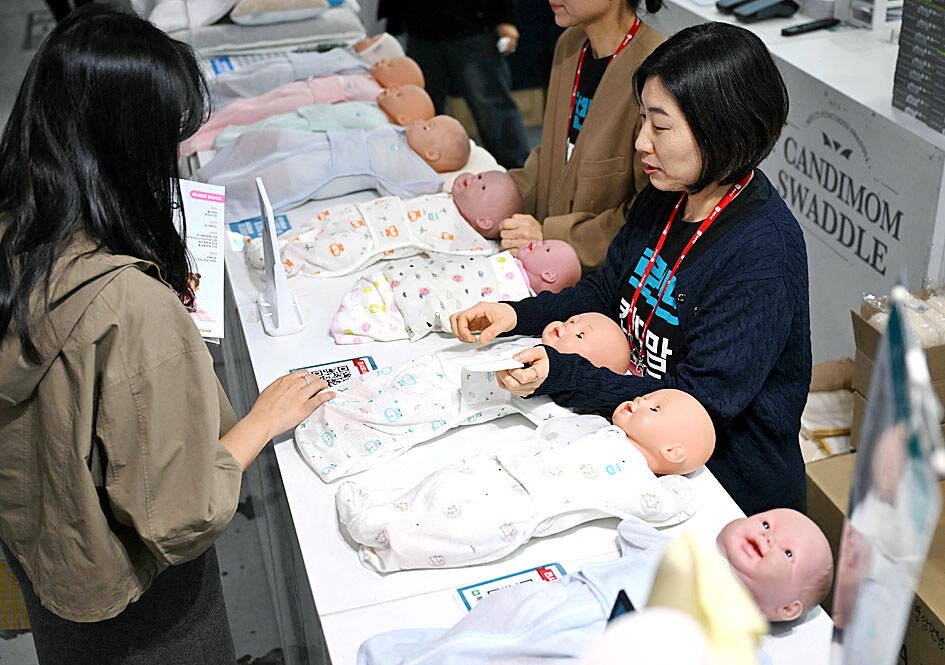
Photo: AFP
Kim, 32, a freelance music industry worker, gave birth to her daughter in January last year despite earlier financial concerns during her four-year marriage.
She shook off worries over housing, schooling and work “because we believed that having [a baby] would bring us happiness,” she said.
South Korea’s fertility rate hit a record low in 2023, but has picked up since then, with the number of monthly births consistently rising compared with the previous year.
About 23,000 babies were born in February, the most for that month in seven years, government statistics showed.
The on-year growth of 13.6 percent was the highest for any February since records began in 1981.
The uptick in births has tracked a similar, though less even, rise in marriages going back to mid-2022, official figures show.
The trend might reflect more positive attitudes toward family among younger South Koreans, experts said.
However, they differed on what was driving the shift and how important it was compared with factors such as pro-natalist policies.
Seoul National University (SNU) economics professor Hong Sok-chul said the programs had been “quite effective.”
“Rather than trying to force marriage or childbirth ... the government focused on lowering the direct and indirect costs to make these choices more rational,” he said.
Kim Woo-jin, 33, said vouchers she received from the government had “played a significant role in alleviating the financial burden” of pregnancy, childbirth and child-rearing.
She cited a payment of 2 million won (US$1,367) when her daughter was born last year, a 1 million won voucher to cover maternity fees, and subsidies for transport and post-natal care.
“I believe that the significant improvements [in state support] ... played a role in the recent rebound” in births, the office worker said.
South Korea also pays parents a 1 million won monthly allowance during the baby’s first year, while other policies include low-interest loans for young families buying homes, expanded parental leave and subsidized fertility treatment.
Some companies also hand large bonuses to staff who have children.
However, for some couples, the incentives have made little difference.
Kim Su-jin said government support “in reality ... provides little substantial assistance.”
“The issue is not merely a matter of a few million won,” she said, citing broader social ills such as exorbitant tutoring fees, widespread school bullying and the threat of job losses due to artificial intelligence.
Demographer Lee Sang-lim, also of SNU, said it was “very difficult” to conclude that the latest government policies had caused the upturn in births, adding that several initiatives only began in early 2024 — less than nine months before the increase became apparent.
More than a decade of policies to help boost fertility might have played a role in improving the environment for childbirth and child-rearing, he said.
South Korea’s total fertility rate — the number of children each woman would have on average — increased last year from 0.75 to 0.8, still well below the threshold of 2.1 needed to maintain the population.
Other theories for the baby bump abound, with implications for how long it might last.
South Korean Ministry of Data and Statistics official Park Hyun-jung in February said that the rise partly reflected the demographic “echo” of a larger-than-normal cohort born in the early 1990s, now in their peak childbearing years.
Younger generations also appear to feel less traditional stigma around having children outside marriage, with the number nearly doubling between 2002 and 2024, according to official figures.
Still, births outside marriage accounted for only 5.8 percent of the total in 2024.
Lee said the recent uptick was driven mainly by marriages and births delayed during the COVID-19 pandemic, adding that people born in the 1990s appeared “more family-oriented.”
He said it was “difficult to define this as a demographic turning point,” warning births could decline “rapidly” again once that group ages out of its peak period.
“Continued aggressive policy support will be necessary,” Hong said, adding that “the current rebound, while positive, is still insufficient for long-term population replacement.”

SPEAKING OUT: After Siranudh Scott’s allegations surfaced, celebrities and public figures took to social media to share their own experiences of sexual misconduct and abuse A high-profile alleged sexual abuse case within a wealthy Thai beer brewing family has prompted a wave of painful accounts from survivors of unconnected abuse in the conservative nation. Siranudh Scott, a member of the billionaire Thai family that founded the ubiquitous Singha beer brand, posted an emotional video this month accusing his elder brother Sunit of repeatedly abusing him when he was a teenager. Sunit, who is in his 30s, later denied the allegations in a video posted online, but Singha parent Boonrawd dismissed him from his executive role with the company on Tuesday last week. “I felt I needed to speak

SEEKING ORDER: Rodrigo Paz said that ‘anyone who wants to destroy the nation will have to deal with this president and the full force of the constitution’ Bolivian President Rodrigo Paz on Wednesday said that the nation was at a “breaking point” after nearly a month of protests that have caused shortages of food, fuel and medicine. Paz, who took office six months ago amid the worst economic crisis there in four decades, is battling a groundswell of fury over his policies. The political capital, La Paz, has been besieged by low-income workers and members of the indigenous majority calling for his resignation. “The country needs order and is reaching breaking point,” the 58-year-old said at a public event in La Paz, renewing his appeal for dialogue. On Tuesday, the Bolivian
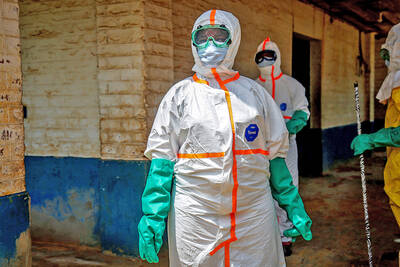
COMMUNITY CONFLICT: Concerns about disease spread from corpses has run up against friends and families’ desire to bury their dead as infection spreads in the area Angry residents of a town at the epicenter of the Ebola outbreak in the Democratic Republic of the Congo (DR Congo) attacked and burned a tent that was part of a health center where people are being treated for the virus, the staff there said Saturday. It was the second such attack in the region in a week. No one was hurt in the attack, according to reports but as patients ran out to escape the fire, 18 people with suspected Ebola infections fled the facility and are unaccounted for, a hospital director said. Angry residents arrived at the clinic in the

Forecasters in Europe yesterday warned of exceptional heat as record temperatures driven by a “heat dome” push temperatures well above seasonal norms across the continent. The surge follows a record-breaking Monday, with France logging its hottest day in the month of May on record, its weather agency said, and the UK also posting unprecedented highs. A so-called “heat dome” of warm air from northern Africa trapped under a high-pressure system over western Europe is behind the high temperatures not usually seen until high summer. Restrictions on outdoor work were imposed in parts of Italy, beaches in southwest France filled earlier than usual and


 RSS
RSS