


The kiwi, New Zealand’s sacred national bird, vanished from the hills around Wellington more than a century ago. Now the capital’s residents are waging an improbable citizen campaign to return the endangered flightless birds to the city.
“They are a part of who we are and our sense of belonging here,” Capital Kiwi Project founder Paul Ward said. “But they’ve been gone from these hills for well over a century and we decided as Wellingtonians that wasn’t right.”
On a hill wreathed in mist above the dark sea that runs between New Zealand’s North and South Islands, Ward and others crossed rugged farmland late on Tuesday night, carrying seven crates in silence by dim red torchlight. Inside each one nestled a kiwi, the 250th bird relocated to Wellington since the Capital Kiwi Project began.
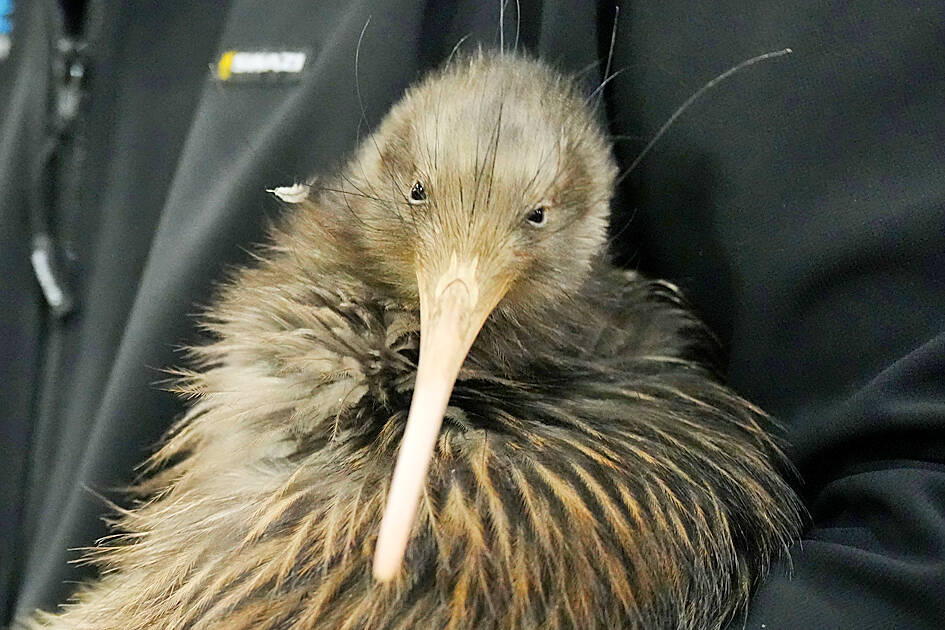
Photo: AP
The kiwi is a shy and odd-looking bird with underdeveloped wings and a whiskery face.
Spiritually significant for many New Zealanders, the kiwi’s image appears everywhere, including on the tail of the country’s air force planes — curious for a bird with no tail which cannot fly.
It is thought that there were 12 million of the birds roaming the landscape before humans arrived in New Zealand. Today only about 70,000 kiwi are left across the country, with the population dropping 2 percent each year.
In the hills where Wellington’s kiwi now live and breed, the only late-night sound on Tuesday was the whoosh of wind turbines. Ward and his friends set their crates down in pairs, slid them open and gently tilted the boxes.
From each crate, a long, curved beak eventually protruded as kiwi took their first tentative steps into the shadowed landscape, then sped to a run and disappeared into the darkness.
New Zealand is home to some of the world’s strangest and rarest bird species. Some have only survived because of against-all-odds conservation programs, at times with uncertain funding.
Initiatives decades ago saw all surviving birds of some species moved onto offshore, predator-free islands or into sanctuaries where they could be carefully monitored and protected, but where few New Zealanders would ever see one.
Ward and his group had a different dream: that New Zealand’s iconic national bird could flourish alongside people in a bustling capital city, where human encroachment and introduced predators had wiped out the kiwi before.
Although unmanaged kiwi populations are shrinking, their numbers have thrived in carefully managed wild bird sanctuaries — so much, in fact, that some of these protected areas have run out of room for them.
That has prompted their relocation to places such as Wellington, where groups such as Ward’s rally residents to embrace their new neighbors.
“They’re living and calling and being encountered on the hills surrounding our city,” Ward said.
That has taken work. Over the past decade, efforts between landowners, the local Maori tribe and the Capital Kiwi Project have produced a sprawling, 24,000-hectare tract of land where kiwi can roam.
It is dotted with more than 5,000 traps for stoats, the main predator of kiwi chicks. So far, the Wellington population has a 90 percent chick survival rate.
Community groups have also taken up the work to rid the nation of predators. Parts of Wellington are now entirely free of mammalian predators apart from household pets, and native birds flourish. Volunteers monitor suburbs with military precision for the appearance of a single rat.
“When I think of endangered species globally, for the most part you can’t do much other than campaign or donate money,” Save the Kiwi CEO Michelle Impey said. “But we have this incredible movement throughout the country where everyday people are taking it on under their own steam to do what they can to protect a threatened species.”

An American scientist convicted of lying to US authorities about payments from China while he was at Harvard University has rebuilt his research lab in Shenzhen, China, to pursue technology the Chinese government has identified as a national priority: embedding electronics into the human brain. Charles Lieber, 67, is among the world’s leading researchers in brain-computer interfaces. The technology has shown promise in treating conditions such as amyotrophic lateral sclerosis and restoring movement in paralyzed people. It also has potential military applications: Scientists at the Chinese People’s Liberation Army have investigated brain interfaces as a way to engineer super soldiers by boosting

Indonesian police have arrested 13 people after shocking images of alleged abuse against small children at a daycare center went viral, sparking outrage across the nation, officials said on Monday. Police on Friday last week raided Little Aresha, a daycare center in Yogyakarta on Java island, following a report from a former employee. CCTV footage circulating on social media showed children, most younger than two, lying on the floor wearing only diapers, their hands and feet bound with rags. The police have confirmed that the footage is authentic. Police said they also found 20 children crammed into a room just 3m by 3m. “So

From post offices and parks to stations and even the summit of Mount Fuji, Japan’s vending machines are ubiquitous, but with the rapid pace of inflation cooling demand for their drinks, operators are being forced to rethink the business. Last month beverage giant DyDo Group Holdings announced it would remove about 20,000 vending machines — about 7 percent of their stock nationwide — by January next year, to “reconstruct a profitable network.” Pokka Sapporo Food & Beverage, based in Nagoya, also said last month it would sell its 40,000-machine operation to Osaka-based Lifedrink Co. “The strength of the vending machine

A grieving mother has ended her life at a clinic in Switzerland four years after the death of her only child. Wendy Duffy, 56, a physically healthy woman, died at the Pegasos clinic in Basel after struggling to cope with the death of her 23-year-old son, Marcus. The former care worker, from the West Midlands, England, had previously attempted to take her own life. The case comes as assisted dying would not become law in England and Wales after proposed legislation, branded “hopelessly flawed” by opponents, ran out of time. Ruedi Habegger, the founder of Pegasos, described Duffy’s death as


 RSS
RSS