


The EU plans to deepen its engagement with Syria by relaunching formal political contacts and paving the way for closer economic and security ties, according to a document seen by Reuters, marking the latest step in a broader policy shift after years of frozen relations.
The background paper, produced by the bloc’s diplomatic arm and circulated to EU member countries this week, says the EU would fully resume its 1978 cooperation agreement with Syria and begin a High-Level Political Dialogue, an EU term for formal and structured talks, with the country’s transitional authorities on May 11.
In a notable policy adjustment, the EU also said it would “reframe and adapt” its sanctions regime to maintain leverage while engaging with Syria’s leadership and targeting spoilers of the transition, the paper said.
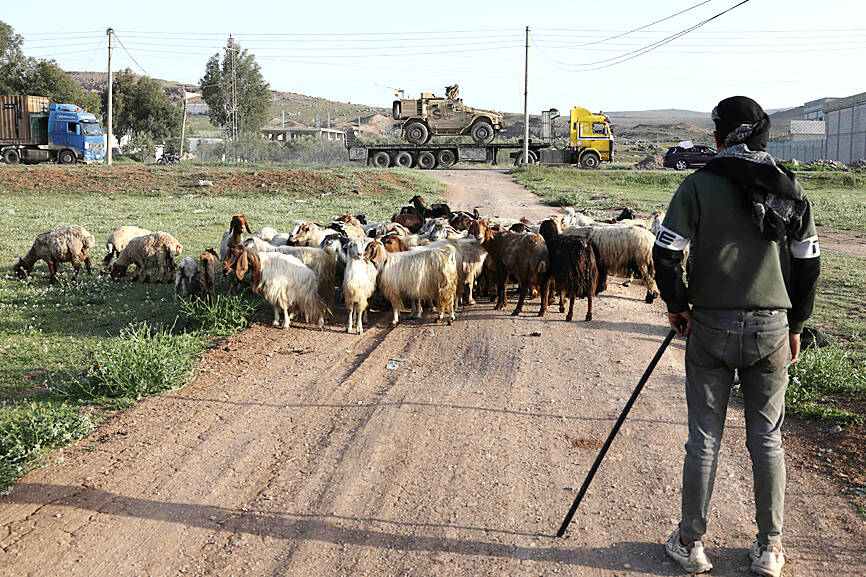
Photo: AFP
Syria, which had most Western sanctions lifted at the end of last year, is seeking broader integration into the international community under interim President Ahmed al-Sharaa, who headed an alliance of Islamist rebel factions to oust Bashar al-Assad as president at the end of 2024, after a devastating 14-year war.
The paper outlines plans to step up economic engagement, including a framework for trade and investment, mobilizing private sector funding and supporting reforms to improve Syria’s business environment through a new technical assistance hub.
It also said the EU would work with authorities on facilitating the “safe, voluntary and dignified return” of refugees and displaced people.
Europe hosts more than 1 million Syrian refugees and asylum seekers, roughly half of whom are in Germany. Their return has been on top of the agenda in most discussions between European capitals and Damascus since al-Assad’s ouster.
The paper highlights ambitions to integrate Syria into regional connectivity projects, including the India-Middle East-Europe Economic Corridor, positioning the country as a hub for transport, energy and digital links.
Syria is emerging as a critical transit point, particularly amid the energy crisis triggered by the closure of the Strait of Hormuz amid the Iran war. A first tanker carrying Iraqi oil transported overland sailed from the Syrian port of Baniyas on Thursday.
Turkey, Syria and Jordan have also agreed to upgrade their railway networks to create a corridor linking southern Europe to the Gulf, Turkish Minister of Transport and Infrastructure Abdulkadir Uraloglu told Bloomberg on Wednesday.
On security, the paper said the EU could support training for Syrian police and institutional capacity-building in the interior ministry, alongside cooperation on counterterrorism and efforts to address drug trafficking and organized crime.
The document also underscores EU backing for implementing an agreement struck in January between Damascus and Kurdish-led authorities in the northeast, which includes integrating local institutions into the state and expanding rights for Syrian Kurds as part of a broader political transition.
As a major step in implementing that agreement, Syria last month appointed the commander of the prominent YPG Kurdish forces as a deputy defense minister for eastern territories, where US forces handed over their last remaining military base to the Syrian army this week.

SPEAKING OUT: After Siranudh Scott’s allegations surfaced, celebrities and public figures took to social media to share their own experiences of sexual misconduct and abuse A high-profile alleged sexual abuse case within a wealthy Thai beer brewing family has prompted a wave of painful accounts from survivors of unconnected abuse in the conservative nation. Siranudh Scott, a member of the billionaire Thai family that founded the ubiquitous Singha beer brand, posted an emotional video this month accusing his elder brother Sunit of repeatedly abusing him when he was a teenager. Sunit, who is in his 30s, later denied the allegations in a video posted online, but Singha parent Boonrawd dismissed him from his executive role with the company on Tuesday last week. “I felt I needed to speak

SEEKING ORDER: Rodrigo Paz said that ‘anyone who wants to destroy the nation will have to deal with this president and the full force of the constitution’ Bolivian President Rodrigo Paz on Wednesday said that the nation was at a “breaking point” after nearly a month of protests that have caused shortages of food, fuel and medicine. Paz, who took office six months ago amid the worst economic crisis there in four decades, is battling a groundswell of fury over his policies. The political capital, La Paz, has been besieged by low-income workers and members of the indigenous majority calling for his resignation. “The country needs order and is reaching breaking point,” the 58-year-old said at a public event in La Paz, renewing his appeal for dialogue. On Tuesday, the Bolivian

COMMUNITY CONFLICT: Concerns about disease spread from corpses has run up against friends and families’ desire to bury their dead as infection spreads in the area Angry residents of a town at the epicenter of the Ebola outbreak in the Democratic Republic of the Congo (DR Congo) attacked and burned a tent that was part of a health center where people are being treated for the virus, the staff there said Saturday. It was the second such attack in the region in a week. No one was hurt in the attack, according to reports but as patients ran out to escape the fire, 18 people with suspected Ebola infections fled the facility and are unaccounted for, a hospital director said. Angry residents arrived at the clinic in the

‘CROSSING THE LINE’: China’s embassy in Seoul criticized US Forces Korea Commander General Xavier Brunson, asking if his ‘hostile’ remarks were authorized by Washington South Korea and the US are in talks over recent public remarks by the commander of US Forces Korea, Seoul’s presidential office said yesterday, after the comments drew sharp criticism from China. In a recent podcast interview, US Forces Korea Commander General Xavier Brunson described South Korea as “the dagger in the heart of Asia” from China’s east coast, prompting the Chinese embassy in Seoul to say that he had “truly crossed the line.” The interview came amid growing speculation that Washington might seek to expand the role of US Forces Korea in countering the growing regional influence of China, a key


 RSS
RSS