


The world’s largest stadium, Southeast Asia’s biggest exhibition hall and hundreds of major road, aviation and energy projects — Vietnam is building faster than ever in its self-proclaimed “era of national rise.”
The country last year broke ground on more than 550 infrastructure projects in a spree that would cost about US$200 billion, and it is planning hundreds more projects, including its first nuclear power plants and a 1,500km high-speed railway.
Overseeing the construction drive is the country’s most powerful leader in decades, Communist Party of Vietnam General Secretary To Lam, who on Tuesday was named president as well.
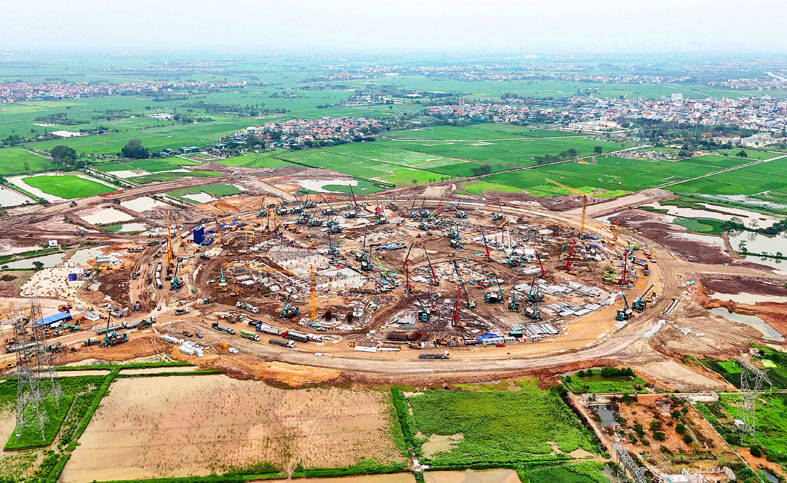
Photo: AFP
He has staked his leadership on aggressive reforms that aim to deliver double-digit percentage growth, slashing bureaucratic red tape, empowering the private sector and channeling vast resources into megaprojects.
“The party understands that legitimacy in Vietnam is ultimately built on delivered living standards,” said Hanoi-based Dan Martin, cohead of business intelligence at Asian business advisory firm Dezan Shira and Associates.
“The most consequential leaders in Vietnamese modern history are remembered for structural transformation,” he added.
The building bonanza is likely to boost GDP, analysts say, but some caution that it comes with risks, while residents displaced in the name of progress complain of being left behind.
Once among the poorest and most isolated countries in Asia, Vietnam has transformed itself into a thriving export economy, supplying consumer electronics, machinery and clothing to Western nations. It aims to become an upper middle-income country by the end of the decade, a goal that would require raising GDP per capita by 70 percent from today’s US$5,000.
Lam has turbocharged the development agenda, promoting a “new growth model” powered by major investments in physical and digital infrastructure.
Elevated to party chief after his predecessor’s death in 2024, he has scrapped whole layers of government and abolished ministries and agencies in a bid to speed up official decisionmaking.
“We cannot accept low economic growth,” he said in a speech to senior Communist Party cadres last month.
Many megaprojects have been in the pipeline for years, but under Lam they have suddenly moved forward.
Others are being built on accelerated timelines, including a new US$8.1 billion airport that will serve the capital region.
“This is a deliberate compression of what would normally take a decade into a three-year window,” Martin said, referencing the country’s megaprojects.
The government is borrowing heavily to finance the construction, also courting private investors, such as mega-conglomerate Vingroup.
The strategy carries fiscal risks as well as the potential for graft in the authoritarian one-party state, analysts said.
“Given the lack of financial transparency involved in these megaprojects, one cannot rule out the possibility that they are simply ways for government officials to steal from the state,” said Tuong Vu, who leads the US-Vietnam Research Center at the University of Oregon.
Lam rose to power by pursuing an aggressive anti-corruption campaign, but under his rule, businesses seen as close to his security-dominated wing of the party have prospered, experts say.
Better infrastructure could boost long-term growth, but poor management of the projects “could overheat the economy, leading to inflation, higher public debt, fiscal strain, and ultimately macroeconomic instability,” Vietnam analyst Le Hong Hiep said.
“Some of these projects may risk becoming ‘white elephants,’ draining public resources,” he added.
Another Hanoi-based analyst, speaking on condition of anonymity, likened the government’s pursuit of pricey projects to “a poor household trying to buy a luxurious Ferrari at all cost.”
That concern resonates with 62-year-old Chung, who was forced to give up much of his farmland outside Hanoi to make way for a massive complex that would include a 135,000-capacity stadium.
“I don’t think Vietnam can host a World Cup, so what’s the use of the world’s largest stadium here?” he said.
Developer Vingroup paid him almost 2 billion dong (US$75,953) in compensation, a fortune for most farmers in Vietnam, but not enough to ease his fears about what will happen to his community.
“We can never benefit from that huge stadium. There will be no jobs there for us,” he said.
About 40km southeast of Hanoi in Lam’s native Hung Yen Province, farmer Dong voiced similar complaints after being evicted to make way for a US$1.5 billion golf course being developed by the Trump Organization.
A luxury resort for the super-rich cannot replace farmland that has sustained the community for generations, she said.
“In just over a year, they quickly took all our land,” she said.

SPEAKING OUT: After Siranudh Scott’s allegations surfaced, celebrities and public figures took to social media to share their own experiences of sexual misconduct and abuse A high-profile alleged sexual abuse case within a wealthy Thai beer brewing family has prompted a wave of painful accounts from survivors of unconnected abuse in the conservative nation. Siranudh Scott, a member of the billionaire Thai family that founded the ubiquitous Singha beer brand, posted an emotional video this month accusing his elder brother Sunit of repeatedly abusing him when he was a teenager. Sunit, who is in his 30s, later denied the allegations in a video posted online, but Singha parent Boonrawd dismissed him from his executive role with the company on Tuesday last week. “I felt I needed to speak

SEEKING ORDER: Rodrigo Paz said that ‘anyone who wants to destroy the nation will have to deal with this president and the full force of the constitution’ Bolivian President Rodrigo Paz on Wednesday said that the nation was at a “breaking point” after nearly a month of protests that have caused shortages of food, fuel and medicine. Paz, who took office six months ago amid the worst economic crisis there in four decades, is battling a groundswell of fury over his policies. The political capital, La Paz, has been besieged by low-income workers and members of the indigenous majority calling for his resignation. “The country needs order and is reaching breaking point,” the 58-year-old said at a public event in La Paz, renewing his appeal for dialogue. On Tuesday, the Bolivian
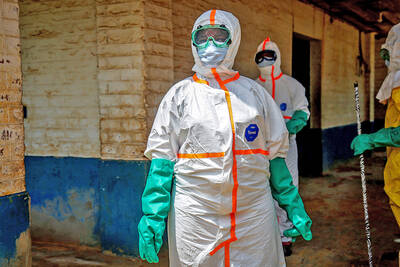
COMMUNITY CONFLICT: Concerns about disease spread from corpses has run up against friends and families’ desire to bury their dead as infection spreads in the area Angry residents of a town at the epicenter of the Ebola outbreak in the Democratic Republic of the Congo (DR Congo) attacked and burned a tent that was part of a health center where people are being treated for the virus, the staff there said Saturday. It was the second such attack in the region in a week. No one was hurt in the attack, according to reports but as patients ran out to escape the fire, 18 people with suspected Ebola infections fled the facility and are unaccounted for, a hospital director said. Angry residents arrived at the clinic in the

Forecasters in Europe yesterday warned of exceptional heat as record temperatures driven by a “heat dome” push temperatures well above seasonal norms across the continent. The surge follows a record-breaking Monday, with France logging its hottest day in the month of May on record, its weather agency said, and the UK also posting unprecedented highs. A so-called “heat dome” of warm air from northern Africa trapped under a high-pressure system over western Europe is behind the high temperatures not usually seen until high summer. Restrictions on outdoor work were imposed in parts of Italy, beaches in southwest France filled earlier than usual and


 RSS
RSS