


A China-born accused scam boss was extradited from Cambodia, Chinese state media said yesterday, linking him to an alleged kingpin indicted by the US for running a multibillion-dollar cyberscam network from the Southeast Asian nation.
“Investigations found that Li Xiong (李雄), the former chairman of Huione Group under Prince Group, is suspected of multiple crimes,” state-run China Central Television (CCTV) said, with the report calling Li “a core member of Chen Zhi’s (陳志) criminal gang.”
Chen, the founder of Prince Group, was extradited to China from Cambodia in January.
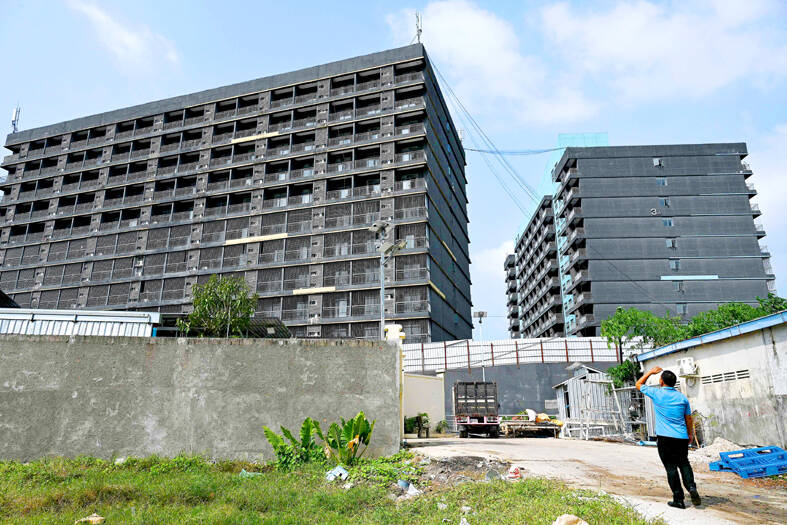
Photo: AFP
Also Chinese-born, Chen had served as an adviser to Cambodian Prime Minister Hun Manet and his father, former leader Hun Sen.
Chen and Li had been granted Cambodian citizenship, which was later revoked by Phnom Penh.
“At present, Li Xiong has been placed under coercive measures according to the law, and the relevant case is under further investigation,” CCTV said.
Across Southeast Asia, organized criminal gangs have used casinos, hotels and fortified compounds as bases to carry out sophisticated online scams, defrauding people around the world through fake romantic relationships and cryptocurrency investment schemes, the UN Office on Drugs and Crime said.
Cambodia hosts dozens of scam centers with tens of thousands of people perpetrating online scams, some willingly and others trafficked, rights monitors say.

SPEAKING OUT: After Siranudh Scott’s allegations surfaced, celebrities and public figures took to social media to share their own experiences of sexual misconduct and abuse A high-profile alleged sexual abuse case within a wealthy Thai beer brewing family has prompted a wave of painful accounts from survivors of unconnected abuse in the conservative nation. Siranudh Scott, a member of the billionaire Thai family that founded the ubiquitous Singha beer brand, posted an emotional video this month accusing his elder brother Sunit of repeatedly abusing him when he was a teenager. Sunit, who is in his 30s, later denied the allegations in a video posted online, but Singha parent Boonrawd dismissed him from his executive role with the company on Tuesday last week. “I felt I needed to speak

SEEKING ORDER: Rodrigo Paz said that ‘anyone who wants to destroy the nation will have to deal with this president and the full force of the constitution’ Bolivian President Rodrigo Paz on Wednesday said that the nation was at a “breaking point” after nearly a month of protests that have caused shortages of food, fuel and medicine. Paz, who took office six months ago amid the worst economic crisis there in four decades, is battling a groundswell of fury over his policies. The political capital, La Paz, has been besieged by low-income workers and members of the indigenous majority calling for his resignation. “The country needs order and is reaching breaking point,” the 58-year-old said at a public event in La Paz, renewing his appeal for dialogue. On Tuesday, the Bolivian

‘CROSSING THE LINE’: China’s embassy in Seoul criticized US Forces Korea Commander General Xavier Brunson, asking if his ‘hostile’ remarks were authorized by Washington South Korea and the US are in talks over recent public remarks by the commander of US Forces Korea, Seoul’s presidential office said yesterday, after the comments drew sharp criticism from China. In a recent podcast interview, US Forces Korea Commander General Xavier Brunson described South Korea as “the dagger in the heart of Asia” from China’s east coast, prompting the Chinese embassy in Seoul to say that he had “truly crossed the line.” The interview came amid growing speculation that Washington might seek to expand the role of US Forces Korea in countering the growing regional influence of China, a key
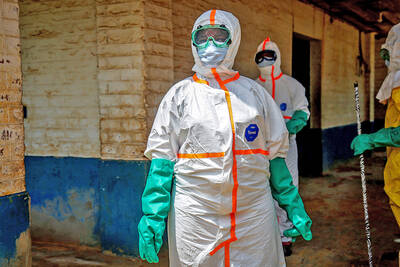
COMMUNITY CONFLICT: Concerns about disease spread from corpses has run up against friends and families’ desire to bury their dead as infection spreads in the area Angry residents of a town at the epicenter of the Ebola outbreak in the Democratic Republic of the Congo (DR Congo) attacked and burned a tent that was part of a health center where people are being treated for the virus, the staff there said Saturday. It was the second such attack in the region in a week. No one was hurt in the attack, according to reports but as patients ran out to escape the fire, 18 people with suspected Ebola infections fled the facility and are unaccounted for, a hospital director said. Angry residents arrived at the clinic in the


 RSS
RSS