


Pressure is mounting on the US Congress to end a funding shutdown that has resulted in travel disruptions, missed paychecks and even warnings of airport closures, but lawmakers have yet to resolve the underlying issue of reining in US President Donald Trump’s immigration enforcement operations.
Senators were expected to vote yesterday on a Republican proposal that would fund the US Transportation Security Administration (TSA) and much of the US Department of Homeland Security, except the enforcement and removal operations conducted by US Immigration and Customs Enforcement (ICE), but it is expected to fail.
Democrats say the plan does not go far enough at putting guardrails on ICE, US Customs and Border Protection and other federal officers who are engaged in the Trump administration’s immigration sweeps, particularly after the deaths of two Americans protesting the actions in Minneapolis.
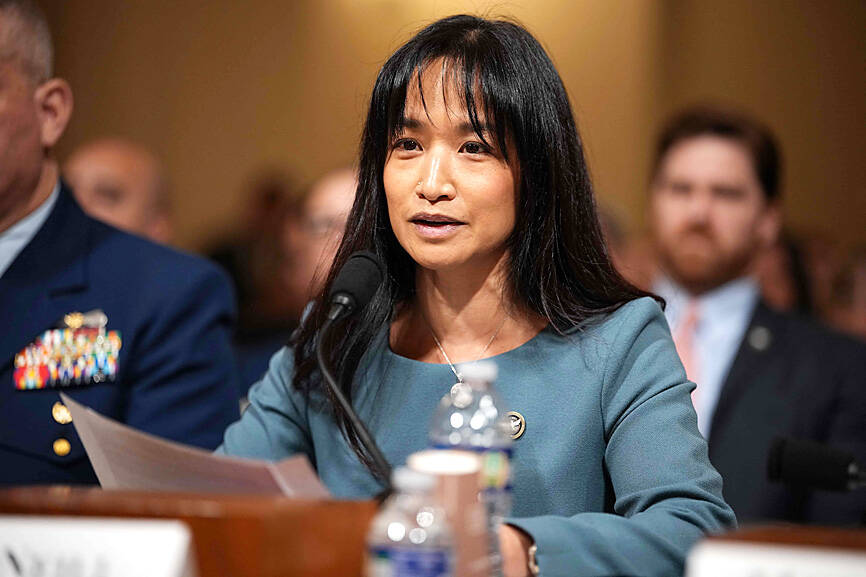
Photo: AFP
With Congress set to leave town by the end of the week for its spring break recess, calls are intensifying for an end to the 41-day stalemate that has put the livelihoods of TSA officers at risk as they provide airport security without pay.
“This is a dire situation,” TSA Acting Administrator Ha Nguyen McNeill testified at a US House of Representatives hearing on Wednesday.
She described the multiple hardships facing unpaid TSA workers —piling up bills and eviction notices, even plasma donations to make ends meet — and warned of potential airport closures if more employees refuse to come to work. Daily callout rates have increased to 11 percent nationwide.
“At this point, we have to look at all options on the table,” she said. “And that does require us to, at some point, make very difficult choices as to which airports we might try to keep open and which ones we might have to shut down as our callout rates increase.”
Trump initially signed off on the plan the Republican senators brought to him late on Monday, but on Tuesday he said he would not be happy with any deal.
While the Republican offer added one new restraint on immigration officers, funding the use of body cameras that had previously been agreed to, it excluded other policies that Democrats have demanded — such as that federal agents wear identification, remove their face masks and refrain from conducting raids around schools, churches or other sensitive places.
Democrats had been in several days of talks with the White House, including with border czar Tom Homan, which appeared to be making progress toward a deal. The White House presented its own offer with several items Democrats had been demanding, including officer IDs and training. Those negotiations broke down over the weekend.
McNeill told lawmakers that multiple airports are experiencing greater than 40 percent callout rates and more than 480 transportation security officers have quit during the shutdown.
She cited the growing financial strain on the TSA workforce.
“Some are sleeping in their cars, selling their blood and plasma, and taking on second jobs to make ends meet, all while being expected to perform at the highest level when in uniform to protect the traveling public,” she said.
McNeil also said TSA officers working at the nation’s airports have experienced a more than 500 percent increase in the frequency of assaults since the shutdown began.
“This is unacceptable, and it will not be tolerated,” she said.

A humanoid robot that won a half-marathon race for robots in Beijing on Sunday ran faster than the human world record in a show of China’s technological leaps. The winner from Honor, a Chinese smartphone maker, completed the 21km race in 50 minutes and 26 seconds, said a WeChat post by the Beijing Economic-Technological Development Area, also known as Beijing E-Town, where the race began. That was faster than the human world record holder, Ugandan Jacob Kiplimo, who finished the same distance in about 57 minutes in March at the Lisbon road race. The performance by the robot marked a significant step forward
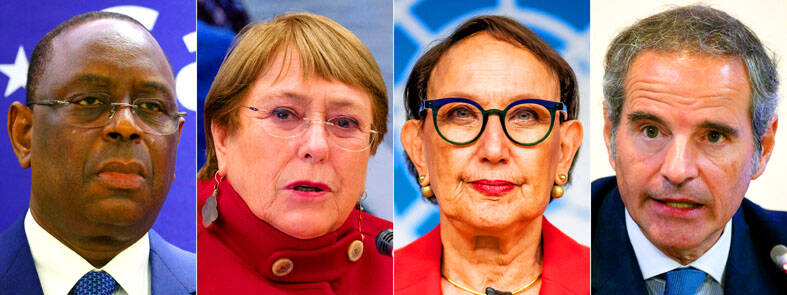
Four contenders are squaring up to succeed Antonio Guterres as secretary-general of the UN, which faces unprecedented global instability, wars and its own crushing budget crisis. Chile’s Michelle Bachelet, Argentina’s Rafael Grossi, Costa Rica’s Rebeca Grynspan and Senegal’s Macky Sall are each to face grillings by 193 member states and non-governmental organizations for three hours today and tomorrow. It is only the second time the UN has held a public question-and-answer, a format created in 2016 to boost transparency. Ultimately the five permanent members of the UN’s top body, the Security Council, hold the power, wielding vetoes over who leads the

South Korea’s air force yesterday apologized for a 2021 midair collision involving two fighter jets, a day after auditors said the pilots were taking selfies and filming during the flight and held them responsible for the accident. “We sincerely apologize to the public for the concern caused by the accident that occurred in 2021,” an air force spokesman told a news conference, adding that one of the pilots involved had been suspended from flying duties, received severe disciplinary action and has since left the military. The apology followed a report released on Wednesday by the South Korean Board of Audit and Inspection,

An earthquake registering a preliminary magnitude of 7.7 off northern Japan on Monday prompted a short-lived tsunami alert and the advisory of a higher risk of a possible mega-quake for coastal areas there. The Cabinet Office and the Japan Meteorological Agency said there was a 1% chance for a mega-quake, compared to a 0.1% chance during normal times, in the next week or so following the powerful quake near the Chishima and Japan trenches. Officials said the advisory was not a quake prediction but urged residents in 182 towns along the northeastern coasts to raise their preparedness while continuing their daily lives. Prime


 RSS
RSS