


In Iraq’s northern Kurdistan region, women perform a traditional dance, their long dresses spinning, gold tassels and heavy necklaces catching the firelight, as smaller crowds than usual celebrate Nowruz, overshadowed by the Middle East conflict.
Among them were Iranian Kurds Sirwa Mustafazada and Kwestan Aminpana, who fled their home country as a result of their activism in 2018.
After three weeks of war, they share the same yearning: “Next year, we will be back.”
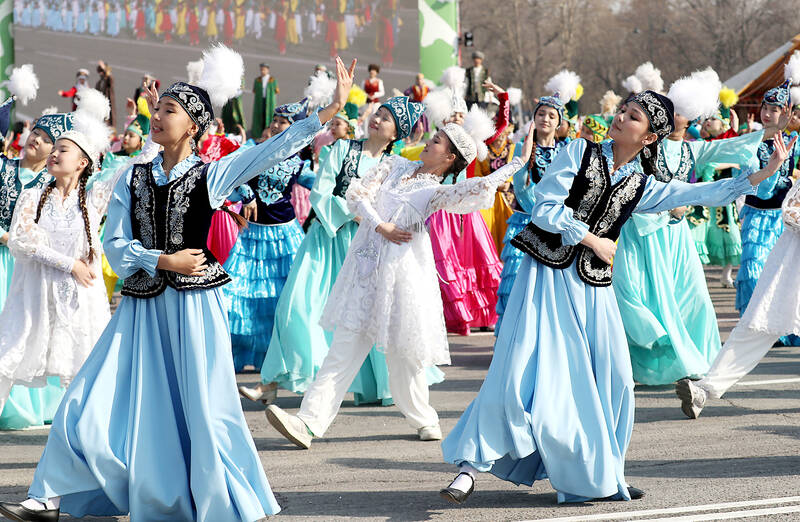
Photo: EPA
“We have lived all this time with this hope,” said Mustafazada, 32, who fled the city of Mahabad in western Iran.
Falling on the equinox in March, Nowruz — the Persian New Year also celebrated by Kurdish communities in Iraq, Syria, Turkey and Iran — is typically marked by weeks of anticipation ahead of joyful family feasts and celebrations.
However, this year, the war launched by Israel and the US on Iran on Feb. 28 has cast a pall over the ancient festivities.
Security concerns muted celebrations across the autonomous Kurdistan region, but crowds still gathered and small bonfires were lit in regional capital Erbil, as well as Sulaimaniyah and Akreh cities
In Sulaimaniyah, the crowd momentarily started when fireworks erupted — recently, similar blasts have signaled drone strikes.
Attacks attributed to Iran and its proxies have repeatedly targeted armed groups of the Iranian Kurdish opposition, organizations long exiled in Iraq.
“The regime is doing everything it can to save its own skin,” Mustafazada said. “But it has no outside support, and nobody wants it anymore inside.”
Nowruz, long frowned upon by hardliners in Iran, is especially contentious this year.
It falls within the 40-day mourning period after the death of Iranian supreme leader Ali Khamenei, killed on the first day of the war.
Both women accused Iranian authorities of attempting to ban the celebration in the past, but 33-year-old Aminpana said with a grin: “They’ll push even harder, and we, in Kurdistan, will push back even more.”
Former Kurdish fighter Saad Qazi said, “Nowruz is a symbol of rebirth, resilience, connection with nature, and joy.”
“It’s important to preserve our traditions and our identity, to be able to answer our children when they ask us, ‘Who are we?’” Qazi added.
On a coffee table in his living room in Erbil, the traditional seven ingredients of “Haft-Sin” are laid out, the candle burning bright.
Qazi’s wife, Parang Jahani, has carefully arranged each item — all of which begin with “S” in Farsi — in small bowls: wheat germ, sweet pudding, jujube berries, sumac, garlic, vinegar and apple.
They will remain there for the 13 days of the festival, a promise of strength, vitality, health and beauty.
Again, they yearn to return, saying: “Next year, maybe, we’ll be back. In any case, we have more hope than last year.”

An American scientist convicted of lying to US authorities about payments from China while he was at Harvard University has rebuilt his research lab in Shenzhen, China, to pursue technology the Chinese government has identified as a national priority: embedding electronics into the human brain. Charles Lieber, 67, is among the world’s leading researchers in brain-computer interfaces. The technology has shown promise in treating conditions such as amyotrophic lateral sclerosis and restoring movement in paralyzed people. It also has potential military applications: Scientists at the Chinese People’s Liberation Army have investigated brain interfaces as a way to engineer super soldiers by boosting
Indonesian police have arrested 13 people after shocking images of alleged abuse against small children at a daycare center went viral, sparking outrage across the nation, officials said on Monday. Police on Friday last week raided Little Aresha, a daycare center in Yogyakarta on Java island, following a report from a former employee. CCTV footage circulating on social media showed children, most younger than two, lying on the floor wearing only diapers, their hands and feet bound with rags. The police have confirmed that the footage is authentic. Police said they also found 20 children crammed into a room just 3m by 3m. “So

Jailed media entrepreneur Jimmy Lai (黎智英) has been awarded Deutsche Welle’s (DW) freedom of speech award for his contribution to Hong Kong’s pro-democracy movement. The German public broadcaster on Thursday said Lai would be presented in absentia with the 12th iteration of the award on June 23 at the DW Global Media Forum in Bonn. Deutsche Welle director-general Barbara Massing praised the 78-year-old founder of the now-shuttered news outlet Apple Daily for standing “unwaveringly for press freedom in Hong Kong at great personal risk.” “With Apple Daily, he gave journalists a platform for free reporting and a voice to the democracy movement in

PHILIPPINE COMMITTEE: The head of the committee that made the decision said: ‘If there is nothing to hide, there is no reason to hide, there is no reason to obstruct’ A Philippine congressional committee on Wednesday ruled that there was “probable cause” to impeach Philippine Vice President Sara Duterte after hearing allegations of unexplained wealth, misuse of state funds and threats to have the president assassinated. The unanimous decision of the 53-member committee in the Philippine House of Representatives sends the two impeachment complaints to deliberations and voting by the entire lower chamber, which has more than 300 lawmakers. The complaints centered on Duterte’s alleged illegal use and mishandling of intelligence funds from the vice president’s office, and from her time as education secretary under Philippine President Ferdinand Marcos Jr. Duterte and the


 RSS
RSS