


In the heart of Sao Paulo, Brazil, a “prisonometer” keeps a live tally of people jailed due to Latin America’s largest artificial intelligence (AI) facial recognition system, but its successes have been marred by mistaken arrests.
The digital counter stands outside the Smart Sampa monitoring center, where dozens of police officers watch images streaming in from 40,000 cameras in the megalopolis.
Latin America’s largest city has long battled high rates of crime. The AI technology was introduced in 2024 to scan the streets and compare images to those in judicial databases.
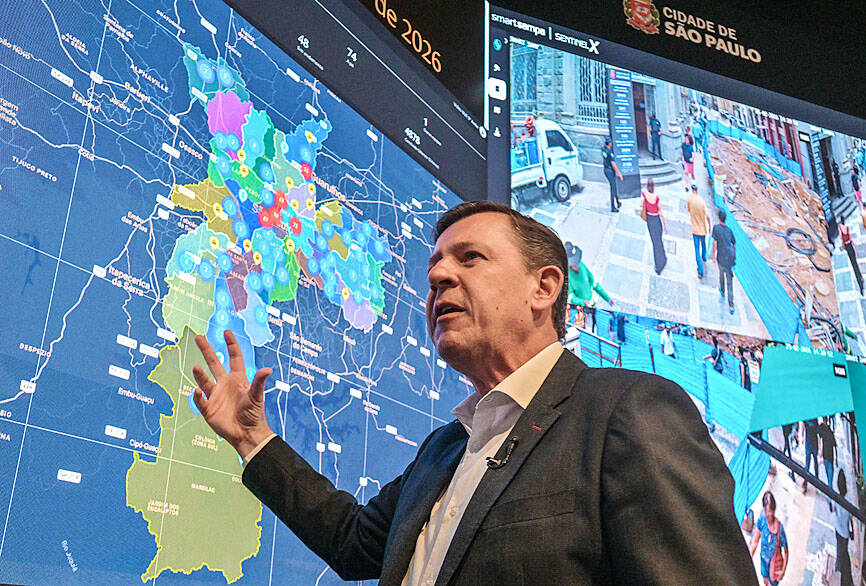
Photo: AFP
Smart Sampa’s dragnet has swept up 3,000 fugitives, while nearly 4,000 people have been caught in the act of committing a crime.
“With the fugitives the system captured, we could fill seven prisons. Today I can no longer imagine Sao Paulo without Smart Sampa,” Sao Paulo Municipal Secretary for Urban Security Orlando Morando told reporters about the program, which costs about US$2 million per month to run.
To show how it works, he uploads a photo of himself to the system. Within seconds, images of him in locations across the city of 12 million people pop up on the screen.
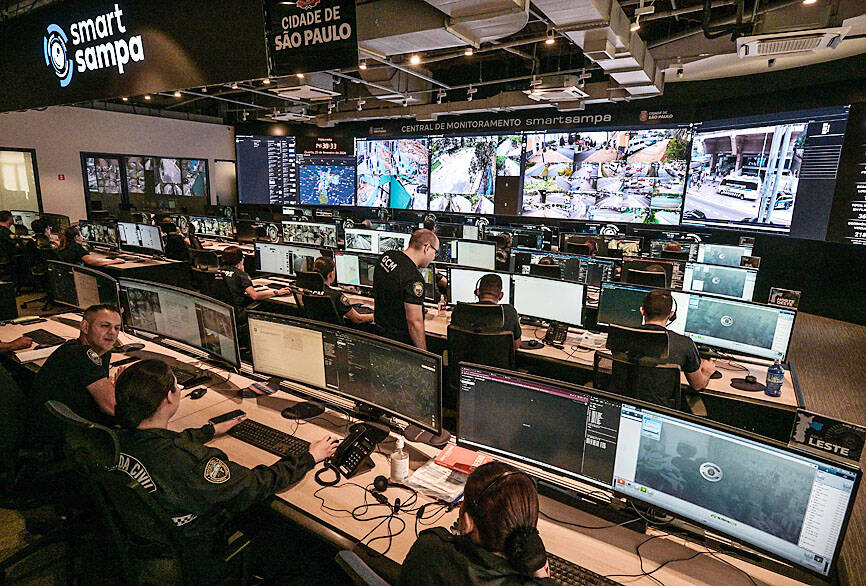
Photo: AF
“It reminds me of the book Nineteen Eighty-Four [by George Orwell] with all that control of people: I love it, I approve 100 percent,” said Sonia Ferreira Silva, a 68-year-old retiree, standing next to a Smart Sampa truck serving as a mobile surveillance post on the iconic Avenida Paulista.
However, the system is far from foolproof.
Official transparency reports analyzed by Agence France-Presse showed that more than 8 percent of people identified as fugitives and arrested in Smart Sampa’s first year had to be released due to errors.
At least 59 detainees were freed because the system mistook them for other people.
In December last year, an 80-year-old retiree spent hours under arrest because Smart Sampa confused him with a rapist.
A month earlier, a group of psychiatric patients were attending therapy at a mental health center when armed police burst in and handcuffed one of them.
After hours at the police station, the detainee was released, and authorities said his arrest warrant was no longer valid.
The system relies not only on street cameras, but also on cameras in public buildings — including health centers — and private buildings that agree to participate.
At least 141 people were arrested due to outdated warrants, but the Sao Paulo government said that those mistakes are the judiciary’s responsibility, not the city’s.
“No one remained imprisoned by mistake: The people were released,” Morando said.
Nearly a half of fugitives captured by Smart Sampa owe child support, a civil offense “that has little to do with public security,” said the report, titled “Smart Sampa: Transparency for whom? Transparency of what?”
“Smart Sampa is presented as a solution to crime, but is used for civil control,” said Amarilis Costa, director of the lawyers’ network Liberdade and a coauthor of the report.
The government denounces attempts to “discredit” Smart Sampa, saying that robberies in the city last year dropped nearly 15 percent.
Nearly one in five cellphone robberies in Brazil, including violent muggings, occurred in Sao Paulo in 2024.
The racial identity of more than half of those found guilty and jailed after being caught by Smart Sampa is not included in official data.
Costa said that creates an information gap that makes it impossible to know whether Smart Sampa suffers from “algorithmic racism.”
Studies in several countries have suggested that AI facial recognition systems tend to make more mistakes with black people.
The government argues that the lack of racial data is the responsibility of the justice system.
“Smart Sampa has no prejudice — we do not arrest people based on color,” Morando said.

‘CROSSING THE LINE’: China’s embassy in Seoul criticized US Forces Korea Commander General Xavier Brunson, asking if his ‘hostile’ remarks were authorized by Washington South Korea and the US are in talks over recent public remarks by the commander of US Forces Korea, Seoul’s presidential office said yesterday, after the comments drew sharp criticism from China. In a recent podcast interview, US Forces Korea Commander General Xavier Brunson described South Korea as “the dagger in the heart of Asia” from China’s east coast, prompting the Chinese embassy in Seoul to say that he had “truly crossed the line.” The interview came amid growing speculation that Washington might seek to expand the role of US Forces Korea in countering the growing regional influence of China, a key

Through the noise of rushing papers and whirring belts at a print factory in Kyoto, two creators watch their photo essay come to life in broadsheet form — part of an effort to win new audiences in the age of artificial intelligence (AI). Despite the decline of the publishing industry, self-publication and handmade “zine” magazines are growing in popularity in Japan, reflecting the nation’s enduring love of paper in the digital era. While speaking to Agence France-Presse at the plant, his hands black with ink, one of the creators, Kazuma Obara, said: “I think [paper] is a medium that engages all five

Australian researchers have trained lab-grown brain cells on a silicon computer chip to play the 1990s shooter game Doom and said they are just scratching the surface of what the neurons could be capable of doing. It is the science-fiction work of biotech boffins at Cortical Labs, who researched and developed the technology that harnesses the workings of the brain’s networking system. Each so-called “biological computer” contains about 200,000 living human brain cells, grown from stem cells that were harvested from blood donations. Having mastered the simple computer game Pong, where a paddle is moved up and down to send a ball

France experienced its hottest spring on record, the French weather service said on Tuesday, after an exceptional early heat wave that also broke highs for the season in England and Wales. Meteo-France said the average nationwide temperature over March to May was 13.8°C — about 1.7°C above the norm, and surpassing records set in 2011 and 2020. “The warmest spring since records began in 1900,” it said in a bulletin. All three months were warmer than average, but the onset of an “unprecedented heatwave” late last month pushed the mercury to highs typically seen at the height of the summer. “Our country had never


 RSS
RSS