


The Chinese public maintains relatively warm sentiments toward Taiwan and strongly prefers non-military paths to improving cross-strait relations, a recent survey conducted by the Atlanta, Georgia-based Carter Center and Emory University showed.
The “China Pulse” research project, which polled 2,506 adults between Oct. 27 last year and Jan. 1 this year, found that 86 percent of respondents support strengthening cultural ties, while 81 percent favor deepening economic interaction.
The report, co-authored by political scientists at Emory University and advisors at the Carter Center, indicates that the Chinese public views Taiwan’s importance through a lens of shared history and culture rather than geopolitical or technological competition.
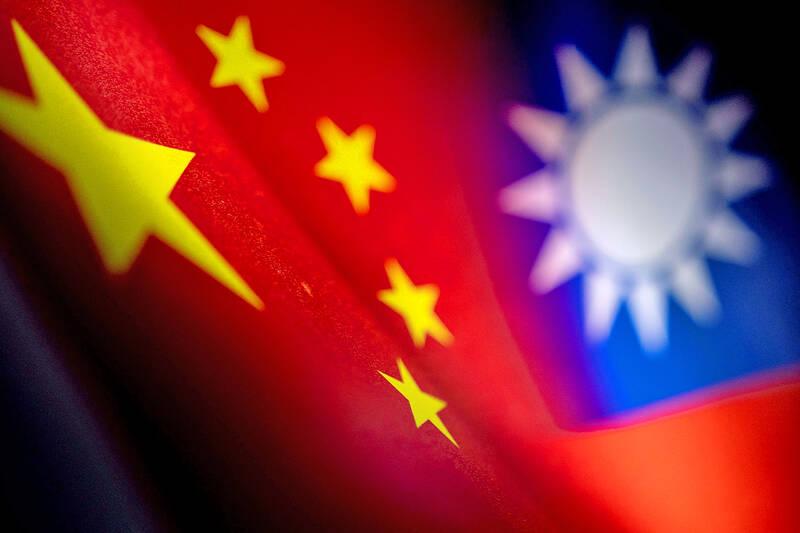
Photo: Reuters
Regarding Taiwan’s semiconductor industry, only 45 percent of Chinese respondents cited high-tech manufacturing as a key part of Taiwan’s value.
Instead, 80 percent believe unification would resolve a “long-standing historical issue” and end the “century of humiliation.”
Despite the focus on peaceful engagement, the survey found no clear mandate for either pacifism or militarism.
The percentage of respondents who believe unification should not be achieved by force “under any circumstances” fell from 51 percent in a pilot poll between July 7 and Aug. 15 last year to 38 percent in the most recent poll.
However, half of the respondents agreed that the use of military force would only make the Taiwan issue worse.
In a hypothetical scenario where Taiwan declares independence, 81 percent of the Chinese public would support limited military operations on offshore islands, such as Kinmen and Matsu.
In contrast, only 32 percent expressed support for a full-scale military attack against Taiwan.
Demographic data suggests that peaceful views are most prevalent among women, lower-income individuals and those with less formal education.
For instance, 54 percent of the lowest-earning respondents supported a peaceful-only approach, compared to roughly one-quarter of high earners.
Ultimately, the findings suggest that while the Chinese public remains committed to unification in principle, there is significant reticence regarding the risks of a major conflict.
Most prefer a negotiated peace and policies that encourage Taiwanese students and businesspeople to study, live and work in China.

Through the noise of rushing papers and whirring belts at a print factory in Kyoto, two creators watch their photo essay come to life in broadsheet form — part of an effort to win new audiences in the age of artificial intelligence (AI). Despite the decline of the publishing industry, self-publication and handmade “zine” magazines are growing in popularity in Japan, reflecting the nation’s enduring love of paper in the digital era. While speaking to Agence France-Presse at the plant, his hands black with ink, one of the creators, Kazuma Obara, said: “I think [paper] is a medium that engages all five

‘CROSSING THE LINE’: China’s embassy in Seoul criticized US Forces Korea Commander General Xavier Brunson, asking if his ‘hostile’ remarks were authorized by Washington South Korea and the US are in talks over recent public remarks by the commander of US Forces Korea, Seoul’s presidential office said yesterday, after the comments drew sharp criticism from China. In a recent podcast interview, US Forces Korea Commander General Xavier Brunson described South Korea as “the dagger in the heart of Asia” from China’s east coast, prompting the Chinese embassy in Seoul to say that he had “truly crossed the line.” The interview came amid growing speculation that Washington might seek to expand the role of US Forces Korea in countering the growing regional influence of China, a key

Australian researchers have trained lab-grown brain cells on a silicon computer chip to play the 1990s shooter game Doom and said they are just scratching the surface of what the neurons could be capable of doing. It is the science-fiction work of biotech boffins at Cortical Labs, who researched and developed the technology that harnesses the workings of the brain’s networking system. Each so-called “biological computer” contains about 200,000 living human brain cells, grown from stem cells that were harvested from blood donations. Having mastered the simple computer game Pong, where a paddle is moved up and down to send a ball

France experienced its hottest spring on record, the French weather service said on Tuesday, after an exceptional early heat wave that also broke highs for the season in England and Wales. Meteo-France said the average nationwide temperature over March to May was 13.8°C — about 1.7°C above the norm, and surpassing records set in 2011 and 2020. “The warmest spring since records began in 1900,” it said in a bulletin. All three months were warmer than average, but the onset of an “unprecedented heatwave” late last month pushed the mercury to highs typically seen at the height of the summer. “Our country had never


 RSS
RSS