


A wave of affection for Spain has swept Turkey the past few weeks over Madrid’s firm stance against the war in the Middle East, with soccer fans roaring their support and social media awash with pro-Spanish sentiment.
Countless images of Turkish and Spanish flags flying side-by-side have emerged alongside memes of a budding romance between a bull representing Spain and a wolf for Turkey, as well as footage of Eskisehirspor fans chanting Spanish tunes and shouting: “Ole” as they perform a Mexican wave.
It began when Spanish Prime Minister Pedro Sanchez defiantly refused to let US troops use its bases to attack Iran at the start of the conflict, repeatedly posting “No to the war” in a move that won hearts and minds in Turkey.
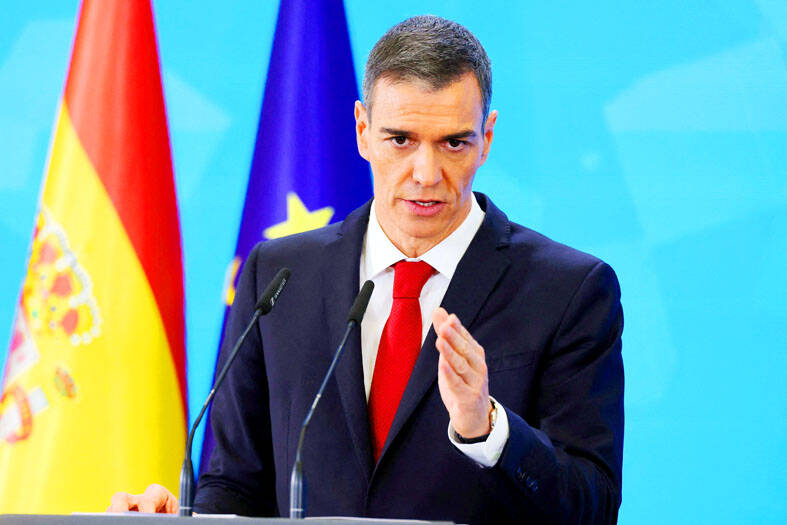
Photo: AFP
Already popular in Turkey over his fierce criticism of the Gaza war which mirrored Ankara’s stance, the Socialist leader’s refusal to bow to US pressure has angered US President Donald Trump, but won him legions of fans in Turkey.
“Greetings to the Turkish Twitter community,” Sanchez on March 7 wrote in a post on X alongside footage showing a large Turkish flag being waved at a party gathering alongside a huge banner reading: “No to the war.”
The conflict began on Feb. 28 when Israeli and US warplanes began bombing Iran, in a move sharply denounced as “illegal” by Turkey, which has also criticized Iran’s indiscriminate retaliation.
Spain’s aura was further burnished after its troops in charge of a Patriot missile battery on Turkish soil spotted a Turkey-bound ballistic missile launched from Iran which was intercepted by NATO.
The troops, who are based at the Incirlik Air Base, a key NATO facility in southern Turkey, had “detected and reported the missile attack,” Spanish Minister of Defense Margarita Robles told Cadena Ser radio on March 5, although they were not the ones who shot it down.
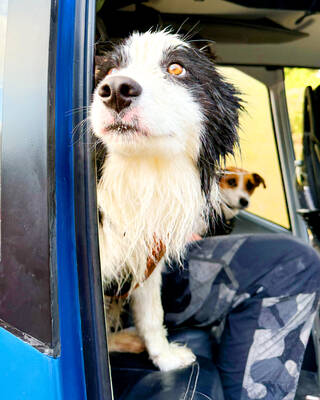
When a hiker fell from a 55m waterfall in wild New Zealand bush, rescuers were forced to evacuate the badly hurt woman without her dog, which could not be found. After strangers raised thousands of dollars for a search, border collie Molly was flown to safety by a helicopter pilot who was determined to reunite the pet and the owner. A week earlier, an emergency rescue helicopter found the woman with bruises and lacerations after a fall at a rocky spot at the waterfall on the South Island’s West Coast. She was airlifted on March 24, but they were forced to
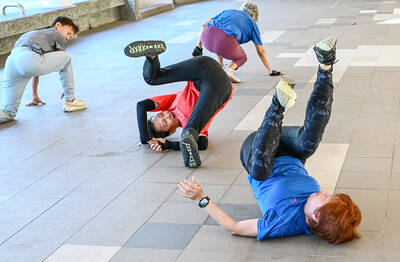
CONFIDENCE BOOSTER: ’After parkour ... you dare to do a lot of things that you think only young people can do,’ a 67-year-old parkour enthusiast said In a corner of suburban Singapore, Betty Boon vaults a guardrail, crawls underneath a slide, executes forward shoulder rolls and scales a steep slope, finishing the course to applause. “Good job,” the 69-year-old’s coach cheers. This is “geriatric parkour,” where about 20 retirees learned to tackle a series of relatively demanding exercises, building their agility and enjoying a sense of camaraderie. Boon, an upbeat grandmother, said learning parkour has aided her confidence and independence as she ages. “When you’re weak, you will be dependent on someone,” she said after sweating it out with her parkour classmates in suburban Toa Payoh,
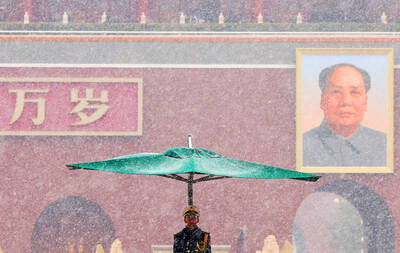
Chinese dissident artist Gao Zhen (高兟), famous for making provocative satirical sculptures of former Chinese leader Mao Zedong (毛澤東), was tried on Monday over accusations of “defaming national heroes and martyrs,” his wife and a rights group said. Gao, 69, who was detained in 2024 during a visit from the US, faces a maximum three-year prison sentence, said his wife, Zhao Yaliang (趙雅良), and Shane Yi, a researcher at the Chinese Human Rights Defenders group which operates outside the nation. The closed-door, one-day trial took place at Sanhe City People’s Court in Hebei Province neighboring the capital, Beijing, and ended without a
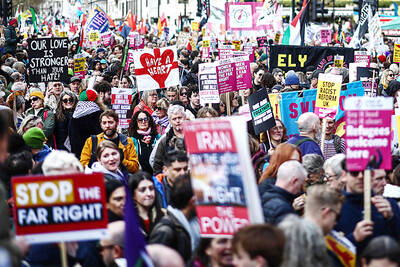
‘TOXIC CLIMATE’: ‘I don’t really recognize Labour anymore... The idea that you can implement far-right ideas in order to stop the far right is nonsense,’ a protester said Tens of thousands of people on Saturday marched through central London to protest against the far right, weeks ahead of local elections and six months after Britain saw one of its largest far-right demonstrations. Organized by hundreds of civic groups, including trade unions, anti-racism campaigners and Muslim representative bodies, Saturday’s Together Alliance event was billed as the biggest in UK history to counter right-wing extremism. A separate pro-Palestinian march had also converged with the main rally. While organizers claimed 500,000 had turned out in total, the police gave a figure of about 50,000. Protesters carrying placards with slogans such as


 RSS
RSS