


Graffiti defaces tattered clay walls and trash piles up in Japan’s oldest student dormitory, but Masako Ueda is savoring every last moment in the mice-infested building slated for temporary closure.
The elite Kyoto University’s “Yoshida Dorm” is self-governed by students, who treasure it as a bastion of free thinking away from the strict hierarchies that permeate many Japanese institutions.
However, the dorm has had to fight to keep its autonomy, and has been enmeshed in a decades-long battle with the university, which owns it and has at times threatened its closure, saying it is unsafe.
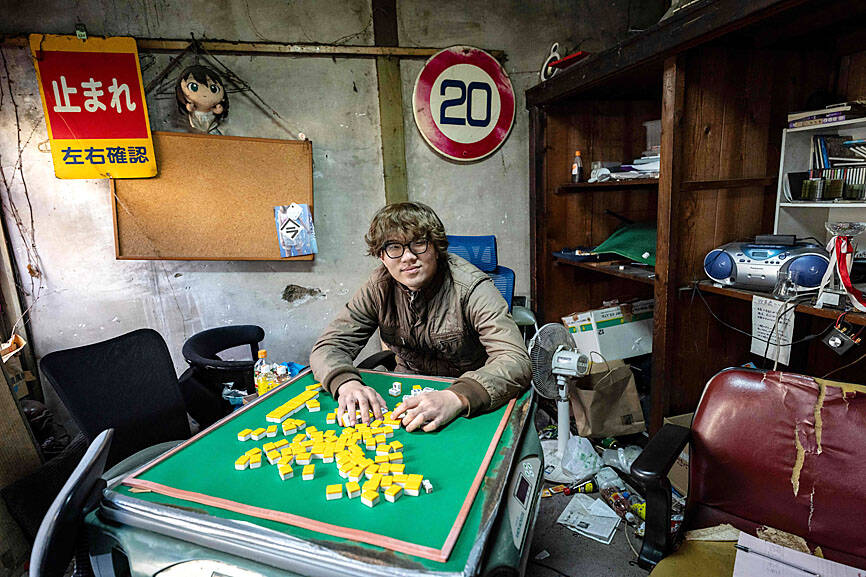
Photo: AFP
Under the terms of a court-mediated settlement reached last year, students would by the end of this month vacate the dorm’s 113-year-old wooden residential building to allow for repairs — but many fear it might be unrecognizable once they return.
“I feel at ease with this shabby place. It’s steeped in humanity — a squeaky-clean place feels lifeless to me,” 39-year-old Ueda said, clutching her favorite turtle plushie.
The about 100 students living in the dormitory enjoy mahjong, video games and hookah together in their decrepit surroundings, where windows are broken, the toilets are rusty and spider webs gather.
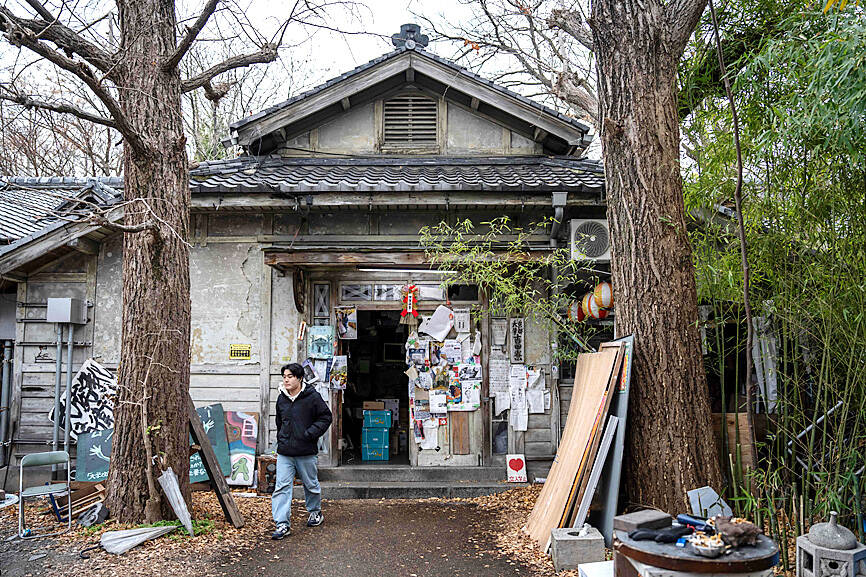
Photo: AFP
Self-initiative is key and students hold sometimes convoluted town hall meetings to agree unanimously on their policies and daily operations. They also choose new dorm members themselves.
Everyone speaks freely regardless of nationality or gender. Even seniority-based formalities, an ingrained feature of Japan’s social and business etiquette, were jettisoned long ago to place freshmen on equal footing with older housemates.
In a conventional dorm with rules laid out by the university, “our lives would’ve been easier, because we wouldn’t have to think for ourselves,” 23-year-old student Rintaro Yoshida said.
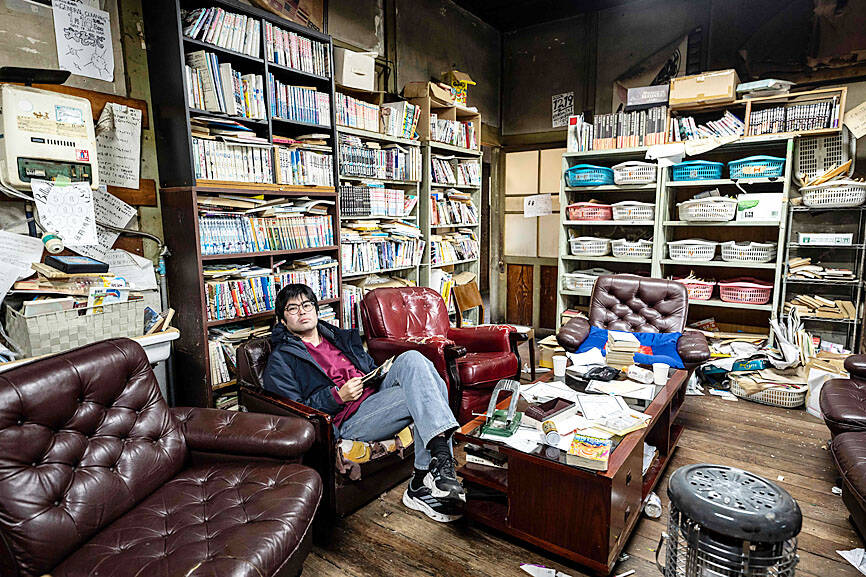
Photo: AFP
“Instead of mindlessly accepting what already exists, here you can modify living spaces or design new systems as you see fit, as long as you can get everyone else on board,” he said.
Two residential buildings and a heavily graffitied dining hall constitute Yoshida Dorm. While most residents sleep in its newer, cleaner property, students still regularly use the squalid “gento” — or old building — which they describe as their “spiritual backbone.”
The monthly rent of ¥2,500 (US$15.80) has made it a safety net for poor students. The spirit of self-governance is best embodied by the retro-style building, the walls of which bear handwritten slogans like “No to Dorm Closures!” and philosophical maxims including by Italian radical leftist Antonio Negri.
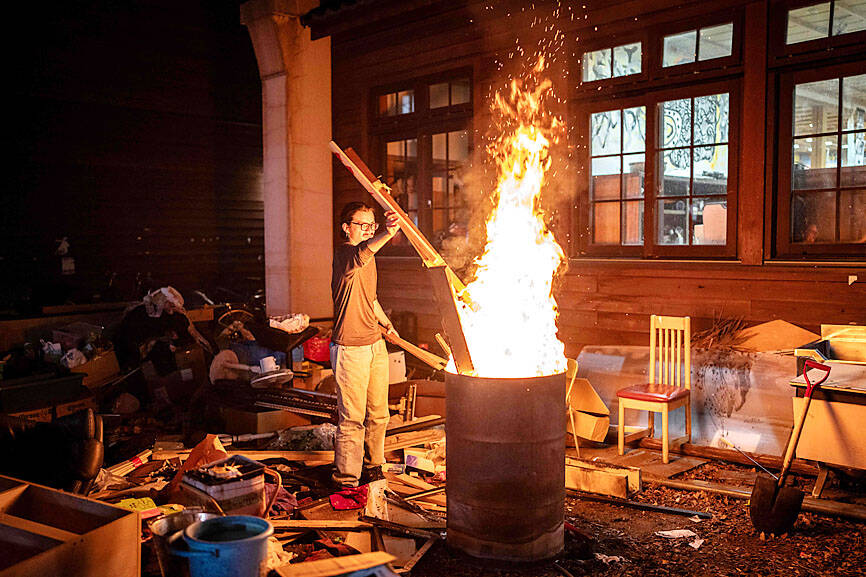
Photo: AFP
The fight to preserve the dormitory’s independence has put the students — who have themselves demanded repairs over the years — at loggerheads with Kyoto University, which counts 10 Nobel prize winners among its alumni.
Fierce anti-closure protests in the 1980s saw students arrested and others injured, and tensions flared again in 2017 when the institution ordered all residents to vacate and banned new admissions on account of earthquake vulnerabilities.
Authorities sued a group of students in 2019 to demand they leave, before the drawn-out saga concluded with officials committing to “seismic renovations, including reconstruction,” and students agreeing to temporarily move.
Chinese student Han Yifan, 27, was not among those named in the lawsuit, but watching his peers as they battled for autonomy, “I felt how helpless we were,” he said.
“It drove home to me just how stressful and exhausting top-down decisionmaking can be for those who aren’t the ones in power,” he said.
As a result, he is now more involved in social activism, joining protests on issues surrounding Palestine and homelessness.
Critics of the repairs say they are largely a pretext for the university to bring the dorm under its control — a view it declined to comment on.
“A self-governed dorm full of students exercising their critical thinking to challenge university authorities is something they want to get rid of,” said Masaaki Sakagami, a retired faculty member.
Kyoto University said that renovation details “are currently under consideration.”
Rumor has it that timbers used for the old building’s construction include those imported from a Japan-colonized Taiwan before World War II.
Remnants of such a “negative history shouldn’t be erased,” 21-year-old political philosophy student Harumitsu Harada said while smoking from a hookah in a dimly lit room.
Yuichi Sakamoto, 39, hopes repairs would preserve the gento’s “mesmerizing beauty.”
In reality, “I can easily picture a fence being abruptly erected one day to demolish it for a futuristic structure, which would be dreadful,” Sakamoto said.
The Kyoto University alumnus now lives alone nearby, but finds himself drawn back to the dorm almost every night to drink with whomever happens to be around.
“This is like my parents’ home,” he said.

‘CROSSING THE LINE’: China’s embassy in Seoul criticized US Forces Korea Commander General Xavier Brunson, asking if his ‘hostile’ remarks were authorized by Washington South Korea and the US are in talks over recent public remarks by the commander of US Forces Korea, Seoul’s presidential office said yesterday, after the comments drew sharp criticism from China. In a recent podcast interview, US Forces Korea Commander General Xavier Brunson described South Korea as “the dagger in the heart of Asia” from China’s east coast, prompting the Chinese embassy in Seoul to say that he had “truly crossed the line.” The interview came amid growing speculation that Washington might seek to expand the role of US Forces Korea in countering the growing regional influence of China, a key

Through the noise of rushing papers and whirring belts at a print factory in Kyoto, two creators watch their photo essay come to life in broadsheet form — part of an effort to win new audiences in the age of artificial intelligence (AI). Despite the decline of the publishing industry, self-publication and handmade “zine” magazines are growing in popularity in Japan, reflecting the nation’s enduring love of paper in the digital era. While speaking to Agence France-Presse at the plant, his hands black with ink, one of the creators, Kazuma Obara, said: “I think [paper] is a medium that engages all five

Australian researchers have trained lab-grown brain cells on a silicon computer chip to play the 1990s shooter game Doom and said they are just scratching the surface of what the neurons could be capable of doing. It is the science-fiction work of biotech boffins at Cortical Labs, who researched and developed the technology that harnesses the workings of the brain’s networking system. Each so-called “biological computer” contains about 200,000 living human brain cells, grown from stem cells that were harvested from blood donations. Having mastered the simple computer game Pong, where a paddle is moved up and down to send a ball

France experienced its hottest spring on record, the French weather service said on Tuesday, after an exceptional early heat wave that also broke highs for the season in England and Wales. Meteo-France said the average nationwide temperature over March to May was 13.8°C — about 1.7°C above the norm, and surpassing records set in 2011 and 2020. “The warmest spring since records began in 1900,” it said in a bulletin. All three months were warmer than average, but the onset of an “unprecedented heatwave” late last month pushed the mercury to highs typically seen at the height of the summer. “Our country had never


 RSS
RSS