


Drones operated by Haitian security forces and private contractors have killed at least 1,243 people and injured 738, Human Rights Watch (HRW) said yesterday.
Of those killed, 17 were children and 43 were adults not believed to be members of any criminal group; of those injured, at least 49 were believed to be civilians, the rights group said.
The killings took place between March 1 last year and Jan. 21.
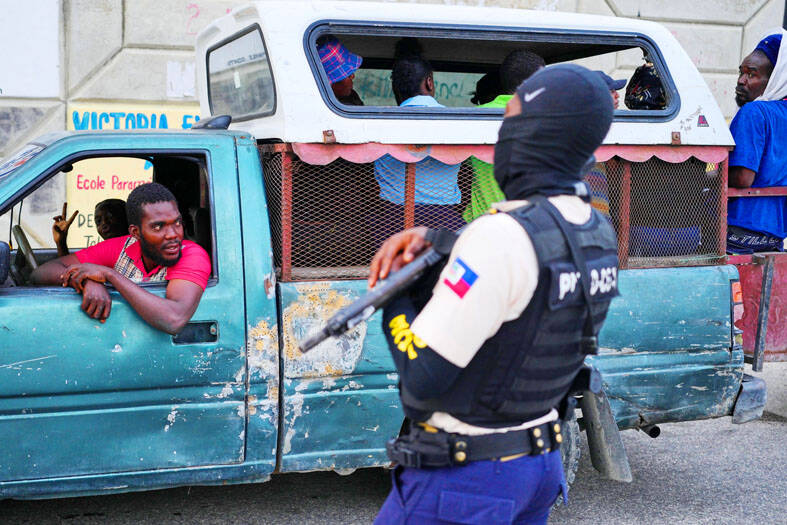
Photo: AP
The most lethal drone operation killed 57 people, HRW said.
“Haitian authorities should urgently rein in the security forces and private contractors working for them before more children die,” Juanita Goebertus, Americas director at Human Rights Watch, said in a statement.
A spokesperson for Haiti’s National Police did not respond to a request for comment.
The nonprofit said the number of armed drone attacks in Haiti’s capital, Port-au-Prince, which is 90 percent controlled by gangs, has “significantly increased” in the past few months, with 57 reported from November to late January, almost double that of the 29 attacks reported from August through October last year.
HRW said its researchers analyzed seven videos uploaded to social media or shared directly with the group that show armed quadcopter drones in action and geolocated four of them to Port-au-Prince.
“The videos show the repeated use of drones equipped with explosives to attack vehicles and people, some of them armed, but none who appear to be engaged in violent acts or pose any imminent threat to life,” the group said.
HRW said it did not find widespread drone use among criminal groups.
One of the attacks highlighted in the report occurred on Sept. 20 in the Simon Pele neighborhood, an extremely impoverished community controlled by a gang of the same name.
The drone attack killed nine people, including three children, and injured at least eight as the leader of the Simon Pele gang prepared to distribute gifts to children in the area.
Human Rights Watch quoted one unnamed resident recalling how the explosion ripped both feet off a baby.
Among those killed was a six-year-old girl, whose unidentified mother was quoted as saying: “In the spaces where the gangs are, there are innocent people, people who raise their children, who follow normal paths.”
The families of those killed said the criminal group organized and controlled access to their funerals, HRW said.
“Some residents said that only people who accepted money or support from the criminal group had been allowed to attend the funeral,” the report said.
On Jan. 1 of this year, an unidentified woman was quoted as saying that she saw a drone fall and explode onto a truck that was transporting her cousin, killing her.
“Many of these attacks appear to be attempts to target and kill people in circumstances that amount to unlawful, extrajudicial killings,” HRW said.
“Authorities should also ensure transparency around and accountability for any unlawful death resulting from a security operation, and conduct prompt, thorough and independent investigations to disclose, to the greatest extent possible, the number and identity of victims, and provide adequate reparation where violations have occurred,” the rights group added.
UN High Commissioner for Human Rights Volker Turk has said that the use of lethal force against gangs in Haiti was unnecessary, disproportionate and likely a violation of international law.
Last year, Haiti’s government created a new task force that has operated outside the oversight of Haiti’s National Police and employed the use of explosive drones. The task force is made up of certain police units and private contractors.
In the middle of last year, Vectus Global, the security firm of former US Navy Seal Erik Prince, expected to deploy nearly 200 personnel from various countries to Haiti as part of a one-year deal to quell gang violence there.
Haitian police also are working alongside a UN-backed mission led by Kenyan police that remains underfunded and understaffed. It is soon expected to transform into a so-called gang suppression force in upcoming months.
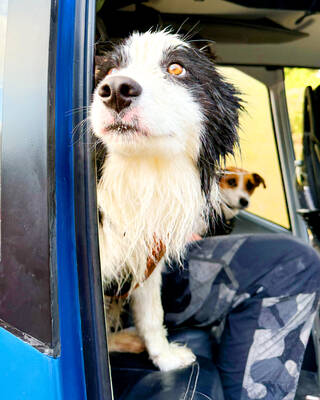
When a hiker fell from a 55m waterfall in wild New Zealand bush, rescuers were forced to evacuate the badly hurt woman without her dog, which could not be found. After strangers raised thousands of dollars for a search, border collie Molly was flown to safety by a helicopter pilot who was determined to reunite the pet and the owner. A week earlier, an emergency rescue helicopter found the woman with bruises and lacerations after a fall at a rocky spot at the waterfall on the South Island’s West Coast. She was airlifted on March 24, but they were forced to

CONFIDENCE BOOSTER: ’After parkour ... you dare to do a lot of things that you think only young people can do,’ a 67-year-old parkour enthusiast said In a corner of suburban Singapore, Betty Boon vaults a guardrail, crawls underneath a slide, executes forward shoulder rolls and scales a steep slope, finishing the course to applause. “Good job,” the 69-year-old’s coach cheers. This is “geriatric parkour,” where about 20 retirees learned to tackle a series of relatively demanding exercises, building their agility and enjoying a sense of camaraderie. Boon, an upbeat grandmother, said learning parkour has aided her confidence and independence as she ages. “When you’re weak, you will be dependent on someone,” she said after sweating it out with her parkour classmates in suburban Toa Payoh,

Chinese dissident artist Gao Zhen (高兟), famous for making provocative satirical sculptures of former Chinese leader Mao Zedong (毛澤東), was tried on Monday over accusations of “defaming national heroes and martyrs,” his wife and a rights group said. Gao, 69, who was detained in 2024 during a visit from the US, faces a maximum three-year prison sentence, said his wife, Zhao Yaliang (趙雅良), and Shane Yi, a researcher at the Chinese Human Rights Defenders group which operates outside the nation. The closed-door, one-day trial took place at Sanhe City People’s Court in Hebei Province neighboring the capital, Beijing, and ended without a

‘TOXIC CLIMATE’: ‘I don’t really recognize Labour anymore... The idea that you can implement far-right ideas in order to stop the far right is nonsense,’ a protester said Tens of thousands of people on Saturday marched through central London to protest against the far right, weeks ahead of local elections and six months after Britain saw one of its largest far-right demonstrations. Organized by hundreds of civic groups, including trade unions, anti-racism campaigners and Muslim representative bodies, Saturday’s Together Alliance event was billed as the biggest in UK history to counter right-wing extremism. A separate pro-Palestinian march had also converged with the main rally. While organizers claimed 500,000 had turned out in total, the police gave a figure of about 50,000. Protesters carrying placards with slogans such as


 RSS
RSS