


EU member states and lawmakers on Thursday agreed to ban using meat-related terms such as “steak” and “bacon” to market plant-based foods — but spared veggie “burgers” and “sausages.”
The decision is a win for Europe’s livestock farmers, many of whom said that plant-based foods which mimic meat are potentially misleading for consumers, threatening their already troubled sector.
Celine Imart, a cereal farmer and right-wing lawmaker from France who sponsored the plan, hailed the deal as an “undeniable success.”
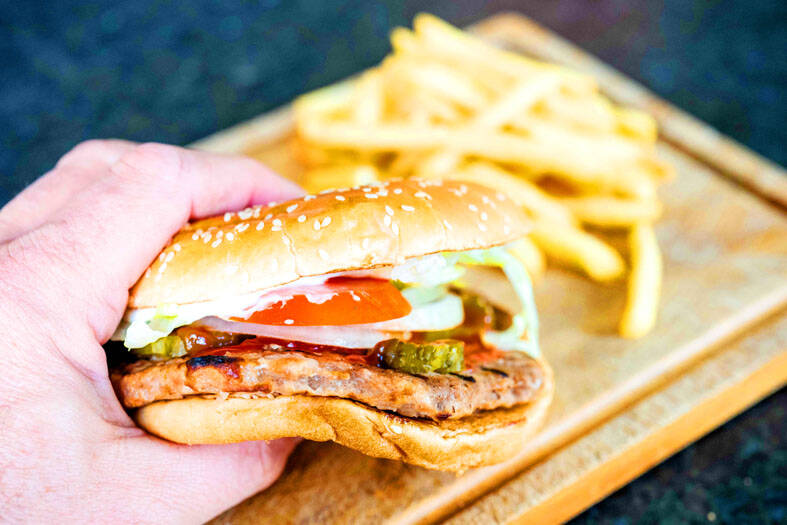
Photo: APA / AFP
It “recognizes the value of livestock farmers’ work and protects their products, fruits of unique know-how, against a form of unfair competition,” she said.
The ban, which applies also to laboratory-grown or cell-based “meat,” was agreed as part of a broad-ranging package of new measures to protect farmers, after months of wrangling, with critics questioning its usefulness.
Food retailers in Germany, Europe’s largest market for plant-based alternative products, had spoken out against it, along with environmentalists and consumer advocates.
“Arguing that these meaty names create confusion amongst consumers is nonsense,” European Consumer Organization (BEUC) director-general Agustin Reyna said, adding that most people agreed with the terms as long as products were clearly labeled vegetarian or vegan.
Representatives for the EU’s 27 member states and the European Parliament nevertheless decided to move ahead with some exceptions.
“This agreement represents a meaningful step toward fairer and more resilient agricultural markets,” Cyprus Minister of Agriculture, Rural Development and Environment Maria Panayiotou said.
“Burger” and “sausage” survived the chop, as did “escalope.”
“Veal,” “pork,” “chicken,” “turkey,” “duck” and “lamb” were less lucky — as well as “meat.”
The full list of banned terms also included: beef, poultry, goose, mutton, ovine, goat, drumstick, tenderloin, sirloin, flank, loin, steak, ribs, shoulder, shank, chop, wing, breast, liver, thigh, brisket, ribeye, T-bone and rump.
EU consumption of plant-based alternatives has grown five-fold since 2011, BEUC said.
Concerns over animal welfare and greenhouse gas emissions by livestock farms, as well as health arguments have fueled the boom.
“Fortunately, the conservative word police have failed to ban the ‘veggie burger,’” lawmaker Anna Strolenberg said. “Unfortunately, a number of other words still end up on the blacklist. That’s a shame, Europe should be backing innovative entrepreneurs, not putting new obstacles in their way.”

An American scientist convicted of lying to US authorities about payments from China while he was at Harvard University has rebuilt his research lab in Shenzhen, China, to pursue technology the Chinese government has identified as a national priority: embedding electronics into the human brain. Charles Lieber, 67, is among the world’s leading researchers in brain-computer interfaces. The technology has shown promise in treating conditions such as amyotrophic lateral sclerosis and restoring movement in paralyzed people. It also has potential military applications: Scientists at the Chinese People’s Liberation Army have investigated brain interfaces as a way to engineer super soldiers by boosting

Indonesian police have arrested 13 people after shocking images of alleged abuse against small children at a daycare center went viral, sparking outrage across the nation, officials said on Monday. Police on Friday last week raided Little Aresha, a daycare center in Yogyakarta on Java island, following a report from a former employee. CCTV footage circulating on social media showed children, most younger than two, lying on the floor wearing only diapers, their hands and feet bound with rags. The police have confirmed that the footage is authentic. Police said they also found 20 children crammed into a room just 3m by 3m. “So
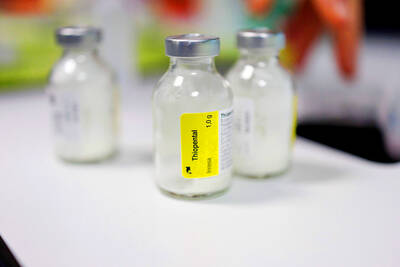
A grieving mother has ended her life at a clinic in Switzerland four years after the death of her only child. Wendy Duffy, 56, a physically healthy woman, died at the Pegasos clinic in Basel after struggling to cope with the death of her 23-year-old son, Marcus. The former care worker, from the West Midlands, England, had previously attempted to take her own life. The case comes as assisted dying would not become law in England and Wales after proposed legislation, branded “hopelessly flawed” by opponents, ran out of time. Ruedi Habegger, the founder of Pegasos, described Duffy’s death as

From post offices and parks to stations and even the summit of Mount Fuji, Japan’s vending machines are ubiquitous, but with the rapid pace of inflation cooling demand for their drinks, operators are being forced to rethink the business. Last month beverage giant DyDo Group Holdings announced it would remove about 20,000 vending machines — about 7 percent of their stock nationwide — by January next year, to “reconstruct a profitable network.” Pokka Sapporo Food & Beverage, based in Nagoya, also said last month it would sell its 40,000-machine operation to Osaka-based Lifedrink Co. “The strength of the vending machine


 RSS
RSS