


A blackout on Wednesday left millions of people without power in Havana and the rest of western Cuba in the latest outage in the nation, which is struggling with dwindling oil reserves and a crumbling electricity grid.
Cuban government radio station Radio Rebelde quoted an energy official as saying that it could take at least 72 hours to restore operations at one of Cuba’s largest thermoelectric power plants, where a shutdown sparked the outage.
The government’s electric utility on X said that the outage affected people from the western town of Pinar del Rio to the central town of Camaguey.
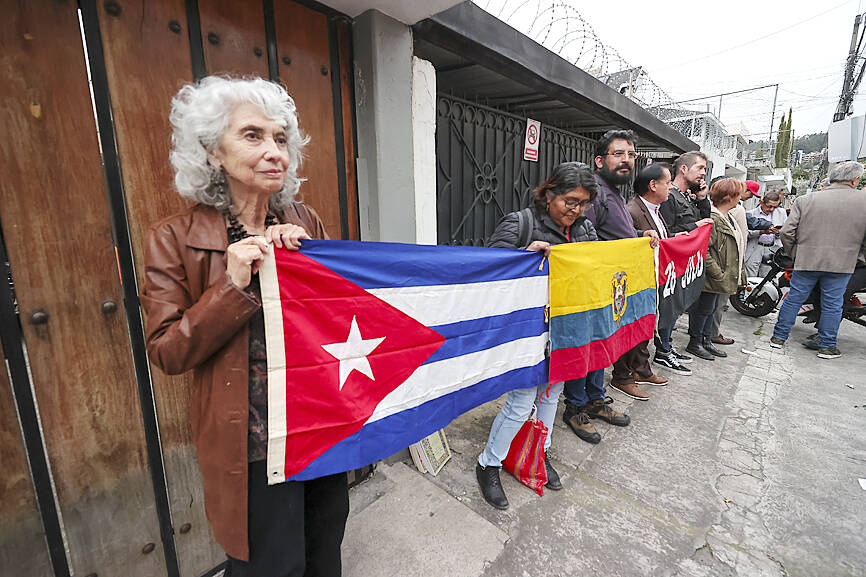
Photo: EPA
Cuban Minister of Energy and Mines Vicente de la O Levy wrote on X that the government was powering critical infrastructure in the affected region as two power plants came online.
Such infrastructure includes hospitals and medical clinics.
“We are working to restore the National Electric System amid a complex energy situation,” he wrote earlier on X.
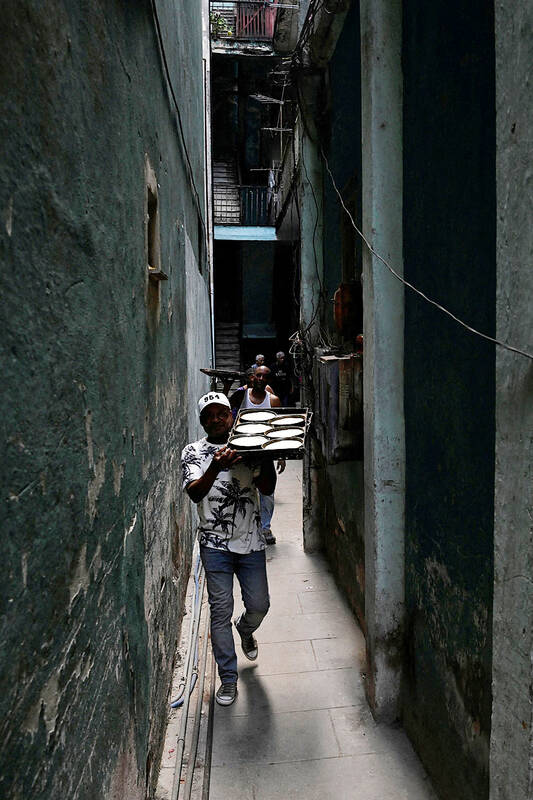
Photo: Reuters
The US embassy warned people to “prepare for significant disruptions,” and conserve fuel, water, food and mobile phone batteries.
“Cuba’s national power grid is increasingly unreliable, and scheduled and unscheduled power outages are prolonged and a daily occurrence across the country, including Havana,” it said on X.
By late afternoon, the government said that crews had restored power to 2.5 percent of Havana, or about 21,100 customers, adding that efforts were gradual and tied to what the system’s conditions would allow.
“We trust in the experience and effort of the electrical workers to overcome this situation in the shortest possible time,” Cuban Prime Minister Manuel Marrero Cruz wrote on X.
As night fell, people across Havana lingered on doorsteps and used wood or charcoal to prepare caldosas, a popular soup shared among neighbors who contribute items including vegetables, chicken and meat.
A group of musicians along the city’s seawall played into the night.
Others played dominoes by a rechargeable lightbulb.
“With the power outages, this is the only thing we young people have to distract ourselves,” Jeferson Silvera said.
State media reported that the outage was caused by a shutdown of the Antonio Guiteras thermoelectric power plant east of Havana following a leak in its boiler.
Radio Rebelde quoted the plant’s technical director Roman Perez Castaneda as saying that crews must first locate the fault before repairing it and restarting the unit.
Castaneda said that a pipe burst in the boiler, causing a water leak and subsequent fire that was extinguished without major damage, Radio Rebelde reported.
In other news, more than 150 Cuban medical staff climbed aboard a plane in Honduras on Wednesday, leaving the Central American country after its new government abruptly canceled an agreement that US Secretary of State Marco Rubio has called a “form of human trafficking.”
Cuba describes its practice of deploying doctors as a means of diplomacy, but medical workers departed from an airport in San Pedro Sula, Honduras, on their way to Havana after the Honduran government said the program did not meet the requirements established by internal regulators.
“The agreement was suspended after considering what is in Honduras’ best interest, because this was not a solidarity medical brigade, but a business,” Honduran Medical Association president Samuel Santos told reporters.
Santos said the work of the Cuban medical staff would be taken over by Honduran doctors and that their absence “does not affect the development of healthcare in Honduras in any way.”
Meanwhile, Ecuador on Wednesday ordered the expulsion of Cuba’s ambassador to Quito, telling him and the rest of his embassy staff that they had 48 hours to leave the country.
The Ecuadoran Ministry of Foreign Affairs declared Basilio Gutierrez persona non grata, but did not offer a specific reason for the decision.
The Cuban Ministry of Foreign Affairs called the dismissal an “unfriendly and unprecedented act that seriously damages the history of friendly and cooperative ties between the two countries.”
“It does not seem accidental that this decision was made in a context marked by a strengthening of US aggression against Cuba, and by strong pressure applied by that government on third countries to join this policy,” it added.
Additional reporting by AFP

An American scientist convicted of lying to US authorities about payments from China while he was at Harvard University has rebuilt his research lab in Shenzhen, China, to pursue technology the Chinese government has identified as a national priority: embedding electronics into the human brain. Charles Lieber, 67, is among the world’s leading researchers in brain-computer interfaces. The technology has shown promise in treating conditions such as amyotrophic lateral sclerosis and restoring movement in paralyzed people. It also has potential military applications: Scientists at the Chinese People’s Liberation Army have investigated brain interfaces as a way to engineer super soldiers by boosting
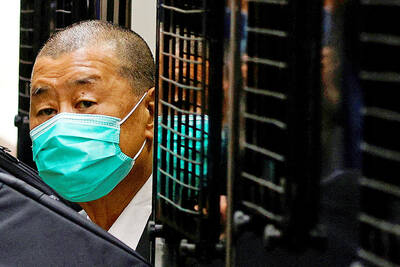
Jailed media entrepreneur Jimmy Lai (黎智英) has been awarded Deutsche Welle’s (DW) freedom of speech award for his contribution to Hong Kong’s pro-democracy movement. The German public broadcaster on Thursday said Lai would be presented in absentia with the 12th iteration of the award on June 23 at the DW Global Media Forum in Bonn. Deutsche Welle director-general Barbara Massing praised the 78-year-old founder of the now-shuttered news outlet Apple Daily for standing “unwaveringly for press freedom in Hong Kong at great personal risk.” “With Apple Daily, he gave journalists a platform for free reporting and a voice to the democracy movement in
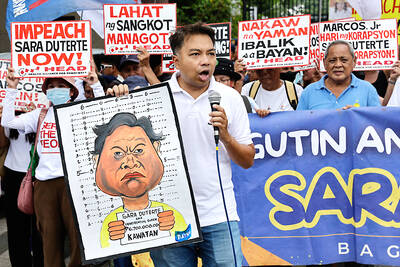
PHILIPPINE COMMITTEE: The head of the committee that made the decision said: ‘If there is nothing to hide, there is no reason to hide, there is no reason to obstruct’ A Philippine congressional committee on Wednesday ruled that there was “probable cause” to impeach Philippine Vice President Sara Duterte after hearing allegations of unexplained wealth, misuse of state funds and threats to have the president assassinated. The unanimous decision of the 53-member committee in the Philippine House of Representatives sends the two impeachment complaints to deliberations and voting by the entire lower chamber, which has more than 300 lawmakers. The complaints centered on Duterte’s alleged illegal use and mishandling of intelligence funds from the vice president’s office, and from her time as education secretary under Philippine President Ferdinand Marcos Jr. Duterte and the

Burmese President Min Aung Hlaing yesterday cut all prisoners’ sentences by one-sixth, a blanket measure that a source close to deposed leader Aung San Suu Kyi said would further shorten her detention. Aung San Suu Kyi has been sequestered since a 2021 military coup, but the senior member of her dissolved National League for Democracy (NLD) party said that while her term had been reduced, her remaining sentence is still unclear. “We also don’t know exactly how many years she has left,” the source told reporters, speaking on condition of anonymity for security reasons. The military toppled Aung San Suu Kyi’s elected government


 RSS
RSS