


The Venezuelan National Assembly on Thursday unanimously approved a long-awaited amnesty law that could free hundreds of political prisoners jailed for being government detractors.
However, the law excludes those who have been prosecuted or convicted of promoting military action against the country — which could include opposition leaders such as Nobel Peace Prize winner Maria Corina Machado, who has been accused by the ruling party of calling for international intervention such as the one that ousted former Venezuelan president Nicolas Maduro.
The bill was signed by Venezuelan interim president Delcy Rodriguez, who pushed for the legislation under pressure from Washington, after she rose to power following Maduro’s capture during a US military raid on Jan. 3.
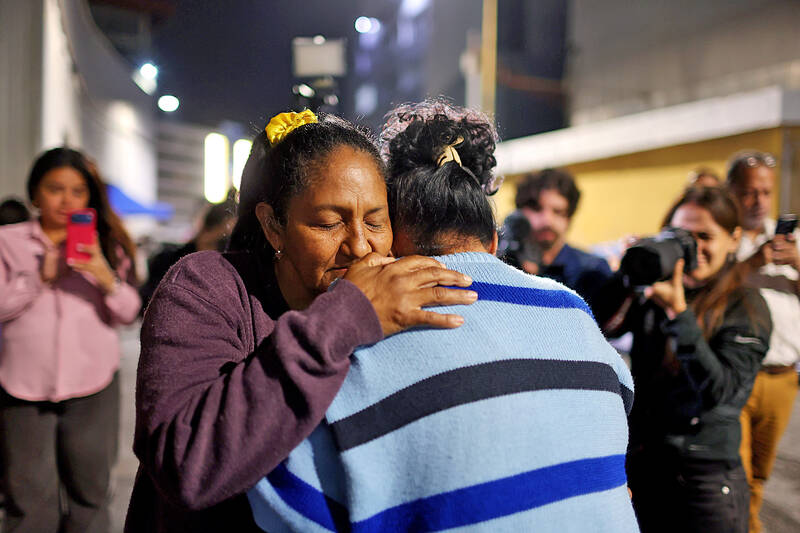
Photo: EPA
“One must know how to ask for forgiveness and one must also know how to receive forgiveness,” Rodriguez said after signing the bill into law.
In one of the first releases after the bill passed, Machado ally and former National Assembly vice president Juan Pablo Guanipa announced his release from detention after about nine months in prison and under house arrest.
“After 10 months in hiding and almost nine months of unjust imprisonment, I confirm that I am now completely free,” Guanipa wrote on social media.
He called for all other political prisoners to be freed and exiles allowed to return, criticizing the law as not an amnesty, but a “flawed document” that excludes some Venezuelans who remain behind bars.
“I thank all Venezuelans for fighting for my release and that of all political prisoners,” he wrote.
The law is meant to apply retroactively to 1999 — including the coup against former Venezuelan president Hugo Chavez, the 2002 oil strike and the 2024 riots against Maduro’s disputed re-election — giving hope to families that loved ones would finally come home.
However, some fear the law could be used by the government to pardon its own and selectively deny freedom to real prisoners of conscience.
Article 9 of the bill lists those excluded from amnesty as “persons who are being prosecuted or may be convicted for promoting, instigating, soliciting, invoking, favoring, facilitating, financing or participating in armed actions, or the use of force against the people, sovereignty and territorial integrity” of Venezuela “by foreign states, corporations or individuals.”
The Venezuelan National Assembly had delayed several sittings meant to pass the amnesty bill.
“The scope of the law must be restricted to victims of human rights violations and expressly exclude those accused of serious human rights violations and crimes against humanity, including state, paramilitary and non-state actors,” UN human rights experts said in a statement.

Heavy rain and strong winds yesterday disrupted flights, trains and ferries, forcing the closure of roads across large parts of New Zealand’s North Island, while snapping power links to tens of thousands. Domestic media reported a few flights had resumed operating by afternoon from the airport in Wellington, the capital, although cancelations were still widespread after airport authorities said most morning flights were disrupted. Air New Zealand said it hoped to resume services when conditions ease later yesterday, after it paused operations at Wellington, Napier and Palmerston North airports. Online images showed flooded semi-rural neighborhoods, inundated homes, trees fallen on vehicles and collapsed
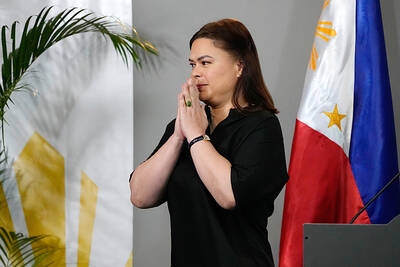
‘COST OF DEFECTION’: Duterte’s announcement could be an effort to keep allies in line with the promise of a return to power amid political uncertainty, an analyst said Philippine Vice President Sara Duterte yesterday announced she would run for president of the Southeast Asian nation of 116 million in 2028. Duterte, who is embroiled in a bitter feud with Philippine President Ferdinand Marcos Jr, was impeached last year only to see the country’s Supreme Court throw the case out over procedural issues. Her announcement comes just days before her father, former Philippine president Rodrigo Duterte, begins a pretrial hearing at the International Criminal Court (ICC) in the Netherlands over crimes against humanity allegedly committed as part of a brutal crackdown on drugs. “I offer my life, my strength and my future

NOT YET THERE: While the show was impressive, it failed to demonstrate their ability to move in unstructured environments, such as a factory floor, an expert said Dancing humanoid robots on Monday took center stage during the annual China Media Group’s Spring Festival Gala, China’s most-watched official television broadcast. They lunged and backflipped (landing on their knees), they spun around and jumped. Not one fell over. The display was impressive, but if robots can now dance and perform martial arts, what else can they do? Experts have mixed opinions, with some saying the robots had limitations and that the display should be viewed through a lens of state propaganda. Developed by several Chinese robotics firms, the robots performed a range of intricate stunts, including martial arts, comedy sketches and choreographed
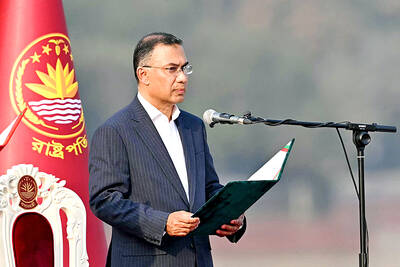
POST-UPRISING: Bangladesh Nationalist Party lawmakers were yesterday expected to formally elect Tarique Rahman as their leader and new head of government Bangladesh’s prime minister-to-be Tarique Rahman and lawmakers were yesterday sworn into parliament, becoming the first elected representatives since a deadly 2024 uprising. Rahman is set to take over from an interim government that has steered the country of 170 million people for 18 months since the autocratic government of Sheikh Hasina was overthrown. The lawmakers, who promised loyalty to Bangladesh, were sworn in by Chief Election Commissioner AMM Nasir Uddin. Bangladesh Nationalist Party (BNP) lawmakers are expected to formally elect Rahman as their leader, with President Mohammed Shahabuddin then to administer the oath of office to the prime minister and his ministers


 RSS
RSS