


A general strike protesting Argentine President Javier Milei’s flagship overhaul of the country’s labor law disrupted public transport, hospitals, ports and schools across Argentina on Thursday, and intensified a standoff between the libertarian leader and long-powerful workers’ unions.
The lower house of the Argentine Congress yesterday approved the bill, which grants employers greater flexibility in matters of hiring, firing, severance and collective bargaining, in a 135-115 vote.
As lawmakers debated the reform, bus lines and subways ground to a halt. Factories paused production, banks closed, airlines canceled hundreds of flights and public hospitals postponed all but emergency surgeries. Uncollected garbage lined streets and shopping areas.
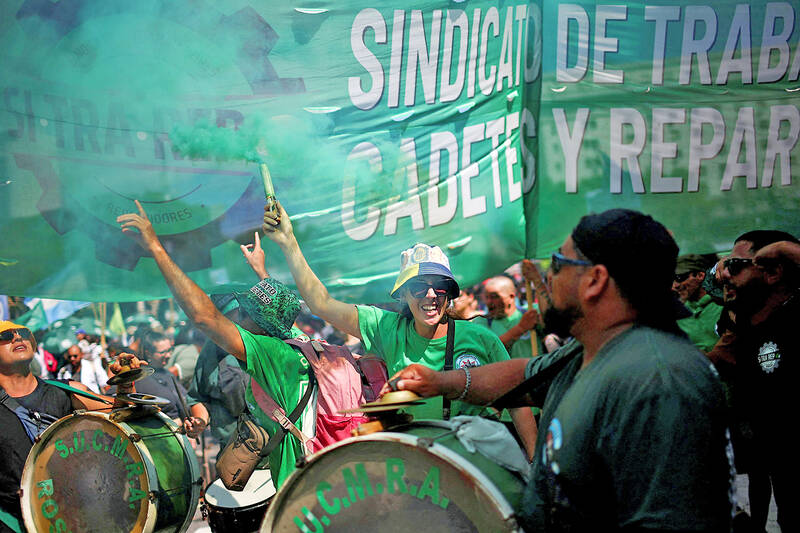
Photo: Reuters
A march to the Argentine Congress by radical left-wing unions briefly turned violent as police fired water canons at protesters throwing stones and bottles.
Milei considered the changes to Argentina’s half-century-old labor code crucial to his efforts to lure foreign investment, increase productivity and boost job creation.
Unions said the law would weaken the workers’ protections that have defined Argentina.
The bill limits the right to strike, reduces the bargaining power of unions and makes it easier for companies to fire workers by extending their probation periods and curbing their ability to sue employers when they are dismissed.
The legislation also cuts Argentina’s traditionally high severance pay and empowers employers to mandate 12-hour workdays, up from eight.
Fierce union backlash has derailed previous government attempts at shaking up Argentina’s archaic labor system, widely seen as among the most costly to companies in Latin America.
“Members of Congress, hear this message: Voting against working people does not come without consequences,” the General Confederation of Labor, Argentina’s largest trade union group, wrote on social media, alongside photos showing Buenos Aires deserted because of the strike. “Jobs are not up for negotiation; hard-won gains are not raffle prizes to be given away.”
The show of force from labor unions comes as economic frustration simmers. Milei’s drastic campaign to slash the size of the state has brought fiscal stability to a nation once plagued by runaway inflation, but struggled to address stubborn unemployment, stagnant wages and sluggish growth.
“To grow, we need more than just labor legislation. We need infrastructure, energy, universities,” Argentine lawmaker Pablo Outes said, criticizing the uneven economic recovery under Milei even as he endorsed the labor bill. “Milei’s model is failing. It is showing cracks.”

Crowds in Bangladesh are flocking to snap photographs with an unlikely social media star — an albino buffalo with flowing blond hair nicknamed “Donald Trump” that is due to be sacrificed within days. Owner Zia Uddin Mridha, 38, said his brother named the 700kg bull over its flowing helmet of hair resembling the signature look of the US president. “My younger brother picked this name because of the buffalo’s extraordinary hair,” he said at his farm in Narayanganj, just outside the capital, Dhaka. Mridha said that a constant stream of curious visitors — social media fans, onlookers and children — have come throughout

It began as a satirical online project. Now millions of young people in India are flocking to it as an outlet for their frustration. A parody political party called the Cockroach Janta Party, with the insect as its symbol, has exploded across India’s social media by turning absurdist humor into protest. Memes and short videos mocking corruption, joblessness and political dysfunction have flooded social media sites, where millions of users are embracing the cockroach — known for its ability to survive harsh conditions — as a tongue-in-cheek symbol of endurance. The online movement’s rise has been unusually rapid. The Cockroach Janta Party (CJP)
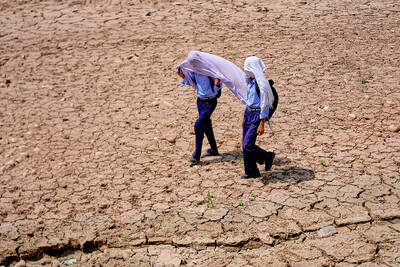
HOTTER: While Indians are accustomed to summer heat, climate change has caused northwestern India to warm faster than other parts of the country, an academic said Roads and markets have emptied during afternoons and some farmers have switched to nighttime work to avoid scorching temperatures as a heat wave grips large parts of India. The India Meteorological Department forecast maximum temperatures for yesterday of about 45°C in the capital, New Delhi, where authorities have opened temporary “cooling zones” to help people cope. The weather department warned that conditions would likely persist across several northern regions in the coming days, with temperatures staying well above seasonal averages. Authorities urged people to stay indoors during the hottest hours and take precautions against heat-related illnesses. India declares a heat wave whenever maximum temperatures
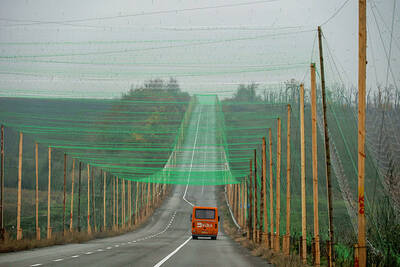
BIGGER ROLE: Beijing has said it maintains an impartial stance on the war in Ukraine, but by training Russian troops, China is far more involved than previously known China’s armed forces secretly trained about 200 Russian military personnel in China late last year, and some have since returned to fight in Ukraine, according to three European intelligence agencies and documents seen by Reuters. While China and Russia have held a number of joint military exercises since Moscow’s full-scale invasion of Ukraine in 2022, Beijing has repeatedly said that it is neutral in the conflict and presents itself as a peace mediator. The covert training sessions, which predominantly focused on the use of drones, were outlined in a dual-language Russian-Chinese agreement signed by senior Russian and Chinese officers in Beijing on


 RSS
RSS