


The kimono, that elaborate, delicate wrap-around garment worn by geisha and samurai from centuries back, is getting a vibrant remake, appreciated these days for a virtue that is more relevant than ever: sustainability.
A genuine silk kimono lasts a hundred years or more. In a Japanese family, it is handed down over generations like heirloom jewelry, artworks and military medals.
It never goes out of style.
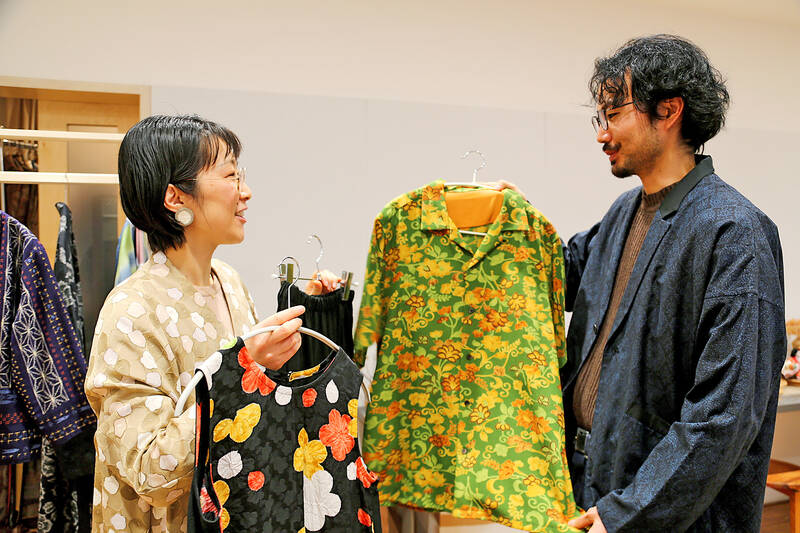
Photo: AP
The design of the kimono and accompanying obi sash has remained basically the same since the 17th-century Edo period depicted in Akira Kurosawa samurai movies.
Today, some people are taking a different creative approach, refashioning the traditional kimono, and also taking apart and resewing them as jackets, dresses and pants.
“I noticed that a lot of beautiful kimono is just sleeping in people’s closets. That’s such a waste,” said Mari Kubo, who heads a kimono-remake business called K’Forward, pronounced “K dash forward.”
Hers is among a recent surge in such services, which also turn old kimono into tote bags and dolls.
The most popular among Kubo’s products are tomesode, a type of formal kimono that is black with colorful, embroidered flowers, birds or foliage at the bottom.
She also creates matching sets. A tomesode is turned into a jacket with its long, flowing sleeves intact, and its intricate patterns placed at the center in the back. She then takes a kimono with a matching pattern to create a skirt or pants to go with the top. Sometimes, an obi is used at the collar to add a pop of color.
A remade kimono at K’Forward could cost as much as ¥160,000 (US$1,032) for a furisode, a colorful kimono with long sleeves meant for young unmarried women, while a black tomesode goes for about ¥25,000.
What designer Tomoko Ohkata loves most about the products she designs using old kimonos is that she does not have to live with a guilty conscience, and instead feels she is helping solve an ecological problem.
“I feel the answer was right there, being handed down from our ancestors,” she said.
Recycling venues in Japan get thousands of old kimonos a day as people find them stashed away in closets by parents and grandparents. These days, Japanese generally wear kimonos just for special occasions such as weddings. Many women prefer to wear a Western-style white wedding dress rather than the kimono, or they wear both.
Many of Ohkata’s clientele are people who have found a kimono at home and want to give it new life.
Her small store in downtown Tokyo displays various dolls, including a samurai paired with his wife, who are traditionally brought out for display in Japanese homes for the Girls’ Day festival every March 3. Her dolls are exquisitely dressed in recycled kimonos, tailored in tiny sizes to fit the dolls. They sell for ¥45,000 a pair.
The original old-style kimono is also getting rediscovered.
“Unlike the dress, you can arrange it,” said Nao Shimizu, who heads a school in Kyoto that teaches people how to wear a kimono and how to carry oneself while wearing it.
“In half a year, you can learn how to do it all by yourself,” she said, demonstrating several ways to tie the obi to express different moods, from playful to understated.
Besides its durability, that versatility also makes the kimono sustainable, Shimizu said.
Younger Japanese are taking a more relaxed view, wearing a kimono with boots, for instance, Shimizu added.
Traditionally, kimono is worn with sandals called zori.
Most Japanese might wear a kimono just a few times in their lives, but wearing one is a memorable experience.
Singer Sumie Kaneko often performs wearing flashy dresses made of recycled kimonos.
The idea of sustainability is deeply rooted in Japanese culture, she said, adding that the ivory and animal hide used in her musical instruments are now hard to obtain.
She called it “the recycling of life.”
“The performer breathes new life into them,” Kaneko said. “In the same way, a past moment — and those patterns and colors that were once loved — can come back to life.”

Kouri Richins, a Utah mother who published a children’s book about grief after the death of her husband is to serve a life sentence for his murder without the possibility of parole, a judge ruled on Wednesday. Richins was convicted in March of aggravated murder for lacing a cocktail given to her husband, Eric Richins, with five times the lethal dose of fentanyl at their home near Park City in 2022. A jury also found her guilty of four other felonies, including insurance fraud, forgery and attempted murder for trying to poison her husband weeks earlier on Feb. 14, 2022, with a

DELA ROSA CASE: The whereabouts of the senator, who is wanted by the ICC, was unclear, while President Marcos faces a political test over the senate situation Philippine authorities yesterday were seeking confirmation of reports that a top politician wanted by the International Criminal Court (ICC) had fled, a day after gunfire rang out at the Philippine Senate where he had taken refuge fearing his arrest. Senator Ronald “Bato” dela Rosa, the former national police chief and top enforcer of former Philippine president Rodrigo Duterte’s “war on drugs,” has been under Senate protection and is wanted for crimes against humanity, the same charges Duterte is accused of. “Several sources confirmed that the senator, Senator Bato, is no longer in the Senate premises, but we are still getting confirmation,” Presidential

HELP DENIED? The US Department of State said that the Cuban leadership refuses to allow the US to provide aid to Cubans, ‘who are in desperate need of assistance’ US Secretary of State Marco Rubio on Wednesday said that Cuba’s leadership must change, as Washington renewed an offer of US$100 million in aid if the communist nation agrees to cooperate. Cuba has been suffering severe economic tumult led by an energy shortage that plunged 65 percent of the country into darkness on Tuesday. Cuba’s leaders have blamed US sanctions, but Rubio, a Cuban American and critic of the government established by Fidel Castro, said the system was to blame, including corruption by the military. “It’s a broken, nonfunctional economy, and it’s impossible to change it. I wish it were different,” he told

Myanmar yesterday published a parliamentary bill proposing the death sentence for those who detain or violently coerce people into working in online scam centers. Internet fraud factories have flourished in Myanmar, part of Southeast Asia’s scam economy, targeting Internet users worldwide with romance and cryptocurrency investment cons. The multibillion-dollar black market attracts many willing employees, but repatriated foreigners have also reported being trafficked to sites in Myanmar and tortured by scam center operators. The draft legislation would allow capital punishment for “violence, torture, unlawful arrest and detention, or cruel treatment against another person for the purpose of forcing them to commit online scams.” The


 RSS
RSS