


Spain is planning to build political and financial links to China as US President Donald Trump upends the global economic order.
The tactic is part of a new Asia-Pacific strategy that outlines Madrid’s priorities for the next three years. The document, which was released yesterday, calls for more high-level meetings and economic exchanges between Spain and China.
“Spain seeks to advance a positive and ambitious bilateral agenda with China, reinforcing the comprehensive strategic partnership as well as the excellent bilateral relationship,” the strategy says.
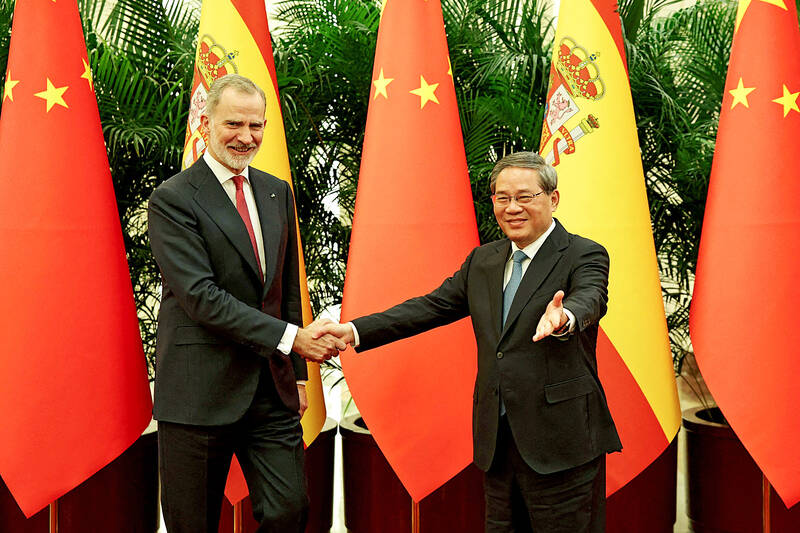
Photo: Reuters
The strategy reaffirms Spain’s position as Europe’s leader on efforts to deepen ties with China — and its willingness to rebuff warnings in doing so from the Trump administration. Last year, Spanish Prime Minister Pedro Sanchez traveled to Beijing just days after Trump announced tariffs on nearly every country, a move US Treasury Secretary Scott Bessent criticized as “cutting your own throat.”
“We maintain a good relationship with China; we work to ensure that this remains the case, given that it is a major global actor,” the Spanish government said in a statement regarding the strategy. “The same applies to the United States. This is consistent with our overall foreign policy, and in fact many European countries, such as France and the United Kingdom, are doing something similar.”
Sanchez is to visit China from April 13 to 15, marking his fourth appearance in more than three years.
Spain’s push to deepen its relationship with China not only risks irking the US, but even some of its European neighbors. While numerous European countries, including Germany, are seeking to stabilize ties with Beijing as the transatlantic partnership fractures, those same countries also increasingly see China as an economic rival that has undermined European manufacturing.
Madrid’s foreign policy calls on EU countries to “address in a coordinated manner the more structural dimensions of relations with actors the size of China and India, in particular those relating to the overall framework of economic and trade relations.”
Madrid wants to improve Spanish companies’ access to the Chinese market while also attracting investment in sectors such as automotive manufacturing and renewable energy. Spain runs a significant trade deficit with China.
“Since 2024, China has been Spain’s top supplier, ahead of Germany and France,” the strategy says.
Proposed measures in the document include “a strategic dialogue mechanism at the ministerial level to further strengthen and institutionalize the high-level exchanges of recent years.”
The strategy also says Spain is particularly interested in China’s rare earths industry, as well as scientific and cultural cooperation.
“Our strategy should be understood as complementary to European action towards our Asian partners,” the Spanish government said.

‘CROSSING THE LINE’: China’s embassy in Seoul criticized US Forces Korea Commander General Xavier Brunson, asking if his ‘hostile’ remarks were authorized by Washington South Korea and the US are in talks over recent public remarks by the commander of US Forces Korea, Seoul’s presidential office said yesterday, after the comments drew sharp criticism from China. In a recent podcast interview, US Forces Korea Commander General Xavier Brunson described South Korea as “the dagger in the heart of Asia” from China’s east coast, prompting the Chinese embassy in Seoul to say that he had “truly crossed the line.” The interview came amid growing speculation that Washington might seek to expand the role of US Forces Korea in countering the growing regional influence of China, a key

SEEKING ORDER: Rodrigo Paz said that ‘anyone who wants to destroy the nation will have to deal with this president and the full force of the constitution’ Bolivian President Rodrigo Paz on Wednesday said that the nation was at a “breaking point” after nearly a month of protests that have caused shortages of food, fuel and medicine. Paz, who took office six months ago amid the worst economic crisis there in four decades, is battling a groundswell of fury over his policies. The political capital, La Paz, has been besieged by low-income workers and members of the indigenous majority calling for his resignation. “The country needs order and is reaching breaking point,” the 58-year-old said at a public event in La Paz, renewing his appeal for dialogue. On Tuesday, the Bolivian

Through the noise of rushing papers and whirring belts at a print factory in Kyoto, two creators watch their photo essay come to life in broadsheet form — part of an effort to win new audiences in the age of artificial intelligence (AI). Despite the decline of the publishing industry, self-publication and handmade “zine” magazines are growing in popularity in Japan, reflecting the nation’s enduring love of paper in the digital era. While speaking to Agence France-Presse at the plant, his hands black with ink, one of the creators, Kazuma Obara, said: “I think [paper] is a medium that engages all five

Australian researchers have trained lab-grown brain cells on a silicon computer chip to play the 1990s shooter game Doom and said they are just scratching the surface of what the neurons could be capable of doing. It is the science-fiction work of biotech boffins at Cortical Labs, who researched and developed the technology that harnesses the workings of the brain’s networking system. Each so-called “biological computer” contains about 200,000 living human brain cells, grown from stem cells that were harvested from blood donations. Having mastered the simple computer game Pong, where a paddle is moved up and down to send a ball


 RSS
RSS