


Indian Prime Minister Narendra Modi on Thursday pitched his country as a central player in the global artificial intelligence (AI) ecosystem, saying it aims to build technology at home while deploying it worldwide.
“Design and develop in India. Deliver to the world. Deliver to humanity,” Modi said to world leaders, technology executives and policymakers at the India AI Impact Summit in New Delhi.
Modi’s remarks came as India — one of the fastest-growing digital markets — seeks to leverage its experience in building large-scale digital public infrastructure and to present itself as a cost-
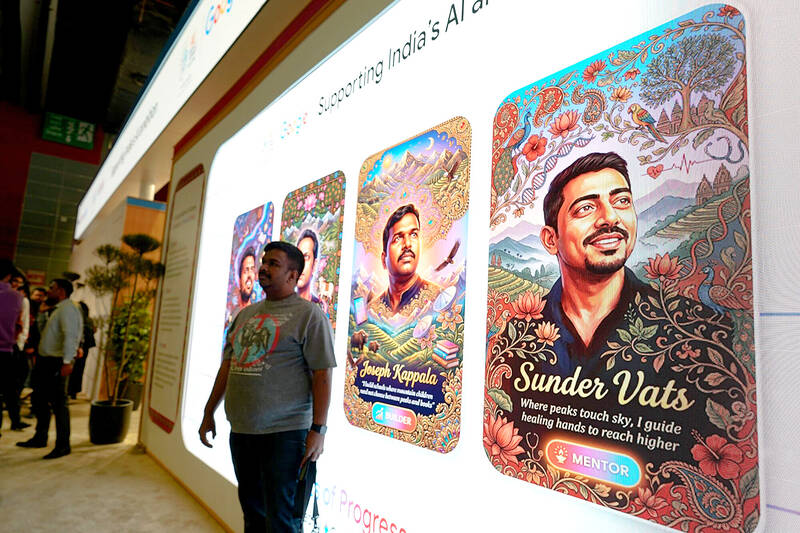
Attendees visit the Google pavilion at the AI Impact Summit in New Delhi, India, on Friday, Feb. 20, 2026. Photo: Bloomberg
effective hub for AI innovation.
The summit was also addressed by French President Emmanuel Macron, Google CEO Sundar Pichai and UN Secretary-General Antonio Guterres, who called for a US$3 billion fund to help poorer countries build basic AI capacity, including skills, data access and affordable computing power.
“The future of AI cannot be decided by a handful of countries, or left to the whims of a few billionaires,” Guterres said, stressing that AI must “belong to everyone.”
“We must democratize AI. It must become a tool for inclusion and empowerment, particularly for the Global South,” Modi said.
OpenAI CEO Sam Altman said the company would collaborate with India’s Tata Group on AI initiatives, including the development of data center infrastructure in the country.
“We believe the democratization of AI is the only fair and safe path forward,” Altman said at the meeting. A group photo with Modi, Altman and a dozen other tech leaders went viral when Modi invited everyone to hold and lift their hands together. Breaking the chain by not holding hands were Altman and Dario Amodei, the CEO of AI company Anthropic, which has been in a fierce rivalry with OpenAI. Altman later said he was confused about what was happening.
With nearly 1 billion internet users, India has become a key market for global technology companies expanding their AI businesses.
In December last year, Microsoft announced a US$17.5 billion investment over four years to expand cloud and AI infrastructure in India. It followed Google’s US$15 billion investment over five years, including plans for its first AI hub in the country. Amazon has also pledged US$35 billion by 2030, targeting AI-driven digitization.
India is also seeking up to US$200 billion in data center investment in the coming years.
However, the country lags in developing its own large-scale AI model like US-based OpenAI or China’s DeepSeek, highlighting challenges such as limited access to advanced semiconductor chips, data centers and hundreds of local languages to learn from.
The summit opened Monday with organizational glitches, as attendees and exhibitors reported long lines and delays, and some complained on social media that personal belongings and display items had been stolen.
A private Indian university was expelled from the summit on Wednesday after a staff member showcased a commercially available Chinese-made robotic dog while claiming it as the institution’s own innovation.
The setbacks continued on Thursday when Microsoft co-founder Bill Gates withdrew from a scheduled keynote address. No reason was given, though the Gates Foundation said the move was intended “to ensure the focus remains on the AI Summit’s key priorities.”
Gates is facing questions over his ties to late sex offender Jeffrey Epstein.
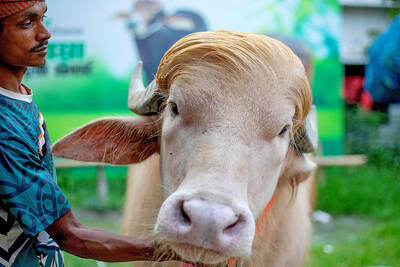
Crowds in Bangladesh are flocking to snap photographs with an unlikely social media star — an albino buffalo with flowing blond hair nicknamed “Donald Trump” that is due to be sacrificed within days. Owner Zia Uddin Mridha, 38, said his brother named the 700kg bull over its flowing helmet of hair resembling the signature look of the US president. “My younger brother picked this name because of the buffalo’s extraordinary hair,” he said at his farm in Narayanganj, just outside the capital, Dhaka. Mridha said that a constant stream of curious visitors — social media fans, onlookers and children — have come throughout

It began as a satirical online project. Now millions of young people in India are flocking to it as an outlet for their frustration. A parody political party called the Cockroach Janta Party, with the insect as its symbol, has exploded across India’s social media by turning absurdist humor into protest. Memes and short videos mocking corruption, joblessness and political dysfunction have flooded social media sites, where millions of users are embracing the cockroach — known for its ability to survive harsh conditions — as a tongue-in-cheek symbol of endurance. The online movement’s rise has been unusually rapid. The Cockroach Janta Party (CJP)
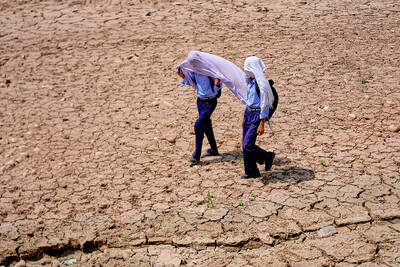
HOTTER: While Indians are accustomed to summer heat, climate change has caused northwestern India to warm faster than other parts of the country, an academic said Roads and markets have emptied during afternoons and some farmers have switched to nighttime work to avoid scorching temperatures as a heat wave grips large parts of India. The India Meteorological Department forecast maximum temperatures for yesterday of about 45°C in the capital, New Delhi, where authorities have opened temporary “cooling zones” to help people cope. The weather department warned that conditions would likely persist across several northern regions in the coming days, with temperatures staying well above seasonal averages. Authorities urged people to stay indoors during the hottest hours and take precautions against heat-related illnesses. India declares a heat wave whenever maximum temperatures
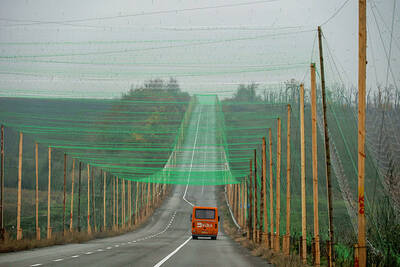
BIGGER ROLE: Beijing has said it maintains an impartial stance on the war in Ukraine, but by training Russian troops, China is far more involved than previously known China’s armed forces secretly trained about 200 Russian military personnel in China late last year, and some have since returned to fight in Ukraine, according to three European intelligence agencies and documents seen by Reuters. While China and Russia have held a number of joint military exercises since Moscow’s full-scale invasion of Ukraine in 2022, Beijing has repeatedly said that it is neutral in the conflict and presents itself as a peace mediator. The covert training sessions, which predominantly focused on the use of drones, were outlined in a dual-language Russian-Chinese agreement signed by senior Russian and Chinese officers in Beijing on


 RSS
RSS