


More than 75,000 people were killed in the first 16 months of the two-year war in Gaza, at least 25,000 more than the death toll announced by local authorities at the time, a study published on Wednesday in the Lancet Global Health medical journal showed.
The research also found that reporting by the Gaza health ministry about the proportion of women, children and elderly people among those killed was accurate.
A total of 42,200 women, children and elderly people died between Oct. 7, 2023, when Hamas launched a surprise attack into Israel that prompted a devastating Israeli offensive into Gaza, and Jan. 5 last year, the study found.
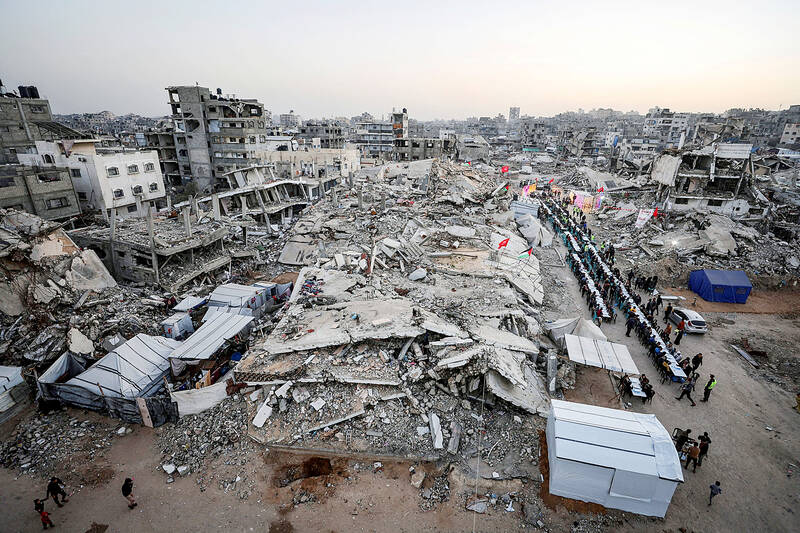
Photo: Reuters
The deaths comprised 56 percent of violent deaths in Gaza.
“The combined evidence suggests that, as of Jan 5., 2025, 3 to 4 percent of the population of the Gaza Strip had been killed violently and there have been a substantial number of nonviolent deaths caused indirectly by the conflict,” the authors of the study, a team including an economist, demographer, epidemiologist and survey specialists.
The exact death toll in Gaza has been bitterly disputed, although last month a senior Israeli security officer told Israeli journalists that figures compiled by health authorities in Gaza were broadly accurate, marking a U-turn after years of official attacks on the data.
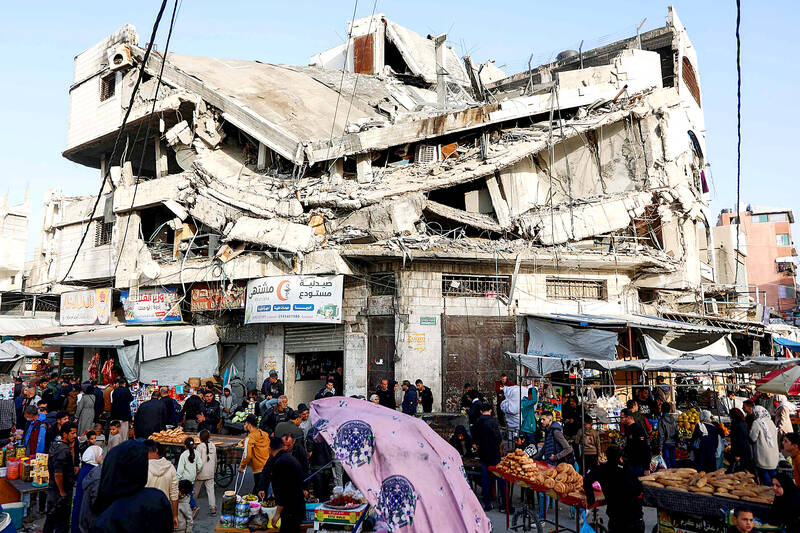
The officer was quoted as saying that about 70,000 Palestinians had been killed by Israeli attacks on the territory since October 2023, excluding those missing.
Gaza health authorities say the direct toll from Israeli attacks has exceeded 71,660 people, including more than 570 killed since a ceasefire came into effect in October last year.
Researchers who published a study in the Lancet Global Health last year estimated the death toll in Gaza during the first nine months of the war given by the Palestinian territory’s health ministry was about 40 percent lower than their estimate.
The new research also suggests that official death toll was a substantial undercount, and by a roughly similar margin.
It was based on a survey of 2,000 families in Gaza, carefully selected to be representative of the territory’s population, who were asked to give details of deaths among their members. The survey was run by experienced Palestinian pollsters known for their work in Palestine and elsewhere in the region.
“This is a very sensitive survey, and potentially very upsetting [for respondents], so it was important to have Palestinians both asking and answering the questions,” said Michael Spagat, a professor of economics at Royal Holloway, University of London, one of the authors of the peer-reviewed study.
Spagat, who has worked on the calculation of casualties of conflicts for more than 20 years, said the new research suggested 8,200 deaths in Gaza from October 2023 to January last year were attributable to indirect effects, such as malnutrition or untreated disease.
He questioned another study published in the journal in 2024 that estimated there would be four “indirect” deaths for every “direct” death.
“There is a huge variation depending on the specific circumstances of every conflict. In [the] Kosovo [conflict of 1998-1999] almost all the deaths were violent. In somewhere like Darfur, you see something very different. In Gaza, at least initially, there were resources in terms of well-trained doctors and a health system... Also, the territory is very small, so when aid does flow you can reach people,” Spagat said.
“I would push back on the notion that this is a small number of deaths. I think we’re experiencing desensitization effects ... but, yes, it’s much lower than what many people say and believe,” he added.

An American scientist convicted of lying to US authorities about payments from China while he was at Harvard University has rebuilt his research lab in Shenzhen, China, to pursue technology the Chinese government has identified as a national priority: embedding electronics into the human brain. Charles Lieber, 67, is among the world’s leading researchers in brain-computer interfaces. The technology has shown promise in treating conditions such as amyotrophic lateral sclerosis and restoring movement in paralyzed people. It also has potential military applications: Scientists at the Chinese People’s Liberation Army have investigated brain interfaces as a way to engineer super soldiers by boosting

PHILIPPINE COMMITTEE: The head of the committee that made the decision said: ‘If there is nothing to hide, there is no reason to hide, there is no reason to obstruct’ A Philippine congressional committee on Wednesday ruled that there was “probable cause” to impeach Philippine Vice President Sara Duterte after hearing allegations of unexplained wealth, misuse of state funds and threats to have the president assassinated. The unanimous decision of the 53-member committee in the Philippine House of Representatives sends the two impeachment complaints to deliberations and voting by the entire lower chamber, which has more than 300 lawmakers. The complaints centered on Duterte’s alleged illegal use and mishandling of intelligence funds from the vice president’s office, and from her time as education secretary under Philippine President Ferdinand Marcos Jr. Duterte and the

Jailed media entrepreneur Jimmy Lai (黎智英) has been awarded Deutsche Welle’s (DW) freedom of speech award for his contribution to Hong Kong’s pro-democracy movement. The German public broadcaster on Thursday said Lai would be presented in absentia with the 12th iteration of the award on June 23 at the DW Global Media Forum in Bonn. Deutsche Welle director-general Barbara Massing praised the 78-year-old founder of the now-shuttered news outlet Apple Daily for standing “unwaveringly for press freedom in Hong Kong at great personal risk.” “With Apple Daily, he gave journalists a platform for free reporting and a voice to the democracy movement in

As evening falls in Fiji’s capital, a steady stream of people approaches a makeshift clinic that is a first line of defense against one of the world’s fastest-growing HIV epidemics. In the South Pacific nation — a popular tourist destination of just under a million people — more than 2,000 new HIV cases were recorded last year, a 26 percent increase from 2024. The government has declared an HIV outbreak and described it as a national crisis. “It’s spreading like wildfire,” said Siteri Dinawai, 46, who came to be tested. The Moonlight Clinic, a converted minibus parked in a suburban cul-de-sac in Suva, is


 RSS
RSS