


In front of Moscow’s ornate Bolshoi Theatre, its soft yellow lights illuminating a snowstorm in the Russian capital, Valentina Ivakina had come to “escape today’s problems.”
It is a knowing reference to the war that has been raging between Russia and Ukraine for the past four years, with Muscovites increasingly turning to culture and art to detach from the reality of the conflict, unleashed by the Kremlin’s February 2022 offensive. Concert halls are packed, the famed Tretyakov Gallery is teeming even on a midweek afternoon. A Marc Chagall exhibition at the Pushkin Museum: sold out.
Museum attendance in Moscow, which competes with Saint Petersburg as Russia’s cultural capital, jumped 30 percent last year, Mowcow Deputy Mayor Natalya Sergunina said.
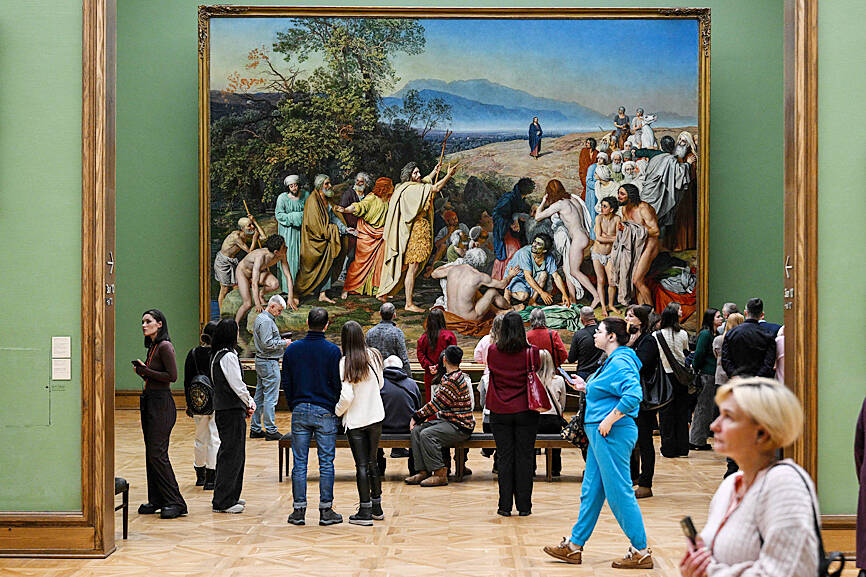
Photo: AFP
Ivakina has spent much of the winter bouncing from show to show.
On a stormy evening, the 45-year-old marketing specialist was heading to a Sergei Prokofiev opera at the Bolshoi’s historic stage. The night before, at its New Stage, she was at a ballet based on an Anton Chekhov work. A week ago, the theater.
“It’s a certain attempt to escape reality,” she said, standing on the glittering square in front of the Bolshoi, as she talked about having “fewer opportunities to go somewhere and leave the country.”
Russians have become accustomed to alluding about the war in code, avoiding specific phrases or opinions that could land them years in prison under military censorship laws.
Usually a single phrase — “the context” — is enough to know the underlying topic of conversation.
The conflict, launched when Russian President Vladimir Putin ordered troops into Ukraine on Feb. 24, 2022, has become Europe’s deadliest since World War II, killing tens of thousands of civilians and hundreds of thousands of soldiers.
Immediately hit with sanctions, Russia has been pushed off the world stage — athletes banned, artists’ shows canceled and tourist visas harder to obtain.
At home, the state has pushed the war into daily life — promoting the army, soldiers and masculine narratives of “patriotic values” as core Russian values.
Those who openly oppose are liable to arrest and prosecution.
“There seems to be very few things left to cling to,” said Viktor Chelin, a photographer coming out of the Chagall exhibition, titled “The Joy of Earthly Gravity,” with his wife.
Trips to the museum are “a kind of silent conspiracy,” he said.
“You walk around and understand that you’re united with others by the admiration of a certain beauty,” he said.
“Something enormous happened in Russia, which we are all afraid of. We close our eyes to it, but try to live and maintain and certain normality,” said Chelin, 30.
Wearing a cap pulled low, he talked about “the feeling, as they say, of a feast in time of plague,” a reference to the 1830s play by Alexander Pushkin, Russia’s national poet, written during a cholera epidemic.
He and his wife moved to Georgia for two years after Russia launched its offensive, before returning to Saint Petersburg.
They are now regular visitors to the grand Hermitage Museum, housed in the former palace of the czars.
“We’re not even going to see specific works of art, we’re grounding ourselves, as if we’re connecting to something familiar,” he said.
Sociologist Denis Volkov of the Levada Center — designated a “foreign agent” by Russian authorities — said escapism is prevalent across Russia.
“People don’t want to follow events, they don’t want to get information about what’s happening on the battlefield,” he said.
“There’s been a continuous desire to cut down the flow of bad news, to filter it out somehow, not to discuss it with relatives or friends. Perhaps that’s where this surge in interest in culture comes from,” he said.
However, he added that the mindset also chimes with the line being put out by the authorities — that life in Russia continues as normal, despite the war.
“Festivals, parties, concerns — it reflects the authorities’ policy that life goes on. They fight somewhere over there, and here we live our lives without worry,” Volkov said.
Outside of the Chagall exhibition in Moscow, former piano teacher Irina refutes the idea of trying to escape from the war.
In her short fur coat and bright pink lips, she said she is well aware of “everything that’s happening in the world, and where black and white lie.”
“We live with it, yes, we live with it,” she said. “We often go to all the exhibitions that nourish us and lift our spirits.”

An American scientist convicted of lying to US authorities about payments from China while he was at Harvard University has rebuilt his research lab in Shenzhen, China, to pursue technology the Chinese government has identified as a national priority: embedding electronics into the human brain. Charles Lieber, 67, is among the world’s leading researchers in brain-computer interfaces. The technology has shown promise in treating conditions such as amyotrophic lateral sclerosis and restoring movement in paralyzed people. It also has potential military applications: Scientists at the Chinese People’s Liberation Army have investigated brain interfaces as a way to engineer super soldiers by boosting
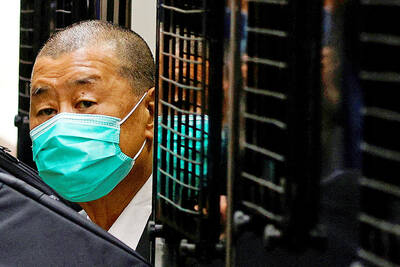
Jailed media entrepreneur Jimmy Lai (黎智英) has been awarded Deutsche Welle’s (DW) freedom of speech award for his contribution to Hong Kong’s pro-democracy movement. The German public broadcaster on Thursday said Lai would be presented in absentia with the 12th iteration of the award on June 23 at the DW Global Media Forum in Bonn. Deutsche Welle director-general Barbara Massing praised the 78-year-old founder of the now-shuttered news outlet Apple Daily for standing “unwaveringly for press freedom in Hong Kong at great personal risk.” “With Apple Daily, he gave journalists a platform for free reporting and a voice to the democracy movement in
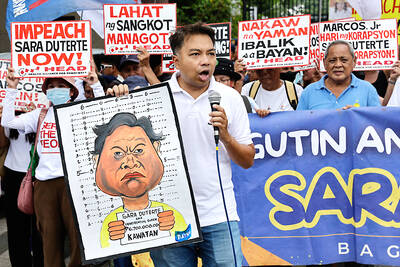
PHILIPPINE COMMITTEE: The head of the committee that made the decision said: ‘If there is nothing to hide, there is no reason to hide, there is no reason to obstruct’ A Philippine congressional committee on Wednesday ruled that there was “probable cause” to impeach Philippine Vice President Sara Duterte after hearing allegations of unexplained wealth, misuse of state funds and threats to have the president assassinated. The unanimous decision of the 53-member committee in the Philippine House of Representatives sends the two impeachment complaints to deliberations and voting by the entire lower chamber, which has more than 300 lawmakers. The complaints centered on Duterte’s alleged illegal use and mishandling of intelligence funds from the vice president’s office, and from her time as education secretary under Philippine President Ferdinand Marcos Jr. Duterte and the
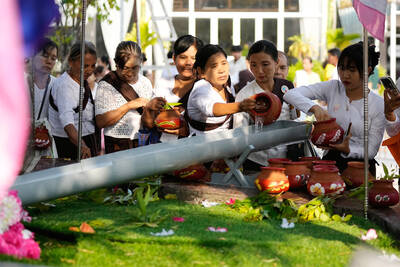
Burmese President Min Aung Hlaing yesterday cut all prisoners’ sentences by one-sixth, a blanket measure that a source close to deposed leader Aung San Suu Kyi said would further shorten her detention. Aung San Suu Kyi has been sequestered since a 2021 military coup, but the senior member of her dissolved National League for Democracy (NLD) party said that while her term had been reduced, her remaining sentence is still unclear. “We also don’t know exactly how many years she has left,” the source told reporters, speaking on condition of anonymity for security reasons. The military toppled Aung San Suu Kyi’s elected government


 RSS
RSS