


South American dart frog experts on Monday said that the toxin alleged to have killed Russian dissident Alexei Navalny was likely a lab-produced replica rather than harvested directly from the wild.
European capitals on Saturday alleged that Navalny — a fierce critic of Russian President Vladimir Putin — was killed by the neurotoxin epibatidine, found in “poison dart frogs in South America.”
A number of South American dart frog species are believed to carry the toxin, with the most likely suspect found in the jungles of Ecuador and Peru. The frogs themselves are easy enough to come by, both legally with permits and illegally for a few dollars.
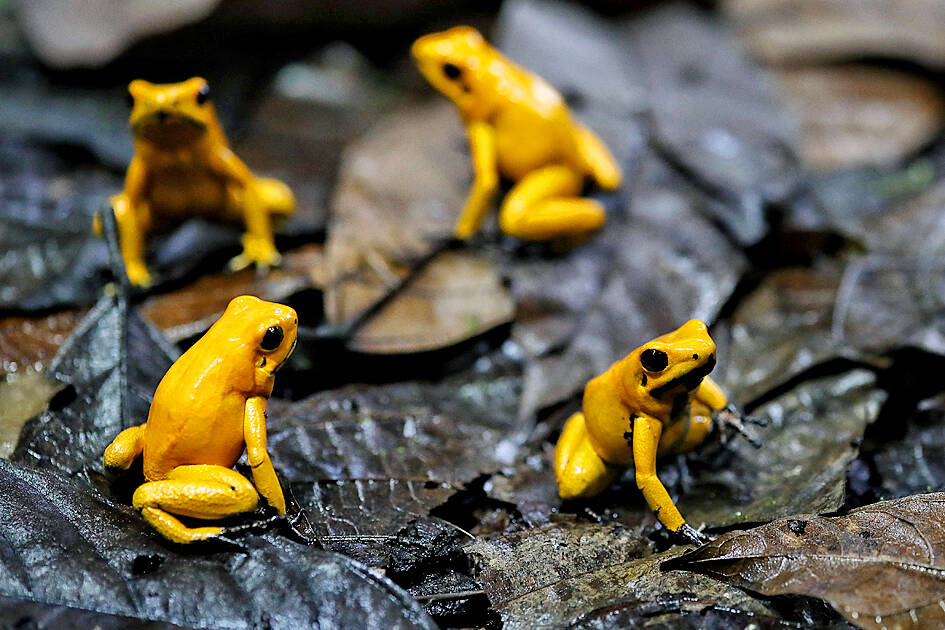
Photo: AP
“It’s not difficult to find them at any market,” said Andrea Teran, collections manager for Ecuador’s Jambatu Center for Amphibian Research and Conservation.
In the past 10 years, more than 800 of the suspected species — Epipedobates anthonyi, also known as Anthony’s poison arrow frog — have been legally exported from Ecuador, according to Convention on International Trade in Endangered Species of Wild Fauna and Flora permit data.
Despite images of spies roaming the jungles of Ecuador or the black market, experts said it is more likely that the toxin was a synthetic copy rather than the real thing.
“It’s easier to buy the toxin or obtain it from labs that produce it,” Teran said.
The quantity of toxin needed and the logistics involved in harvesting make synthetics a much easier option.
Tesoros de Colombia, a conservation center, holds permits to trade the frogs as pets and for scientific and pharmaceutical use. Center director Ivan Lozano said that an “enormous number of frogs” — each about 2cm to 3cm long, would be needed to produce a lethal dose for a human.
He said he believes it is “impossible” to gather that many to make a deadly poison, adding that only a “synthetic version” made in a laboratory could kill a person.
There is also a question of timing.
The frog’s toxins come from its insect diet in the wild, and are quickly lost in captivity, said Devin Edmonds, a doctoral student at the University of Illinois.
“The alkaloids in the skin of captive-bred frogs differ a lot from wild frogs,” he said.
“In captivity, they are fed fruit flies so they aren’t poisonous,” he said. “Wild frogs in captivity will lose their toxicity after a few months of eating flies.”
Navalny died in an arctic prison colony in February 2024 while serving a 19-year sentence for “extremism,” a charge that he and his supporters said was punishment for his opposition work.
The UK, Sweden, France, Germany and the Netherlands on Saturday issued a joint statement saying they believed he had been poisoned with epibatidine.
“We naturally do not accept such accusations. We disagree with them. We consider them biased and baseless,” Kremlin spokesman Dmitry Peskov told reporters.
Russia and the Soviet Union have a long history of developing, researching and allegedly using toxins — from ricin to Novichok — against political foes.

Hungarian authorities temporarily detained seven Ukrainian citizens and seized two armored cars carrying tens of millions of euros in cash across Hungary on suspicion of money laundering, officials said on Friday. The Ukrainians were released on Friday, following their detention on Thursday, but Hungarian officials held onto the cash, prompting Ukraine to accuse Hungary’s Russia-friendly government of illegally seizing the money. “We will not tolerate this state banditism,” Ukrainian Minister of Foreign Affairs Andrii Sybiha said. The seven detained Ukrainians were employees of the Ukrainian state-owned Oschadbank, who were traveling in the two armored cars that were carrying the money between Austria and

Kosovar President Vjosa Osmani on Friday after dissolving the Kosovar parliament said a snap election should be held as soon as possible to avoid another prolonged political crisis in the Balkan country at a time of global turmoil. Osmani said it is important for Kosovo to wrap up the upcoming election process and form functional institutions for political stability as the war rages in the Middle East. “Precisely because the geopolitical situation is that complex, it is important to finish this electoral process which is coming up,” she said. “It is very hard now to imagine what will happen next.” Kosovo, which declared

MORE BANS: Australia last year required sites to remove accounts held by under-16s, with a few countries pushing for similar action at an EU level and India considering its own ban Indonesia on Friday said it would ban social media access for children under 16, citing threats from online pornography, cyberbullying, online fraud and Internet addiction. “Accounts belonging to children under 16 on high-risk platforms will start to be deactivated, beginning with YouTube, TikTok, Facebook, Instagram, Threads, X, Bigo Live and Roblox,” Indonesian Minister of Communications and Digital Meutya Hafid said. “The government is stepping in so that parents no longer have to fight alone against the giants of the algorithm. Implementation will begin on March 28, 2026,” she said. The social media ban would be introduced in stages “until all platforms fulfill their

Counting was under way in Nepal yesterday, after a high-stakes parliamentary election to reshape the country’s leadership following protests last year that toppled the government. Key figures vying for power include former Nepalese prime minister K. P. Sharma Oli, rapper-turned-mayor Balendra Shah, who is bidding for the youth vote, and newly elected Nepali Congress party leader Gagan Thapa. In Kathmandu’s tea shops and city squares, people were glued to their phones, checking results as early trends flashed up — suggesting Shah’s centrist Rastriya Swatantra Party (RSP) was ahead. Nepalese Election Commission spokesman Prakash Nyupane said the counting was ongoing “in a peaceful manner”


 RSS
RSS