


Australian Prime Minister Anthony Albanese yesterday said that his government would not help Australians in a Syrian camp holding families of suspected Islamic State (IS) militants return home, with the government open to prosecutions if they make it back.
“We have a very firm view that we won’t be providing assistance or repatriation,” Albanese told ABC News.
Thirty-four Australians released on Monday from a camp in northern Syria were returned to the detention center due to “technical reasons,” two sources told Reuters on Monday.
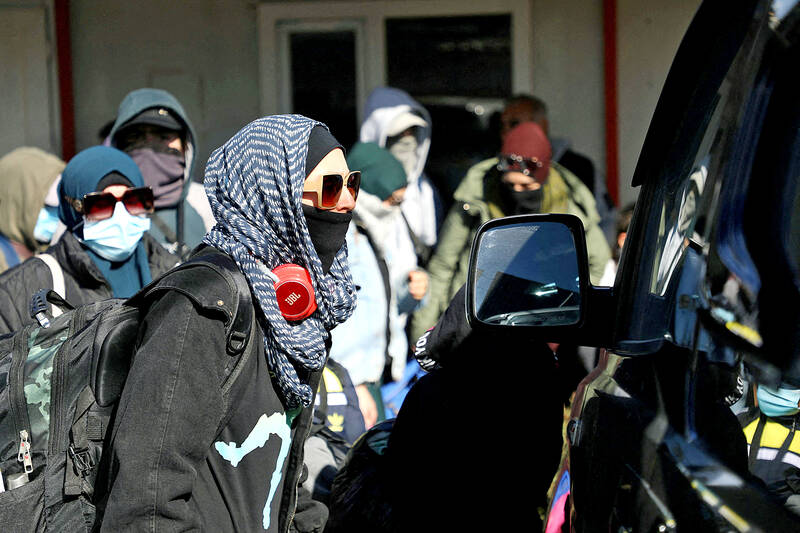
Photo: Reuters
Dubbed “IS brides” by local media — though the group also includes children — they are expected to travel to Damascus before eventually returning to Australia, despite objection from ruling and opposition lawmakers.
A spokesperson for Australian Minister for Home Affairs Tony Burke said Australia’s security agencies had been monitoring the situation in Syria, and said those who had broken the law would be prosecuted.
“People in this cohort need to know that if they have committed a crime and if they return to Australia they will be met with the full force of the law,” he said.
Islamic State is a listed terror organization in Australia, with membership of the group punishable by up to 25 years in prison. Australia also has the power to strip dual nationals of citizenship if they are an Islamic State member.
The return of relatives of suspected Islamic State militants is a political issue in Australia, which has seen a surge in popularity of the right-wing, anti-immigration One Nation party led by Pauline Hanson.
“They hate Westerners, and that’s what it’s all about. You say there’s great Muslims out there, well I’m sorry, how can you tell me there are good Muslims?” Hanson said in an interview on Sky News on Monday, following news of the suspected Islamic State family members’ return.
The comments were criticized by members of Hanson’s party.
A poll this week found One Nation’s share of the popular vote at a record high of 26 percent, above the combined support for the traditional center-right coalition currently in opposition.
Sarah Henderson, a senator in the Liberal party that has seen its vote eroded by One Nation, said that Australians with sympathies towards Islamic State should be barred from re-entering the country.
“If these are people who subscribed to ISIS ideology, who subscribe to this extremist ideology, then they should not be returning to Australia,” she told ABC.
Australian citizens have a legal right to enter the country under both local and international law.

A humanoid robot that won a half-marathon race for robots in Beijing on Sunday ran faster than the human world record in a show of China’s technological leaps. The winner from Honor, a Chinese smartphone maker, completed the 21km race in 50 minutes and 26 seconds, said a WeChat post by the Beijing Economic-Technological Development Area, also known as Beijing E-Town, where the race began. That was faster than the human world record holder, Ugandan Jacob Kiplimo, who finished the same distance in about 57 minutes in March at the Lisbon road race. The performance by the robot marked a significant step forward
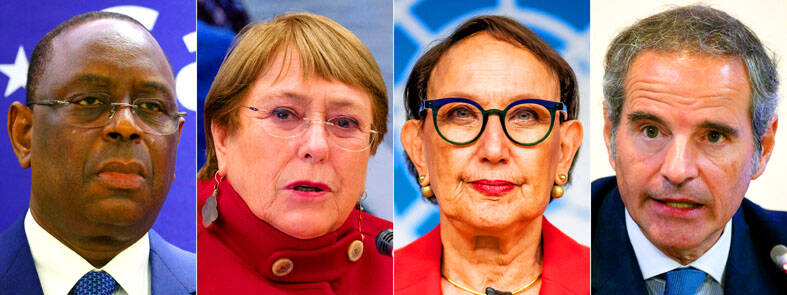
Four contenders are squaring up to succeed Antonio Guterres as secretary-general of the UN, which faces unprecedented global instability, wars and its own crushing budget crisis. Chile’s Michelle Bachelet, Argentina’s Rafael Grossi, Costa Rica’s Rebeca Grynspan and Senegal’s Macky Sall are each to face grillings by 193 member states and non-governmental organizations for three hours today and tomorrow. It is only the second time the UN has held a public question-and-answer, a format created in 2016 to boost transparency. Ultimately the five permanent members of the UN’s top body, the Security Council, hold the power, wielding vetoes over who leads the
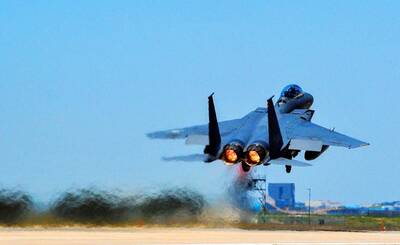
South Korea’s air force yesterday apologized for a 2021 midair collision involving two fighter jets, a day after auditors said the pilots were taking selfies and filming during the flight and held them responsible for the accident. “We sincerely apologize to the public for the concern caused by the accident that occurred in 2021,” an air force spokesman told a news conference, adding that one of the pilots involved had been suspended from flying duties, received severe disciplinary action and has since left the military. The apology followed a report released on Wednesday by the South Korean Board of Audit and Inspection,

An earthquake registering a preliminary magnitude of 7.7 off northern Japan on Monday prompted a short-lived tsunami alert and the advisory of a higher risk of a possible mega-quake for coastal areas there. The Cabinet Office and the Japan Meteorological Agency said there was a 1% chance for a mega-quake, compared to a 0.1% chance during normal times, in the next week or so following the powerful quake near the Chishima and Japan trenches. Officials said the advisory was not a quake prediction but urged residents in 182 towns along the northeastern coasts to raise their preparedness while continuing their daily lives. Prime


 RSS
RSS