


US Secretary of State Marco Rubio was to begin a two-day trip yesterday to bolster ties with Slovakia and Hungary, whose conservative leaders, often at odds with other EU countries, have warm ties with US President Donald Trump.
Rubio would use the trip to discuss energy cooperation and bilateral issues, including NATO commitments, the US Department of State said earlier this month.
“These are countries that are very strong with us, very cooperative with the United States, work very closely with us, and it’s a good opportunity to go see them and two countries I’ve never been in,” Rubio said.
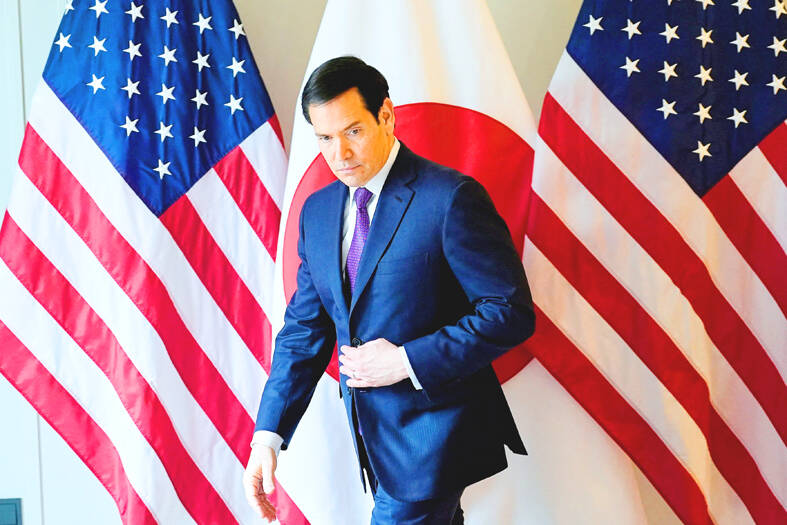
Photo: Reuters
Rubio, who in his dual role also serves as Trump’s national security adviser, was to meet in Bratislava yesterday with Slovakian Prime Minister Robert Fico, who visited Trump in Florida last month.
Rubio is expected to meet today with Hungarian Prime Minister Viktor Orban, who is trailing in most polls ahead of an election in April when he could be voted out of power.
“The President said he’s very supportive of him, and so are we,” Rubio said. “But obviously we were going to do that visit as a bilateral visit.”
Orban, one of Trump’s closest allies in Europe, is considered by many on the US’ hard-right as a model for Trump’s tough policies on immigration, and support for families and Christian conservatism.
Budapest has repeatedly hosted Conservative Political Action Conference events, which bring together conservative activists and leaders, with another due next month.
Fico and Orban have clashed with EU institutions over probes into backsliding on democratic rules.
They have also maintained ties with Moscow, criticized and at times delayed the imposition of EU sanctions on Russia, and opposed sending military aid to Ukraine.
Even as other EU countries have secured alternative energy supplies after Moscow invaded Ukraine in 2022, including by buying US natural gas, Slovakia and Hungary have also continued to buy Russian gas and oil, a practice Washington has criticized.
Rubio said this would be discussed during his brief tour, but did not give any details.
Fico, who has described the EU as an institution that is in “deep crisis,” has showered Trump with praise saying he would bring peace back to Europe.
However, Fico criticized the US capture of then-Venezuelan president Nicolas Maduro last month.
Hungary and Slovakia have also so far diverged from Trump on NATO spending.
They have raised defense spending to NATO’s minimum threshold of 2 percent of GDP.
However, Fico has refused to raise expenditure above that level for now, even though Trump has repeatedly asked all NATO members to increase their military spending to 5 percent. Hungary has also planned for 2 percent defense spending in this year’s budget.
On nuclear cooperation, Slovakia last month signed an agreement with the US and Fico has said US-based Westinghouse was likely to build a new nuclear power plant.
He also said after meeting the chief of France’s nuclear engineering company, Framatome, that he would welcome more companies taking part in the project.

A humanoid robot that won a half-marathon race for robots in Beijing on Sunday ran faster than the human world record in a show of China’s technological leaps. The winner from Honor, a Chinese smartphone maker, completed the 21km race in 50 minutes and 26 seconds, said a WeChat post by the Beijing Economic-Technological Development Area, also known as Beijing E-Town, where the race began. That was faster than the human world record holder, Ugandan Jacob Kiplimo, who finished the same distance in about 57 minutes in March at the Lisbon road race. The performance by the robot marked a significant step forward
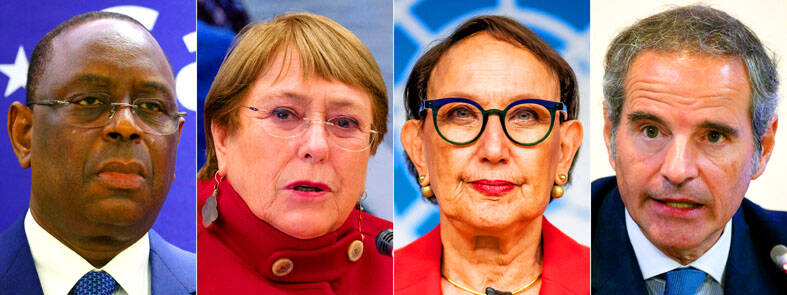
Four contenders are squaring up to succeed Antonio Guterres as secretary-general of the UN, which faces unprecedented global instability, wars and its own crushing budget crisis. Chile’s Michelle Bachelet, Argentina’s Rafael Grossi, Costa Rica’s Rebeca Grynspan and Senegal’s Macky Sall are each to face grillings by 193 member states and non-governmental organizations for three hours today and tomorrow. It is only the second time the UN has held a public question-and-answer, a format created in 2016 to boost transparency. Ultimately the five permanent members of the UN’s top body, the Security Council, hold the power, wielding vetoes over who leads the

South Korea’s air force yesterday apologized for a 2021 midair collision involving two fighter jets, a day after auditors said the pilots were taking selfies and filming during the flight and held them responsible for the accident. “We sincerely apologize to the public for the concern caused by the accident that occurred in 2021,” an air force spokesman told a news conference, adding that one of the pilots involved had been suspended from flying duties, received severe disciplinary action and has since left the military. The apology followed a report released on Wednesday by the South Korean Board of Audit and Inspection,
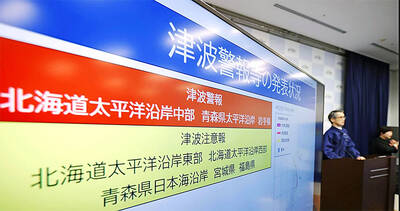
An earthquake registering a preliminary magnitude of 7.7 off northern Japan on Monday prompted a short-lived tsunami alert and the advisory of a higher risk of a possible mega-quake for coastal areas there. The Cabinet Office and the Japan Meteorological Agency said there was a 1% chance for a mega-quake, compared to a 0.1% chance during normal times, in the next week or so following the powerful quake near the Chishima and Japan trenches. Officials said the advisory was not a quake prediction but urged residents in 182 towns along the northeastern coasts to raise their preparedness while continuing their daily lives. Prime


 RSS
RSS