


Jeremiah Kithinji had never touched a computer before he finished high school. A decade later, he is teaching robotics, and even took a team of rural Kenyans to the World Robotics Olympiad in Singapore.
In a classroom in Laikipia County — a sparsely populated grasslands region of northern Kenya known for its rhinos and cheetahs — pupils are busy snapping together wheels, motors and sensors to assemble a robot.
Guiding them is Kithinji, 27, who runs a string of robotics clubs in the area that have taken some of his pupils far beyond the rural landscapes outside.

Photo: AFP
In November, he took a team of three to Singapore for the Olympiad, where he also served as the competition’s first Kenyan judge. They presented a simulated space mission with a robot that could launch a model satellite and collect space debris.
Singapore was an eye-opening experience for Kithinji, who was educated in a modest rural school without access to computers.
“I felt this country is so advanced. Interacting with the people showed me how much they care about their nation, and it made me think about how I can instil the same mindset in my students,” he said.
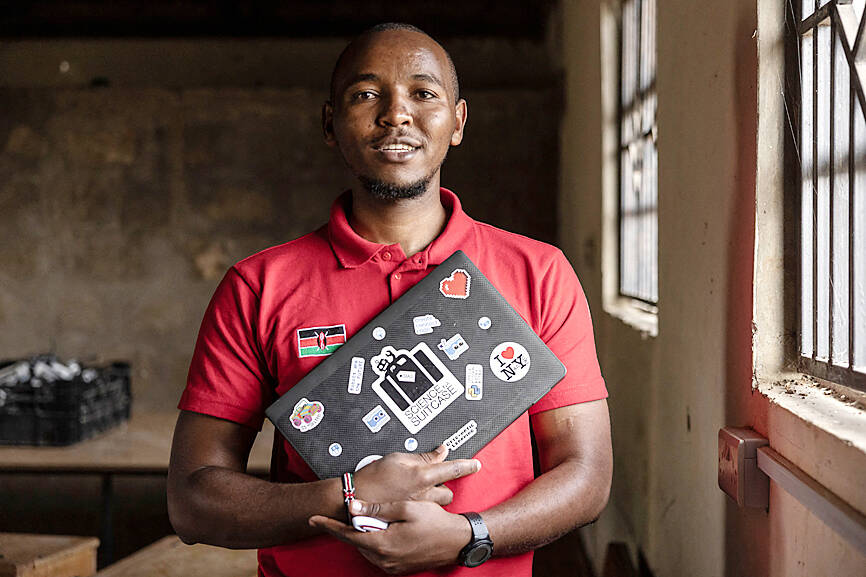
Photo: AFP
Kenya has pushed science and engineering in its latest curriculum, but lacks the resources for robotics training.
The clubs in Laikipia, which reach about 200 pupils, are funded by Science in a Suitcase, which helped train Kithinji and funded the trip to Singapore.
They have inspired Natalia Wangari, 14.
“In the future, when I become a neurosurgeon, I won’t have to perform every surgery myself. I can build a robot that acts as a doctor. I’ll just need to code it, and it will do the surgery itself,” she said.
Kithinji said he hoped robotics could provide solutions to some of Kenya’s specific challenges.
He previously coached a team at the African Olympiad in South Africa in 2024, where they designed agricultural robots that can operate farming tools and irrigate fields, and sees particular benefits for rural hospitals — assisting in surgeries and delivering medication.
He dreams of more support and collaborators to expand his robotics program across the country.
For now, his pupils are focused on winning a place at the next Olympiad, in Puerto Rico, and they are brainstorming ideas for this year’s theme: Robots meet culture.
Whatever happens, Kithinji said he is happy they are taking control of modern technology.
“The skills these kids are developing — critical thinking, problem-solving and technical skills... are the future skills our country needs,” he said. “I want our kids to create the technology, not just consume it.”

PHISHING: The con might appear convincing, as the scam e-mails can coincide with genuine messages from Apple saying you have run out of storage For a while you have been getting messages from Apple saying “your iCloud storage is full.” They say you have exceeded your storage plan, so documents are no longer being backed up, and photos you take are not being uploaded. You have been resisting Apple’s efforts to get you to pay a minimum of £0.99 (US$1.33) a month for more storage, but it seems that you cannot keep putting off the inevitable: You have received an e-mail which says your iCloud account has been blocked, and your photos and videos would be deleted very soon. To keep them you need

The Israeli military has demolished entire villages as part of its invasion of south Lebanon, rigging homes with explosives and razing them to the ground in massive remote detonations. The Guardian reviewed three videos posted by the Israeli military and on social media, which showed Israel carrying out mass detonations in the villages of Taybeh, Naqoura and Deir Seryan along the Israel-Lebanon border. Lebanese media has reported more mass detonations in other border villages, but satellite imagery was not readily available to verify these claims. The demolitions came after Israeli Minister of Defense Israel Katz called for the destruction of

A US YouTuber who caused outrage for filming himself kissing a statue commemorating Korean wartime sex slaves has been sentenced to six months in prison, a court in Seoul said yesterday. Johnny Somali, 25, gained notoriety several years ago for recording himself doing a series of provocative stunts in South Korea and Japan, and streaming them on platforms such as YouTube and Twitch. South Korean authorities indicted Somali — whose real name is Ramsey Khalid Ismael — in 2024 on public order violations and obstruction of business, and banned him from leaving the country. “The court has sentenced him to six months in

The death toll from a shooting in western Afghanistan rose to 11 on Saturday, after gunmen targeted civilians at a picnic spot in Herat, the provincial authority said. Bullet marks were visible on a wall of the Sayed Mohammad Agha Shia shrine, while bloodstains marked a blanket abandoned at the scene. “Eleven people have been recorded dead and eight others wounded from Friday’s incident, with the condition of two of the wounded reported as critical,” Herat’s information office said in a statement. The update raises a toll of seven killed provided on Friday by the Afghan Ministry of Interior Affairs


 RSS
RSS