


Pope Leo XIV yesterday warned of the risk of “a new arms race” as the last US-Russia nuclear treaty is set to expire.
New START, the last nuclear treaty between Washington and Moscow after decades of agreements dating to the Cold War, is due to expire today, and with it restrictions on the two top nuclear powers.
“I urge you not to abandon this instrument without seeking to ensure that it is followed up in a concrete and effective manner,” the US pope said at his weekly general audience.
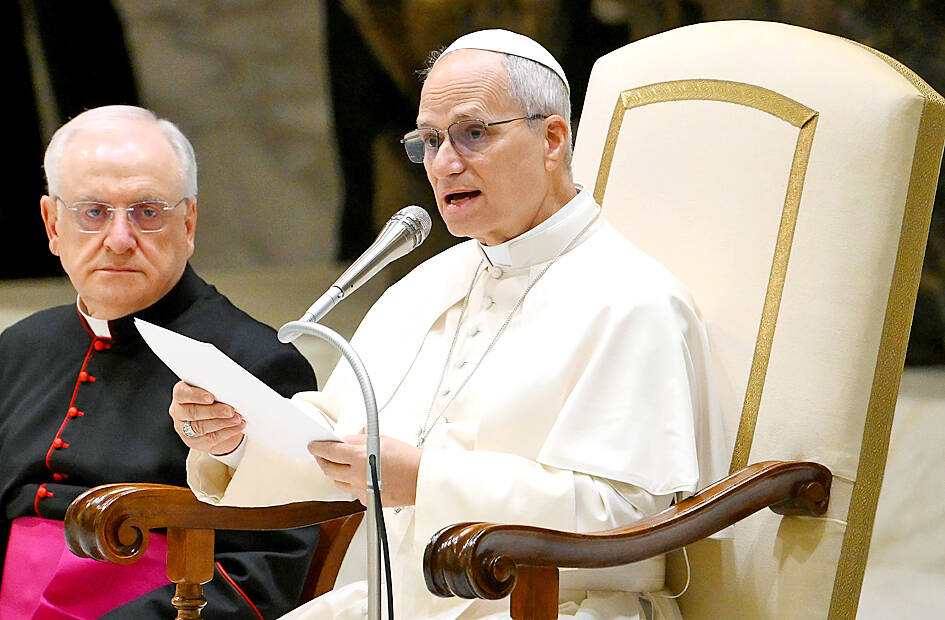
Photo: EPA
“The current situation requires us to do everything possible to avert a new arms race, which further threatens peace between nations,” he said.
Leo, the Catholic Church’s first US pontiff, said it was “more urgent than ever to replace the logic of fear and mistrust with a shared ethic capable of guiding choices towards the common good.”
The Kremlin has offered a one-year extension of the treaty, but while US President Donald Trump said in September last year that an extension of the New START “sounds like a good idea,” little has changed since then.
The treaty, which included a monitoring mechanism, was signed in 2010 by then-Russian president Dmitry Medvedev and then-US president Barack Obama.
However, Russia suspended monitoring inspections during the COVID-19 pandemic and talks on extending the agreement have broken down due to tensions over the Ukraine war.
Moscow had also accused Washington of impeding monitoring missions on US soil.
In 2023, Russia froze its participation in New START, but it has continued to voluntarily adhere to the limits set in the treaty.
Moscow last year tested its latest nuclear weapon carriers without atomic warheads, and Trump said he was moving two nuclear submarines closer to Russia.
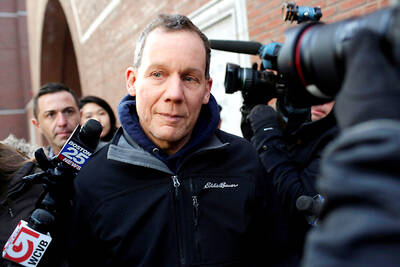
An American scientist convicted of lying to US authorities about payments from China while he was at Harvard University has rebuilt his research lab in Shenzhen, China, to pursue technology the Chinese government has identified as a national priority: embedding electronics into the human brain. Charles Lieber, 67, is among the world’s leading researchers in brain-computer interfaces. The technology has shown promise in treating conditions such as amyotrophic lateral sclerosis and restoring movement in paralyzed people. It also has potential military applications: Scientists at the Chinese People’s Liberation Army have investigated brain interfaces as a way to engineer super soldiers by boosting
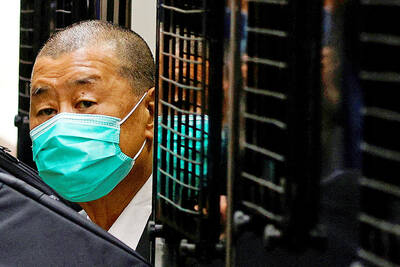
Jailed media entrepreneur Jimmy Lai (黎智英) has been awarded Deutsche Welle’s (DW) freedom of speech award for his contribution to Hong Kong’s pro-democracy movement. The German public broadcaster on Thursday said Lai would be presented in absentia with the 12th iteration of the award on June 23 at the DW Global Media Forum in Bonn. Deutsche Welle director-general Barbara Massing praised the 78-year-old founder of the now-shuttered news outlet Apple Daily for standing “unwaveringly for press freedom in Hong Kong at great personal risk.” “With Apple Daily, he gave journalists a platform for free reporting and a voice to the democracy movement in
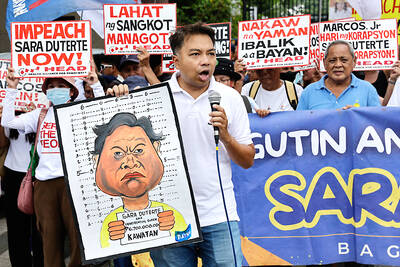
PHILIPPINE COMMITTEE: The head of the committee that made the decision said: ‘If there is nothing to hide, there is no reason to hide, there is no reason to obstruct’ A Philippine congressional committee on Wednesday ruled that there was “probable cause” to impeach Philippine Vice President Sara Duterte after hearing allegations of unexplained wealth, misuse of state funds and threats to have the president assassinated. The unanimous decision of the 53-member committee in the Philippine House of Representatives sends the two impeachment complaints to deliberations and voting by the entire lower chamber, which has more than 300 lawmakers. The complaints centered on Duterte’s alleged illegal use and mishandling of intelligence funds from the vice president’s office, and from her time as education secretary under Philippine President Ferdinand Marcos Jr. Duterte and the
Burmese President Min Aung Hlaing yesterday cut all prisoners’ sentences by one-sixth, a blanket measure that a source close to deposed leader Aung San Suu Kyi said would further shorten her detention. Aung San Suu Kyi has been sequestered since a 2021 military coup, but the senior member of her dissolved National League for Democracy (NLD) party said that while her term had been reduced, her remaining sentence is still unclear. “We also don’t know exactly how many years she has left,” the source told reporters, speaking on condition of anonymity for security reasons. The military toppled Aung San Suu Kyi’s elected government


 RSS
RSS