


At Yiwu International Trade City, China’s largest wholesale market, customers crowd into a small shop searching for an unlikely bestseller ahead of the Lunar New Year.
They are looking for a red plush horse with a downturned mouth, a gold bell around its neck and eyes that appear to shy away from a viewer’s gaze.
The toy has gone viral on Chinese social media ahead of the Spring Festival holiday, which this year marks the Year of the Horse in the Chinese zodiac.
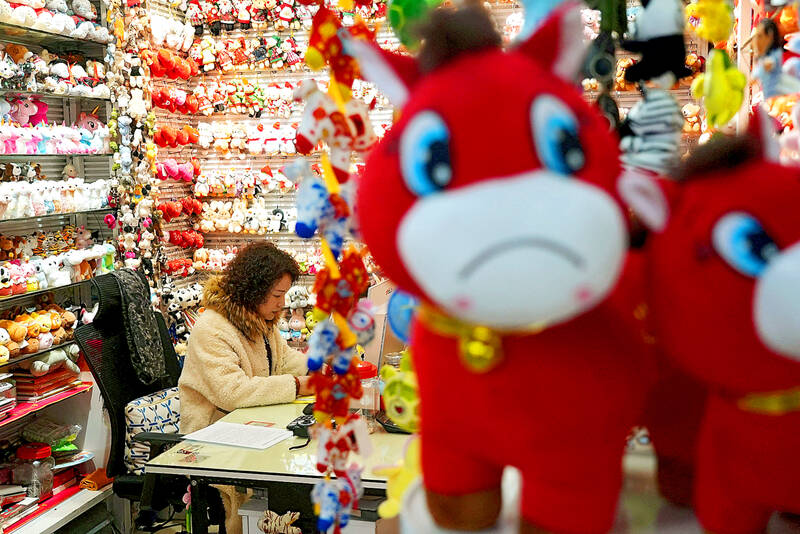
Photo: Reuters
Called the “crying horse” by online users, the toy was designed as a happy-faced Lunar New Year decoration, but a manufacturing mistake turned its smile into a frown.
“A worker sewed the mouth on upside down by accident,” said Zhang Huoqing (張火清), owner of the Yiwu-based shop Happy Sister.
Zhang said she offered a refund after discovering the flaw, but the customer never returned the toy. Not long after, she discovered photos of it circulating online.
“People joked that the crying horse is how you look at work, while the smiling one is how you look after work,” Zhang said.
As demand surged, Zhang decided to keep making the sad-faced version.
Some young white-collar workers in China say the horse’s dour expression mirrors their long hours and workplace stress.
It also taps into a broader trend for so-called “ugly-cute” toys, popularized in recent years by characters such as Pop Mart’s toothy monster Labubu.
“These days, almost everyone who walks through the door asks for the crying horse,” said Lou Zhenxian, a Yiwu vendor who has sold festive toys for more than 25 years.
By early afternoon, racks of crying horses outside Happy Sister had sold out and employees were rushing to restock the shelves.
“We will keep selling it,” Zhang said. “This crying horse really fits the reality of modern working people.”

‘TERRORIST ATTACK’: The convoy of Brigadier General Hamdi Shukri resulted in the ‘martyrdom of five of our armed forces,’ the Presidential Leadership Council said A blast targeting the convoy of a Saudi Arabian-backed armed group killed five in Yemen’s southern city of Aden and injured the commander of the government-allied unit, officials said on Wednesday. “The treacherous terrorist attack targeting the convoy of Brigadier General Hamdi Shukri, commander of the Second Giants Brigade, resulted in the martyrdom of five of our armed forces heroes and the injury of three others,” Yemen’s Saudi Arabia-backed Presidential Leadership Council said in a statement published by Yemeni news agency Saba. A security source told reporters that a car bomb on the side of the road in the Ja’awla area in

PRECARIOUS RELATIONS: Commentators in Saudi Arabia accuse the UAE of growing too bold, backing forces at odds with Saudi interests in various conflicts A Saudi Arabian media campaign targeting the United Arab Emirates (UAE) has deepened the Gulf’s worst row in years, stoking fears of a damaging fall-out in the financial heart of the Middle East. Fiery accusations of rights abuses and betrayal have circulated for weeks in state-run and social media after a brief conflict in Yemen, where Saudi airstrikes quelled an offensive by UAE-backed separatists. The United Arab Emirates is “investing in chaos and supporting secessionists” from Libya to Yemen and the Horn of Africa, Saudi Arabia’s al-Ekhbariya TV charged in a report this week. Such invective has been unheard of

US President Donald Trump on Saturday warned Canada that if it concludes a trade deal with China, he would impose a 100 percent tariff on all goods coming over the border. Relations between the US and its northern neighbor have been rocky since Trump returned to the White House a year ago, with spats over trade and Canadian Prime Minister Mark Carney decrying a “rupture” in the US-led global order. During a visit to Beijing earlier this month, Carney hailed a “new strategic partnership” with China that resulted in a “preliminary, but landmark trade agreement” to reduce tariffs — but
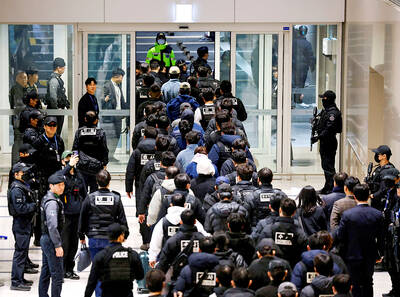
SCAM CLAMPDOWN: About 130 South Korean scam suspects have been sent home since October last year, and 60 more are still waiting for repatriation Dozens of South Koreans allegedly involved in online scams in Cambodia were yesterday returned to South Korea to face investigations in what was the largest group repatriation of Korean criminal suspects from abroad. The 73 South Korean suspects allegedly scammed fellow Koreans out of 48.6 billion won (US$33 million), South Korea said. Upon arrival in South Korea’s Incheon International Airport aboard a chartered plane, the suspects — 65 men and eight women — were sent to police stations. Local TV footage showed the suspects, in handcuffs and wearing masks, being escorted by police officers and boarding buses. They were among about 260 South


 RSS
RSS