


Dozens of South Koreans allegedly involved in online scams in Cambodia were yesterday returned to South Korea to face investigations in what was the largest group repatriation of Korean criminal suspects from abroad.
The 73 South Korean suspects allegedly scammed fellow Koreans out of 48.6 billion won (US$33 million), South Korea said.
Upon arrival in South Korea’s Incheon International Airport aboard a chartered plane, the suspects — 65 men and eight women — were sent to police stations. Local TV footage showed the suspects, in handcuffs and wearing masks, being escorted by police officers and boarding buses.
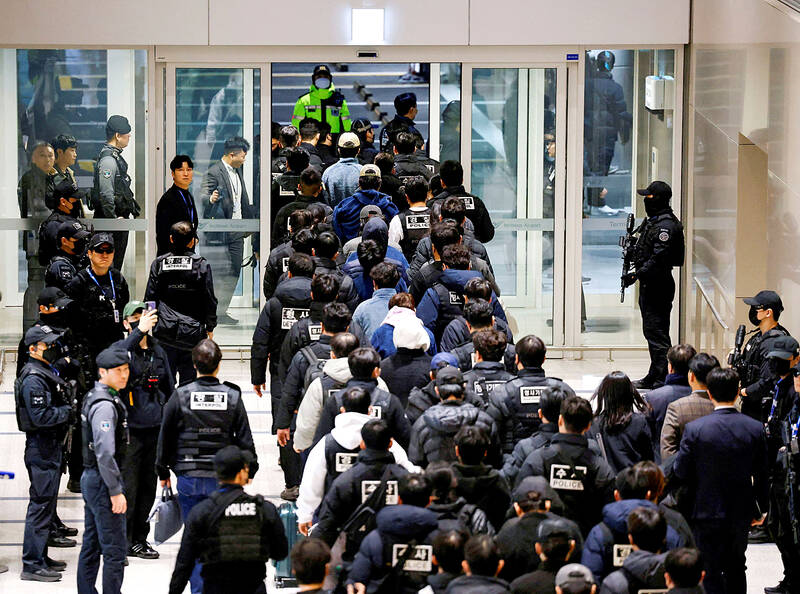
Photo: Reuters
They were among about 260 South Koreans detained in a crackdown in Cambodia over the past few months.
“When it comes to crimes that harm our people, we’ll track down and arrest those involved to the very end and get them to face corresponding consequences,” senior police officer Yoo Seung-ryul said.
Public outrage over scam centers in Southeast Asia flared in South Korea when a South Korean student was found dead last summer after reportedly being forced to work at a scam compound in Cambodia.
Authorities at the time said he died after being tortured and beaten, and South Korea sent a government delegation to Cambodia in October for talks on a joint response.
The suspects repatriated include a couple who allegedly operated a deepfake romance scam to dupe 12 billion won from about 100 people in fraudulent investment schemes.
South Korea has made various efforts to bring them back home, including more than 10 rounds of video meetings with Cambodian officials, the South Korean Ministry of Justice said.
At the airport briefing, senior Ministry of Foreign Affairs official Yoo Byung-seok expressed gratitude to the the Cambodian government over the repatriation.
South Korea hoped to continue close bilateral coordination until online scams targeting South Koreans are eradicated in Cambodia, Yoo added.
Cybercrime has flourished in Southeast Asia, particularly in Cambodia and Myanmar, as trafficked foreign nationals were employed to run romance and cryptocurrency scams, often after being recruited with false job offers and then forced to work in conditions of near-slavery.
Since October, about 130 South Korean scam suspects from Cambodia, as well as more than 20 such Korean suspects from Laos, Vietnam, Thailand and the Philippines, have been sent back home.
About 60 South Koreans remain detained in Cambodia awaiting repatriation, police said.
South Korean President Lee Jae-myung called for stern responses to transnational cybercrimes that he said erodes mutual trust in society and triggers diplomatic disputes with other countries.

School bullies in Singapore are to face caning under new guidelines, but the education minister on Tuesday said it would be meted out only as a last resort with strict safeguards. Human rights groups regularly criticize Singapore for the use of corporal punishment, which remains part of the school and criminal justice systems, but authorities have defended it as a deterrent to crime and serious misconduct. Caning was discussed in the parliament after legislators asked how it would be used in relation to bullying in schools. The debate followed stricter guidelines on serious student misconduct, including bullying, unveiled by the Singaporean Ministry of

As evening falls in Fiji’s capital, a steady stream of people approaches a makeshift clinic that is a first line of defense against one of the world’s fastest-growing HIV epidemics. In the South Pacific nation — a popular tourist destination of just under a million people — more than 2,000 new HIV cases were recorded last year, a 26 percent increase from 2024. The government has declared an HIV outbreak and described it as a national crisis. “It’s spreading like wildfire,” said Siteri Dinawai, 46, who came to be tested. The Moonlight Clinic, a converted minibus parked in a suburban cul-de-sac in Suva, is
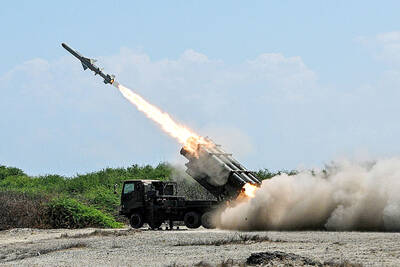
A MESSAGE: Japan’s participation in the Balikatan drills is a clear deterrence signal to China not to attack Taiwan while the US is busy in the Middle East, an analyst said The Japan Self-Defense Forces yesterday fired a Type 88 anti-ship missile during a joint maritime exercise with US, Australian and Philippine forces, hitting a decommissioned Philippine Navy ship in waters facing the disputed South China Sea, in drills that underscore Tokyo’s rising willingness to project military power on China’s doorstep. The drill took place as Manila and Tokyo began talks on a potential defense equipment transfer, made possible by Japan’s decision to scrap restrictions on military exports. The discussions include the possible early transfer of Abukuma-class destroyers and TC-90 aircraft to the Philippines, Japanese Minister of Defense Shinjiro Koizumi said. Philippine Secretary of
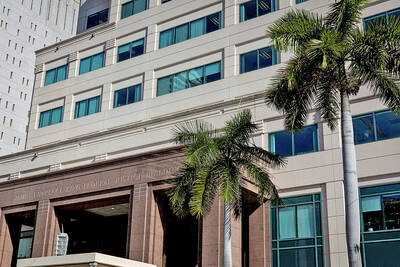
‘GROSS NEGLIGENCE?’ Despite a spleen typically being significantly smaller than a liver, the surgeon said he believed Bryan’s spleen was ‘double the size of what is normal’ A Florida surgeon who is facing criminal charges after allegedly removing a patient’s liver instead of his spleen has said he is “forever traumatized” by that person’s death. In a deposition from November last year that was recently obtained by NBC, 44-year-old Thomas Shaknovsky described the death of 70-year-old William Bryan as an “incredibly unfortunate event that I regret deeply.” Bryan died after the botched surgery; and last month, a grand jury in Tallahassee indicted Shaknovsky on a charge of manslaughter. “I’m forever traumatized by it and hurt by it,” Shaknovsky added, also saying that wrong-site surgeries can happen “during


 RSS
RSS