


Rusted nails hold used infusion tubes on the wall of a clinic run by one among hundreds of thousands of unqualified doctors operating across Pakistan.
Every day, dozens of patients visit the small roadside shop in Sindh Province, where a few chairs are arranged around wooden tables used to lay patients down.
“These patients have faith in me. They believe I can treat them well,” said Abdul Waheed, who opened the facility a few months ago outside Hyderabad.

Photo: AFP
During the day, the 48-year-old works at a private hospital, and in the evenings, he comes to the village of Tando Saeed Khan to see patients at his clinic, charging 300 rupees (US$1) per consultation.
There is no signboard and no registration number, and he has no legal authorization to practice as a doctor.
Waheed, who has a diploma in homeopathy and has completed a four-year nursing course, spoke with confidence, and insisted that patients come to him willingly and trust his abilities.
“No one has questioned me yet. If someone comes, I will see what to do,” he said, reflecting the ease with which unqualified people practice medicine in Pakistan.
Such unlicensed clinics are often the first, and sometimes the only, point of care for poor communities.
Pakistan Medical Association Secretary-General Abdul Ghafoor Shoro said there are “more than 600,000 fake doctors” operating across the country.
This nationwide figure has been confirmed by the Sindh Healthcare Commission (SHCC), based on estimates from the Pakistan Medical and Dental Council.
Calling the practice a public health epidemic, Shoro said that such practitioners work with doctors, learn a few things there and then open their own clinics.
“Unqualified doctors don’t know the side effects and exact dosage of medicines. If a disease is not properly diagnosed, it can become dangerous,” Shoro said. “The instruments they use are not sterilized. They simply wash them with water and continue using them. They reuse syringes, which increases the spread of hepatitis and AIDS.”
Medical experts said this unchecked practice has a direct impact on Pakistan’s already strained healthcare system, with tertiary care hospitals overwhelmed by patients whose conditions worsen after improper treatment.
Civil Hospital Karachi head Khalid Bukhari said the facility regularly receives such cases.
“They misdiagnose and mistreat patients. Our hospital is overloaded. Most of the cases we receive are those ruined by them,” Bukhari said. “These people are playing with the lives of poor citizens. If people go to proper doctors and receive precise treatment, they will not need to come to us.”
Regulatory authorities acknowledge their failure to control the problem.
“We have limited resources. This practice cannot be eliminated easily. If we shut down 25 outlets, 25 new ones open the very next day,” Sindh HealthCare Commission (SHCC) head Ahson Qavi Siddiqi said.
“The law against it is weak. We file cases, but the accused get bail the next day because it is a bailable offence,” Siddiqi said, adding that inspection teams also face serious security threats.
“These people are influential in their areas. In many cases, our teams are taken hostage. We are fired upon. I don’t have the force to take strong action,” he said.

An American scientist convicted of lying to US authorities about payments from China while he was at Harvard University has rebuilt his research lab in Shenzhen, China, to pursue technology the Chinese government has identified as a national priority: embedding electronics into the human brain. Charles Lieber, 67, is among the world’s leading researchers in brain-computer interfaces. The technology has shown promise in treating conditions such as amyotrophic lateral sclerosis and restoring movement in paralyzed people. It also has potential military applications: Scientists at the Chinese People’s Liberation Army have investigated brain interfaces as a way to engineer super soldiers by boosting
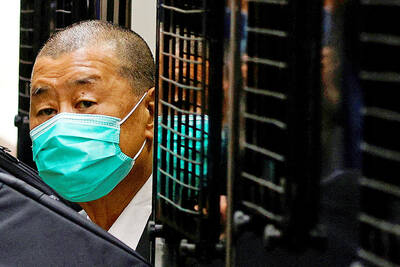
Jailed media entrepreneur Jimmy Lai (黎智英) has been awarded Deutsche Welle’s (DW) freedom of speech award for his contribution to Hong Kong’s pro-democracy movement. The German public broadcaster on Thursday said Lai would be presented in absentia with the 12th iteration of the award on June 23 at the DW Global Media Forum in Bonn. Deutsche Welle director-general Barbara Massing praised the 78-year-old founder of the now-shuttered news outlet Apple Daily for standing “unwaveringly for press freedom in Hong Kong at great personal risk.” “With Apple Daily, he gave journalists a platform for free reporting and a voice to the democracy movement in
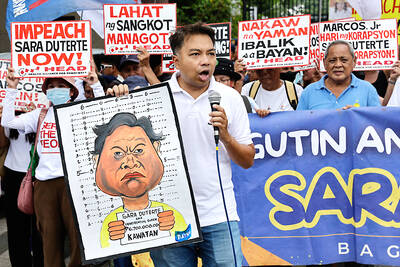
PHILIPPINE COMMITTEE: The head of the committee that made the decision said: ‘If there is nothing to hide, there is no reason to hide, there is no reason to obstruct’ A Philippine congressional committee on Wednesday ruled that there was “probable cause” to impeach Philippine Vice President Sara Duterte after hearing allegations of unexplained wealth, misuse of state funds and threats to have the president assassinated. The unanimous decision of the 53-member committee in the Philippine House of Representatives sends the two impeachment complaints to deliberations and voting by the entire lower chamber, which has more than 300 lawmakers. The complaints centered on Duterte’s alleged illegal use and mishandling of intelligence funds from the vice president’s office, and from her time as education secretary under Philippine President Ferdinand Marcos Jr. Duterte and the

Burmese President Min Aung Hlaing yesterday cut all prisoners’ sentences by one-sixth, a blanket measure that a source close to deposed leader Aung San Suu Kyi said would further shorten her detention. Aung San Suu Kyi has been sequestered since a 2021 military coup, but the senior member of her dissolved National League for Democracy (NLD) party said that while her term had been reduced, her remaining sentence is still unclear. “We also don’t know exactly how many years she has left,” the source told reporters, speaking on condition of anonymity for security reasons. The military toppled Aung San Suu Kyi’s elected government


 RSS
RSS