


A trial against two pro-democracy activists behind a group that for decades organized a vigil that commemorated people killed in Beijing’s 1989 Tiananmen Square Massacre opened today, in another landmark case brought under China-imposed national security legislation that has practically crushed protests in Hong Kong.
Critics say their case shows that Beijing’s promise to keep the territory’s Western-style civil liberties intact for 50 years when the former British colony returned to Chinese rule in 1997 has weakened over time, but Hong Kong’s government has said its law enforcement actions were evidence-based and strictly in accordance with the law.
Chow Hang-tung (鄒幸彤) and Lee Cheuk-yan (李卓人), former leaders of the Hong Kong Alliance in Support of Patriotic Democratic Movements of China, were charged with incitement to subversion in September 2021 under Hong Kong’s National Security Law. They are accused of inciting others to organize, plan or act through unlawful means with a view to subvert state power, and if convicted, face a maximum penalty of 10 years in prison.
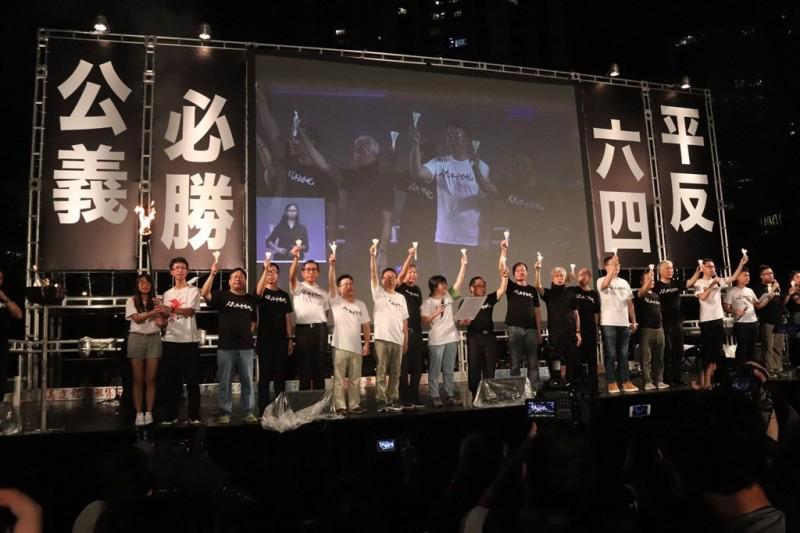
Photo: CNA
As they entered the courtroom, Lee waved at his supporters, who waved back and said: “Good morning.”
Codefendant Albert Ho (何俊仁) sat calmly.
Chow thanked her supporters for enduring winds during the night and bowed to her supporters.
Minutes later, Lee and Chow pleaded not guilty, while Ho entered a guilty plea, which could help him get a reduced sentence.
The prosecution this morning began reading out the case details about Ho, and had not yet started its case.
Among people sitting in the public gallery were Lee’s wife, Chow’s mother and other pro-democracy activists such as Tang Ngok-kwan (鄧岳君).
Before sunrise, dozens of people were already in line outside the court building to secure a seat in the public gallery under a cold-weather warning.
Tang, a former core member of the alliance, had been queuing since Monday afternoon.
He said he wanted to show support for his former colleagues in detention.
“They use their freedom to exchange for a dignified defense,” he said. “It’s about being accountable to history.”
Former pro-democracy district councilor Chan Kim-kam (陳劍琴), a former vigil-goer and also Chow’s friend, stayed awake the whole night outside the building.
“We need to witness this, regardless of the results,” she said.
Trial expected to last 75 days
Three government-vetted judges are to preside over the trial, which is expected to last 75 days. Videos related to the alliance’s years of work would be part of the prosecution evidence.
Chow, also a lawyer defending herself, tried to throw out her case in November last year, saying that the prosecution had not specified what “unlawful means” were involved.
However, the judges rejected her bid.
The judges yesterday explained their decision, saying that the prosecution made it clear that “unlawful means” meant ending the Chinese Communist Party’s rule and contravening the Chinese constitution.
The prosecution accused the defendants of promoting the call of “ending one-party rule” by inciting people’s hatred of and disgust over the state’s power, the judges said.
The prosecution had pointed to the defendants’ media interviews and public speeches related to the alliance to sustain the group’s operation and promote that call to others after the security law took effect in June 2020, they said.
Although the scope of the charge was relatively wide, the prosecutors had provided sufficient details for the defendants, they added.
The court would not allow the trial to become a tool of political suppression in the name of law, the judges said.
Prosecutors are expected to detail their case this week.
The case goes to the heart of freedom of expression, said Urania Chiu, a lecturer in law at Oxford Brookes University.
“The prosecution case hinges on the argument that the alliance’s general call for ‘bringing the one-party rule to an end’ constitutes subversion without more, which amounts to criminalizing an idea, a political ideal that is very far from being actualized,” she said.
The case is about “rewriting history and punishing those who refuse to forget the victims of the Tiananmen crackdown,” said Sarah Brooks, Amnesty International’s deputy regional director for Asia.
Alliance’s disbandment a blow to civil society
The alliance was best known for organizing the only large-scale public commemoration of the 1989 massacre in China for decades. Tens of thousands of people attended it annually until authorities banned it in 2020, citing COVID-19 pandemic measures.
After COVID-19 restrictions were lifted, the park was occupied instead by a carnival organized by pro-Beijing groups. Those who tried to commemorate the event near the site were detained.
Before the alliance voted to disband in September 2021, police had sought details about the group, saying that they had reasonable grounds to believe it was acting as a foreign agent.
The alliance rejected the allegations and refused to cooperate.
Chow, Tang and another core member of the alliance were in 2023 convicted in a separate case for failing to provide authorities with information on the group and were each sentenced to four and a half months in prison, but the trio overturned their convictions at the territory’s top court in March last year.
Chow, Lee and Ho have been in custody, awaiting the trial’s opening, which has been postponed twice.
Beijing said the 2020 security legislation was necessary for the territory’s stability following the 2019 protests, which sent hundreds of thousands of people onto the streets.
The same legislation has convicted dozens of other leading democracy activists, including former media mogul Jimmy Lai (黎智英) last month. Dozens of civil society groups have closed since the law took effect.

An American scientist convicted of lying to US authorities about payments from China while he was at Harvard University has rebuilt his research lab in Shenzhen, China, to pursue technology the Chinese government has identified as a national priority: embedding electronics into the human brain. Charles Lieber, 67, is among the world’s leading researchers in brain-computer interfaces. The technology has shown promise in treating conditions such as amyotrophic lateral sclerosis and restoring movement in paralyzed people. It also has potential military applications: Scientists at the Chinese People’s Liberation Army have investigated brain interfaces as a way to engineer super soldiers by boosting
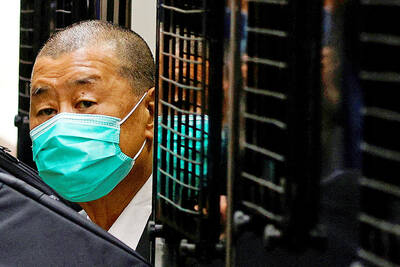
Jailed media entrepreneur Jimmy Lai (黎智英) has been awarded Deutsche Welle’s (DW) freedom of speech award for his contribution to Hong Kong’s pro-democracy movement. The German public broadcaster on Thursday said Lai would be presented in absentia with the 12th iteration of the award on June 23 at the DW Global Media Forum in Bonn. Deutsche Welle director-general Barbara Massing praised the 78-year-old founder of the now-shuttered news outlet Apple Daily for standing “unwaveringly for press freedom in Hong Kong at great personal risk.” “With Apple Daily, he gave journalists a platform for free reporting and a voice to the democracy movement in
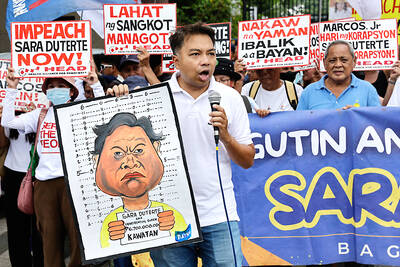
PHILIPPINE COMMITTEE: The head of the committee that made the decision said: ‘If there is nothing to hide, there is no reason to hide, there is no reason to obstruct’ A Philippine congressional committee on Wednesday ruled that there was “probable cause” to impeach Philippine Vice President Sara Duterte after hearing allegations of unexplained wealth, misuse of state funds and threats to have the president assassinated. The unanimous decision of the 53-member committee in the Philippine House of Representatives sends the two impeachment complaints to deliberations and voting by the entire lower chamber, which has more than 300 lawmakers. The complaints centered on Duterte’s alleged illegal use and mishandling of intelligence funds from the vice president’s office, and from her time as education secretary under Philippine President Ferdinand Marcos Jr. Duterte and the

Burmese President Min Aung Hlaing yesterday cut all prisoners’ sentences by one-sixth, a blanket measure that a source close to deposed leader Aung San Suu Kyi said would further shorten her detention. Aung San Suu Kyi has been sequestered since a 2021 military coup, but the senior member of her dissolved National League for Democracy (NLD) party said that while her term had been reduced, her remaining sentence is still unclear. “We also don’t know exactly how many years she has left,” the source told reporters, speaking on condition of anonymity for security reasons. The military toppled Aung San Suu Kyi’s elected government


 RSS
RSS