


A landmark case accusing Myanmar of committing genocide against minority Muslim Rohingya yesterday opened at the UN’s top court.
It is the first genocide case the International Court of Justice (ICJ) is to hear in full in more than a decade. The outcome will have repercussions beyond Myanmar, likely affecting South Africa’s genocide case at the ICJ against Israel over the war in Gaza.
Myanmar has denied accusations of genocide.
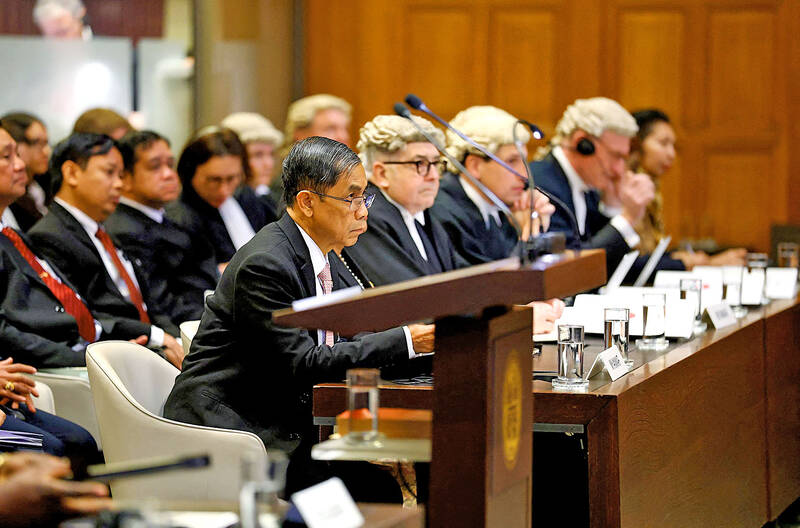
Photo: Reuter
“The case is likely to set critical precedents for how genocide is defined and how it can be proven, and how violations can be remedied,” said Nicholas Koumjian, head of the UN’s Independent Investigative Mechanism for Myanmar.
The predominantly Muslim West African country of Gambia filed the case at the ICJ — also known as the World Court — in 2019, accusing Myanmar of committing genocide against the Rohingya, a mainly Muslim minority in the remote western Rakhine state.
Myanmar’s armed forces launched an offensive in 2017 that forced at least 730,000 Rohingya from their homes and into neighboring Bangladesh, where they recounted killings, mass rape and arson.
A UN fact-finding mission concluded the 2017 military offensive had included “genocidal acts.”
Speaking in The Hague before the hearings, Rohingya victims said they want the long-awaited court case to deliver justice.
“We are hoping for a positive result that will tell the world that Myanmar committed genocide, and we are the victims of that and we deserve justice,” said Yousuf Ali, a 52-year-old Rohingya refugee who says he was tortured by the Burmese military.
Burmese authorities rejected that report, saying its military offensive was a legitimate counterterrorism campaign in response to attacks by Muslim militants. In the 2019 preliminary hearings in the ICJ case, then-Myanmar leader Aung San Suu Kyi rejected Gambia’s accusations of genocide as “incomplete and misleading.”
The hearings at the ICJ mark the first time that Rohingya victims of the alleged atrocities are to be heard by an international court, although those sessions are closed to the public and the media for sensitivity and privacy reasons.
In total, the hearings are to span three weeks.
MYANMAR ELECTIONS
In other news, Myanmar’s main pro-military party yesterday claimed victory in the parliamentary seat of sidelined democratic leader Aung San Suu Kyi in elections being derided as a ploy to prolong junta rule.
The armed forces have ruled Myanmar for most of the nation’s post-independence history before a decade-long democratic thaw saw civilians assume control. However, the military snatched back power with a 2021 coup, deposing and detaining Aung San Suu Kyi after claiming she won a landslide election win over pro-military party by means of massive voter fraud.
The junta says the current month-long vote — which has its final phase scheduled for Jan. 25 — would return power to the people.
With Aung San Suu Kyi still held in seclusion and her hugely popular party dissolved, democracy advocates say the vote has been rigged by a crackdown on dissent and a ballot stacked with military allies.
An official from the Union Solidarity and Development Party (USDP), speaking anonymously because they were unauthorized to share results, said they “won in Kawhmu” — Aung san Suu Kyi’s former seat in Yangon region.
“We won 15 lower house seats out of 16 places in Yangon region,” they added, after Kawhmu and dozens of other constituencies voted in the election’s second stage on Sunday.
The official did not say by what margin the party claimed its win and official results of the second round have yet to be posted by the junta-stacked election commission.
However, the USDP — described by many analysts as the military’s prime proxy — won nearly 90 percent of lower house seats in the first phase, official results say.
“It should surprise no one that the military-backed party has claimed a landslide victory,” UN rights expert Tom Andrews said in a statement last week.
“The junta engineered the polls to ensure victory for its proxy, entrench military domination, and manufacture a facade of legitimacy while violence and repression continue unabated,” he said.

An American scientist convicted of lying to US authorities about payments from China while he was at Harvard University has rebuilt his research lab in Shenzhen, China, to pursue technology the Chinese government has identified as a national priority: embedding electronics into the human brain. Charles Lieber, 67, is among the world’s leading researchers in brain-computer interfaces. The technology has shown promise in treating conditions such as amyotrophic lateral sclerosis and restoring movement in paralyzed people. It also has potential military applications: Scientists at the Chinese People’s Liberation Army have investigated brain interfaces as a way to engineer super soldiers by boosting
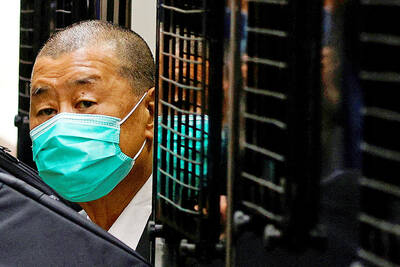
Jailed media entrepreneur Jimmy Lai (黎智英) has been awarded Deutsche Welle’s (DW) freedom of speech award for his contribution to Hong Kong’s pro-democracy movement. The German public broadcaster on Thursday said Lai would be presented in absentia with the 12th iteration of the award on June 23 at the DW Global Media Forum in Bonn. Deutsche Welle director-general Barbara Massing praised the 78-year-old founder of the now-shuttered news outlet Apple Daily for standing “unwaveringly for press freedom in Hong Kong at great personal risk.” “With Apple Daily, he gave journalists a platform for free reporting and a voice to the democracy movement in
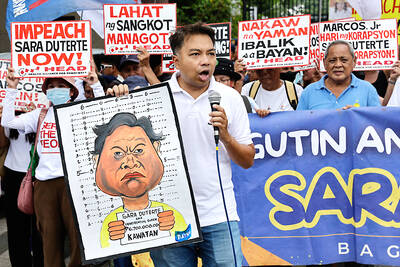
PHILIPPINE COMMITTEE: The head of the committee that made the decision said: ‘If there is nothing to hide, there is no reason to hide, there is no reason to obstruct’ A Philippine congressional committee on Wednesday ruled that there was “probable cause” to impeach Philippine Vice President Sara Duterte after hearing allegations of unexplained wealth, misuse of state funds and threats to have the president assassinated. The unanimous decision of the 53-member committee in the Philippine House of Representatives sends the two impeachment complaints to deliberations and voting by the entire lower chamber, which has more than 300 lawmakers. The complaints centered on Duterte’s alleged illegal use and mishandling of intelligence funds from the vice president’s office, and from her time as education secretary under Philippine President Ferdinand Marcos Jr. Duterte and the

Burmese President Min Aung Hlaing yesterday cut all prisoners’ sentences by one-sixth, a blanket measure that a source close to deposed leader Aung San Suu Kyi said would further shorten her detention. Aung San Suu Kyi has been sequestered since a 2021 military coup, but the senior member of her dissolved National League for Democracy (NLD) party said that while her term had been reduced, her remaining sentence is still unclear. “We also don’t know exactly how many years she has left,” the source told reporters, speaking on condition of anonymity for security reasons. The military toppled Aung San Suu Kyi’s elected government


 RSS
RSS