


Syria’s Kurdish fighters yesterday said that they agreed under a ceasefire to withdraw from Aleppo after days of fighting government forces in the city.
Hours earlier, Syria’s military said it had finished operations in the Kurdish-held Sheikh Maqsud neighborhood with state television reporting that Kurdish fighters who surrendered were being bused to the north.
The military had already announced its seizure of Aleppo’s other Kurdish-held neighborhood, Ashrafiyeh.
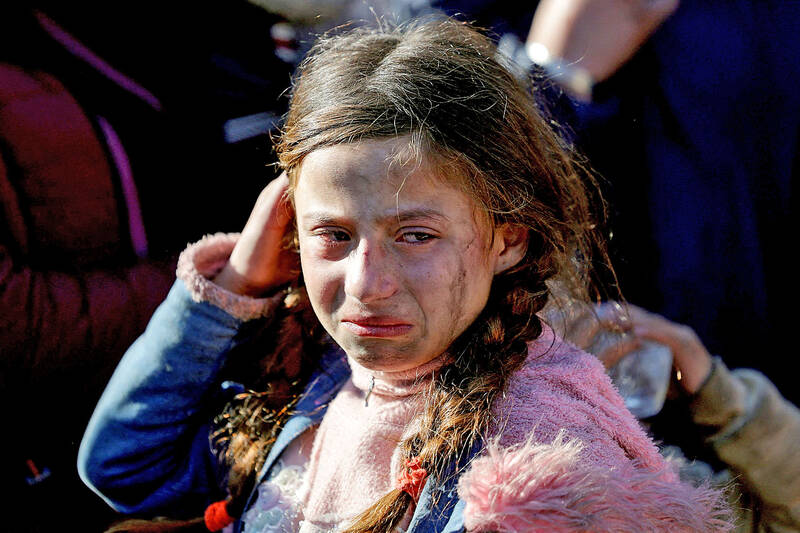
Photo: Reuters
Kurdish forces had controlled pockets of Syria’s second-largest city Aleppo and operate a de facto autonomous administration across swathes of the north and northeast, much of it captured during the 14-year civil war.
The latest clashes erupted after negotiations to integrate the Kurds into the country’s new government stalled.
“We reached an understanding that led to a ceasefire and secured the evacuation of the martyrs, the wounded, the trapped civilians and the fighters from Ashrafiyeh and Sheikh Maqsud neighborhoods to northern and eastern Syria,” the Kurdish-led Syrian Democratic Forces (SDF) wrote in a statement.
Syria’s official SANA news agency reported that “buses carrying the last batch of members of the SDF organization have left the Sheikh Maqsud neighborhood in Aleppo, heading toward northeastern Syria.”
The SDF initially denied its fighters were leaving, describing the bus transfers as forced displacement of civilians.
An Agence France-Presse (AFP) correspondent on Saturday saw at least five buses carrying men out of Sheikh Maqsud, but could not independently verify their identities.
The ceasefire was reached “through the mediation of international parties to stop the attacks and violations against our people in Aleppo,” the SDF said.
The US and EU called for the Syrian government and Kurdish authorities to return to political dialogue.
The fighting, some of the most intense since the ousting of long-time ruler Bashar al-Assad in December 2024, has killed at least 21 civilians, according to figures from both sides, while the Aleppo governor said 155,000 people fled their homes.
Both sides blamed the other for starting the clashes on Tuesday last week.
On the outskirts of Sheikh Maqsud, families who had been trapped by the fighting were leaving, accompanied by Syrian security forces.
An AFP correspondent saw men carrying children on their backs board buses headed to shelters.
Dozens of young men in civilian clothing were separated from the crowd, with security forces making them sit on the ground before transporting them to an unknown destination, the correspondent said.
A Syrian security official told AFP on condition of anonymity that the young men were “fighters” being “transferred to Syrian detention centers.”
US envoy Tom Barrack on Saturday met Syrian President Ahmed al-Sharaa and afterward called for a “return to dialogue” with the Kurds in accordance with the integration framework agreed in March last year. The deal was meant to be implemented last year, but differences, including Kurdish demands for decentralized rule, stymied progress as Damascus repeatedly rejected the idea.
The fighting in Aleppo raised fears of a regional escalation, with neighboring Turkey, a close ally of Syria’s new authorities, saying it was ready to intervene. Israel has sided with the Kurdish forces. The clashes have also tested the Syrian authorities’ ability to reunify the country after the brutal civil war and commitment to protecting minorities, after sectarian bloodshed rocked the country’s Alawite and Druze communities last year.
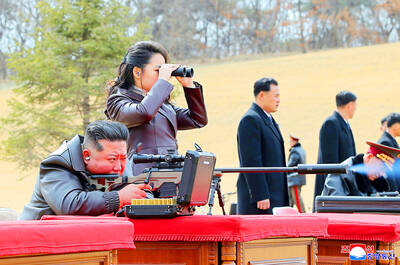
LIKE FATHER, LIKE DAUGHTER: By showing Ju-ae’s ability to handle a weapon, the photos ‘suggest she is indeed receiving training as a successor,’ an academic said North Korea on Saturday released a rare image of leader Kim Jong-un’s teenage daughter firing a rifle at a shooting range, adding to speculation that she is being groomed as his successor. Kim’s daughter, Ju-ae, has long been seen as the next in line to rule the secretive, nuclear-armed state, and took part in a string of recent high-profile outings, including last week’s military parade marking the closing stages of North Korea’s key party congress. Pyongyang’s official Korean Central News Agency (KCNA) released a photo of Ju-ae shooting a rifle at an outdoor shooting range, peering through a rifle scope
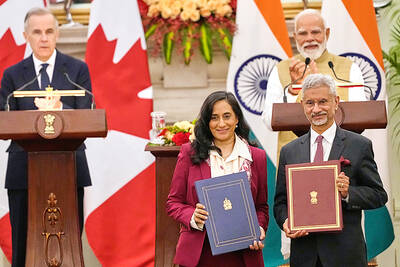
India and Canada yesterday reached a string of agreements, including on critical mineral cooperation and a “landmark” uranium supply deal for nuclear power, the countries’ leaders said in New Delhi. The pacts, which also covered technology and promoting the use of renewable energy, were announced after Indian Prime Minister Narendra Modi and Canadian Prime Minister Mark Carney hailed a fresh start in the relationship between their nations. “Our ties have seen a new energy, mutual trust and positivity,” Modi said. Carney’s visit is a key step forward in ties that effectively collapsed in 2023 after Ottawa accused New Delhi
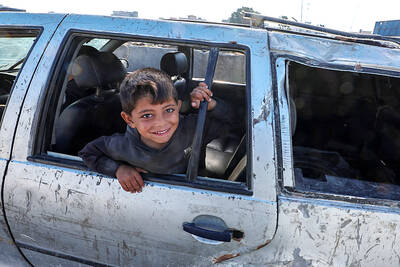
Gaza is rapidly running out of its limited fuel supply and stocks of food staples might become tight, officials said, after Israel blocked the entry of fuel and goods into the war-shattered territory, citing fighting with Iran. The Israeli military closed all Gaza border crossings on Saturday after announcing airstrikes on Iran carried out jointly with the US. Israeli authorities late on Monday night said that they would reopen the Kerem Shalom crossing from Israel to Gaza yesterday, for “gradual entry of humanitarian aid” into the strip, without saying how much. Israeli authorities previously said the crossings could not be operated safely during
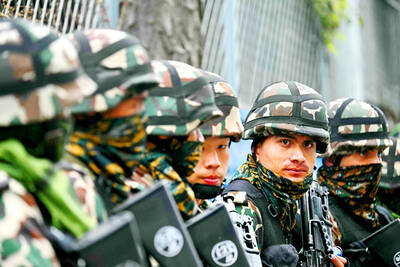
Counting was under way in Nepal yesterday, after a high-stakes parliamentary election to reshape the country’s leadership following protests last year that toppled the government. Key figures vying for power include former Nepalese prime minister K. P. Sharma Oli, rapper-turned-mayor Balendra Shah, who is bidding for the youth vote, and newly elected Nepali Congress party leader Gagan Thapa. In Kathmandu’s tea shops and city squares, people were glued to their phones, checking results as early trends flashed up — suggesting Shah’s centrist Rastriya Swatantra Party (RSP) was ahead. Nepalese Election Commission spokesman Prakash Nyupane said the counting was ongoing “in a peaceful manner”


 RSS
RSS