


Iranian protesters shouted and marched through the streets into yesterday morning after a call by the country’s exiled crown prince for demonstrations, despite Iran’s theocracy cutting off the nation from the Internet and international telephone calls.
Short online videos shared by activists purported to show protesters chanting against Iran’s government around bonfires as debris littered the streets in Tehran and other areas.
Iranian state media broke its silence over the protests, alleging “terrorist agents” of the US and Israel set fires and sparked violence.
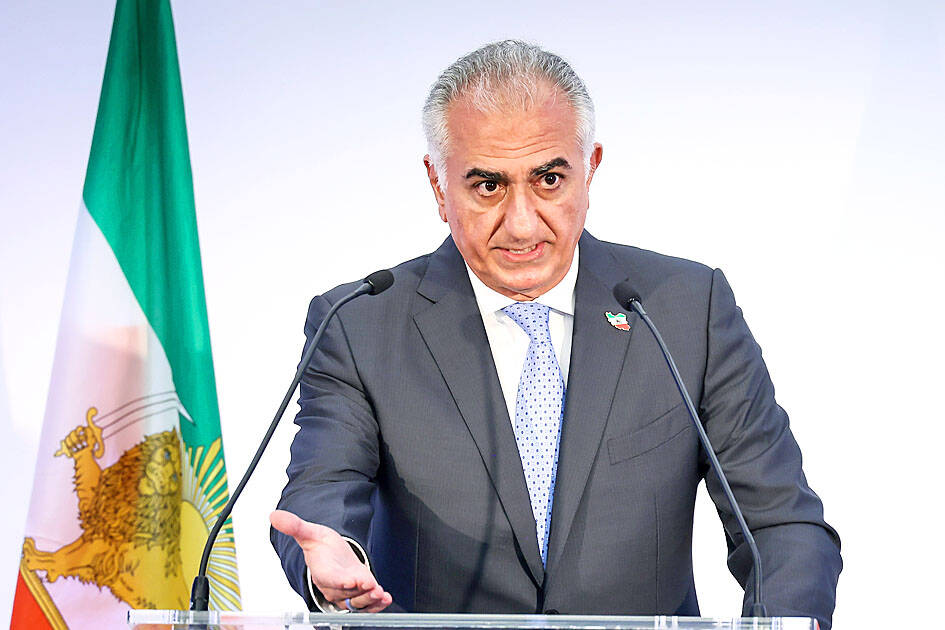
Photo: AP
It also said there were “casualties,” without elaborating.
The full scope of the demonstrations could not be immediately determined due to the communications blackout, although it represented yet another escalation in protests that began over Iran’s ailing economy and that has morphed into the most significant challenge to the government in several years.
The protests have intensified steadily since Dec. 28 and represented the first test of whether the Iranian public could be swayed by Crown Prince Reza Pahlavi, whose fatally ill father fled Iran just before the country’s 1979 Islamic Revolution. Demonstrations have included cries in support of the shah, something that could bring a death sentence in the past, but now underlines the anger fueling the protests that began over Iran’s ailing economy.
So far, violence around the demonstrations has killed at least 42 people while more than 2,270 have been detained, Human Rights Activists News Agency said.
Pahlavi, who called for protests Thursday night, similarly has called for demonstrations yesterday.
“What turned the tide of the protests was former Crown Prince Reza Pahlavi’s calls for Iranians to take to the streets at 8pm on Thursday and Friday,” Washington Institute for Near East Policy senior fellow Holly Dagres said. “Per social media posts, it became clear that Iranians had delivered and were taking the call seriously to protest in order to oust the Islamic Republic.”
“This is exactly why the Internet was shut down: to prevent the world from seeing the protests. Unfortunately, it also likely provided cover for security forces to kill protesters,” Dagres added.
When the clock struck 8pm on Thursday, neighborhoods across Tehran erupted in chanting, witnesses said.
The chants included “Death to the dictator!” and “Death to the Islamic Republic!”
Others praised the shah, shouting: “This is the last battle! Pahlavi will return!”
Thousands could be seen on the streets before all communication to Iran cut out.
“Iranians demanded their freedom tonight. In response, the regime in Iran has cut all lines of communication,” Pahlavi said. “It has shut down the Internet. It has cut landlines. It may even attempt to jam satellite signals.”
He went on to call for European leaders to join US President Donald Trump in promising to “hold the regime to account.”
“I call on them to use all technical, financial, and diplomatic resources available to restore communication to the Iranian people so that their voice and their will can be heard and seen,” he added. “Do not let the voices of my courageous compatriots be silenced.”
Pahlavi had said he would offer further plans depending on the response to his call. His support of and from Israel has drawn criticism in the past. Demonstrators have shouted in support of the shah in some demonstrations, but it is not clear whether that is support for Pahlavi himself or a desire to return to a time before the 1979 Islamic Revolution.
The Internet cut also appears to have taken Iran’s state-run and semiofficial news agencies offline as well.

Kouri Richins, a Utah mother who published a children’s book about grief after the death of her husband is to serve a life sentence for his murder without the possibility of parole, a judge ruled on Wednesday. Richins was convicted in March of aggravated murder for lacing a cocktail given to her husband, Eric Richins, with five times the lethal dose of fentanyl at their home near Park City in 2022. A jury also found her guilty of four other felonies, including insurance fraud, forgery and attempted murder for trying to poison her husband weeks earlier on Feb. 14, 2022, with a

‘PERSONAL MISTAKES’: Eileen Wang has agreed to plead guilty to the felony, which comes with a maximum sentence of 10 years in federal prison A southern California mayor has agreed to plead guilty to acting as an illegal agent for the Chinese government and has resigned from her city position, officials said on Monday. Eileen Wang (王愛琳), mayor of Arcadia, was charged last month with one count of acting in the US as an illegal agent of a foreign government. She was accused of doing the bidding of Chinese officials, such as sharing articles favorable to Beijing, without prior notification to the US government as required by law. The 58-year-old was elected in November 2022 to a five-person city council, from which the mayor is selected

DELA ROSA CASE: The whereabouts of the senator, who is wanted by the ICC, was unclear, while President Marcos faces a political test over the senate situation Philippine authorities yesterday were seeking confirmation of reports that a top politician wanted by the International Criminal Court (ICC) had fled, a day after gunfire rang out at the Philippine Senate where he had taken refuge fearing his arrest. Senator Ronald “Bato” dela Rosa, the former national police chief and top enforcer of former Philippine president Rodrigo Duterte’s “war on drugs,” has been under Senate protection and is wanted for crimes against humanity, the same charges Duterte is accused of. “Several sources confirmed that the senator, Senator Bato, is no longer in the Senate premises, but we are still getting confirmation,” Presidential
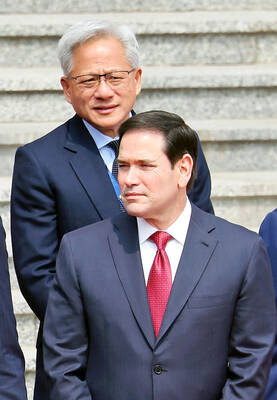
HELP DENIED? The US Department of State said that the Cuban leadership refuses to allow the US to provide aid to Cubans, ‘who are in desperate need of assistance’ US Secretary of State Marco Rubio on Wednesday said that Cuba’s leadership must change, as Washington renewed an offer of US$100 million in aid if the communist nation agrees to cooperate. Cuba has been suffering severe economic tumult led by an energy shortage that plunged 65 percent of the country into darkness on Tuesday. Cuba’s leaders have blamed US sanctions, but Rubio, a Cuban American and critic of the government established by Fidel Castro, said the system was to blame, including corruption by the military. “It’s a broken, nonfunctional economy, and it’s impossible to change it. I wish it were different,” he told


 RSS
RSS