


A vessel seized in Finland suspected of damaging a telecommunications cable between Helsinki and Tallinn was transporting Russian steel targeted by EU sanctions, Finnish Customs said on Thursday.
Finnish police on Wednesday detained the Fitburg, a 132m long cargo ship en route from St Petersburg, Russia, to Haifa, Israel, and its 14 crew members following suspicion the ship’s anchor had damaged the subsea telecoms cable in the Gulf of Finland.
“Preliminary information indicated that the cargo consisted of steel products originating in Russia, which are subject to extensive sanctions imposed on Russia,” Finnish Customs said.
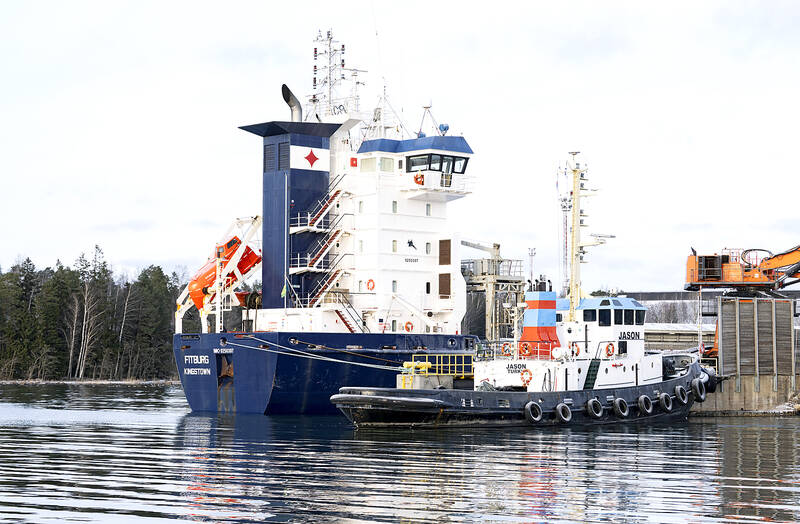
Photo: EPA
The agency therefore carried out an inspection of the ship’s cargo on Wednesday.
“According to the assessment of experts at Finnish Customs, the structural steel in question falls under the EU’s sectoral sanctions,” it said. “Import of such sanctioned goods into the EU is prohibited under EU sanctions regulations.”
Finnish Customs said it was still investigating “the applicability of EU sanctions legislation to this case.”
The steel remained impounded pending clarification, it said, adding that Finnish Customs has opened a preliminary inquiry “with a view to launching a pre-trial investigation into a potential sanctions violation.”
Finnish police said they were investigating the damaged cable incident as “aggravated criminal damage, attempted aggravated criminal damage and aggravated interference with telecommunications.”
The Fitburg is flagged from St Vincent and Grenadines, and its crew members were detained and to be questioned by Finnish police.
Two of the crew members were on Thursday placed under arrest and two others were placed under a travel ban, police said, refusing to disclose their nationalities or roles in the crew.
Energy and communications infrastructure, including underwater cables and pipelines, have been damaged in the Baltic Sea in recent years. Since Russia’s full-scale invasion of Ukraine in February 2022, many experts and political leaders have viewed the suspected cable sabotage as part of a “hybrid war” carried out by Russia against Western countries.
EU High Representative for Foreign Affairs and Security Policy Kaja Kallas said Europe “remains vigilant,” as its critical infrastructure was “at high risk of sabotage.”
“The EU will continue to fortify its critical infrastructure, including by investing in new cables, strengthening surveillance, ensuring more repair capacity, and moving against Moscow’s shadow fleet, which also acts as a launchpad for hybrid attacks,” she wrote on X.
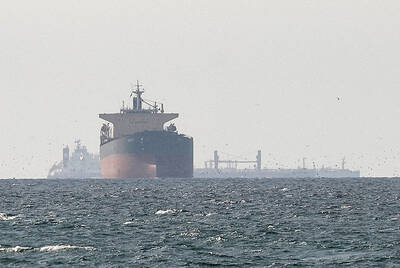
A ship that appears to be taking on the identity of a scrapped gas carrier exited the Strait of Hormuz on Friday, showing how strategies to get through the waterway are evolving as the Middle East war progresses. The vessel identifying as liquefied natural gas (LNG) carrier Jamal left the Strait on Friday morning, ship-tracking data show. However, the same tanker was also recorded as having beached at an Indian demolition yard in October last year, where it is being broken up, according to market participants and port agent’s reports. The ship claiming to be Jamal is likely a zombie vessel that
Japan is to downgrade its description of ties with China from “one of its most important” in an annual diplomatic report, according to a draft reviewed by Reuters, as relations with Beijing worsen. This year’s Diplomatic Bluebook, which Japanese Prime Minister Sanae Takaichi’s government is expected to approve next month, would instead describe China as an important neighbor and the relationship as “strategic” and “mutually beneficial.” The draft cites a series of confrontations with Beijing over the past year, including export controls on rare earths, radar lock-ons targeting Japanese military aircraft and increased pressure around Taiwan. The shift in tone underscores a deterioration

LAW CONSTRAINTS: The US has been pressing allies to send warships to open the Strait, but Tokyo’s military actions are limited under its postwar pacifist constitution Japan could consider deploying its military for minesweeping in the Strait of Hormuz if a ceasefire is reached in the war on Iran, Japanese Minister of Foreign Affairs Toshimitsu Motegi said yesterday. “If there were to be a complete ceasefire, hypothetically speaking, then things like minesweeping could come up,” Motegi said. “This is purely hypothetical, but if a ceasefire were established and naval mines were creating an obstacle, then I think that would be something to consider.” Japan’s military actions are limited under its postwar pacifist constitution, but 2015 security legislation allows Tokyo to use its Self-Defense Forces overseas if an attack,

German Chancellor Friedrich Merz’s conservative Christian Democratic Union (CDU) yesterday faced a regional election battle in Rhineland-Palatinate, now held by the center-left Social Democratic Party (SPD). Merz’s CDU has enjoyed a narrow poll lead over the SPD — their coalition partners at the national level — who have ruled the mid-sized state for 35 years. Polling third is the far-right Alternative for Germany (AfD), which spells a greater threat to the two centrist parties in several state elections in September in the country’s ex-communist east. The picturesque state of Rhineland-Palatinate, bordering France, Belgium and Luxembourg and with a population of about 4 million,


 RSS
RSS