


The first place in the world to legalize voluntary euthanasia 31 years ago could this year become the last part of Australia to secure the same legal reform, as the Northern Territory government yesterday announced plans to legislate for doctor-assisted dying for a second time.
The Northern Territory’s world-first laws passed in 1995 were overturned by the Australian parliament two years later and after four terminally ill patients were legally helped to die.
Since then, all six Australian states have passed assisted dying laws and the Australian parliament has lifted the ban on the two territories, Northern Territory and Australian Capital Territory, passing such laws of their own.
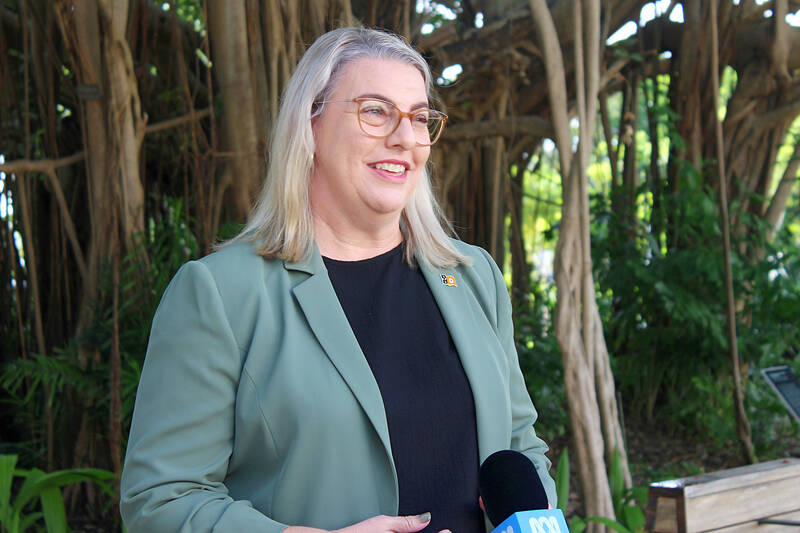
Photo: AAP Image via AP
The Australian Capital Territory passed its voluntary euthanasia laws in 2024 and Northern Territory Attorney-General Marie-Clare Boothby yesterday said awmakers in her jurisdiction would consider a bill by the middle of this year.
Lawmakers would be allowed to vote on it according to their own consciences rather than being expected to follow a party line.
“Legislating for the rights of the terminally ill is one of the most sensitive and complex reforms any government can undertake,” Boothby said. “We’re taking the time to get this right. We’re working carefully and consultatively — not rushing it — and we are committed to getting the balance right.”
A parliamentary committee in September last year recommended that a doctor-assisted suicide law be adopted by the Northern Territory, as well as recommending a public education campaign be launched to raise awareness and counter misinformation, particularly in remote and indigenous communities.
Drafting of the bill was underway, Boothby said.
“We won’t shy away from difficult issues and we are committed to progressing these reforms carefully, thoughtfully and responsibly,” Boothby said.
The Northern Territory has several unique characteristics and challenges among Australian states and territories.
The territory has by far the smallest population of the eight Australian jurisdictions: 260,000 people scattered across an area almost the size of France. Australia’s population is 28 million.
While indigenous people accounted for 3.8 percent of the Australian population of 25 million at the last census in 2021, they account for more than a quarter of the Northern Territory population.
Indigenous views vary on voluntary euthanasia. Some are suspicious of the medical system and fear they could be killed against their wishes. Others advocate for equitable access to assisted dying with strong cultural safeguards. There also are conflicting cultural beliefs surrounding death.
Northern Territory Legislative Assembly Speaker Robyn Lambley said establishing adequate education about the assisted dying law for indigenous people, many of whom do not speak English as a first language, was “probably unrealistic.”
“I don’t think we’re ready,” Lambley wrote online. “Maybe we’ll never be ready in the Territory. Aboriginal people have reluctance around accessing health services for anything, even having babies.”
“It will be a disaster. I don’t think it will work. We just need to take it at our own pace,” she added.

VAGUE: The criteria of the amnesty remain unclear, but it would cover political violence from 1999 to today, and those convicted of murder or drug trafficking would not qualify Venezuelan Acting President Delcy Rodriguez on Friday announced an amnesty bill that could lead to the release of hundreds of prisoners, including opposition leaders, journalists and human rights activists detained for political reasons. The measure had long been sought by the US-backed opposition. It is the latest concession Rodriguez has made since taking the reins of the country on Jan. 3 after the brazen seizure of then-Venezuelan president Nicolas Maduro. Rodriguez told a gathering of justices, magistrates, ministers, military brass and other government leaders that the ruling party-controlled Venezuelan National Assembly would take up the bill with urgency. Rodriguez also announced the shutdown

Civil society leaders and members of a left-wing coalition yesterday filed impeachment complaints against Philippine Vice President Sara Duterte, restarting a process sidelined by the Supreme Court last year. Both cases accuse Duterte of misusing public funds during her term as education secretary, while one revives allegations that she threatened to assassinate former ally Philippine President Ferdinand Marcos Jr. The filings come on the same day that a committee in the House of Representatives was to begin hearings into impeachment complaints against Marcos, accused of corruption tied to a spiraling scandal over bogus flood control projects. Under the constitution, an impeachment by the
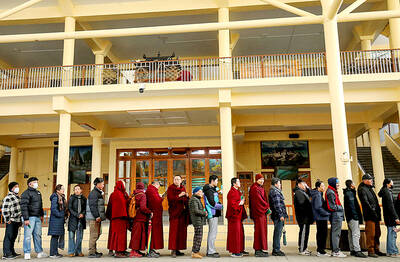
Exiled Tibetans began a unique global election yesterday for a government representing a homeland many have never seen, as part of a democratic exercise voters say carries great weight. From red-robed Buddhist monks in the snowy Himalayas, to political exiles in megacities across South Asia, to refugees in Australia, Europe and North America, voting takes place in 27 countries — but not China. “Elections ... show that the struggle for Tibet’s freedom and independence continues from generation to generation,” said candidate Gyaltsen Chokye, 33, who is based in the Indian hill-town of Dharamsala, headquarters of the government-in-exile, the Central Tibetan Administration (CTA). It

China executed 11 people linked to Myanmar criminal gangs, including “key members” of telecom scam operations, state media reported yesterday, as Beijing toughens its response to the sprawling, transnational industry. Fraud compounds where scammers lure Internet users into fake romantic relationships and cryptocurrency investments have flourished across Southeast Asia, including in Myanmar. Initially largely targeting Chinese speakers, the criminal groups behind the compounds have expanded operations into multiple languages to steal from victims around the world. Those conducting the scams are sometimes willing con artists, and other times trafficked foreign nationals forced to work. In the past few years, Beijing has stepped up cooperation


 RSS
RSS