


Safari Martins led his client Ian Njenga into a sparse shack on the rural roadside in Kiambu, at the edge of metropolitan Nairobi. On the shack’s wooden walls hung a shovel, iron, agricultural shears and a wrench, but Njenga was not there to buy equipment. He was there to get a haircut.
“I just use unconventional tools,” Martins said, smiling, moments before sliding a razor-sharp shovel edge across Njenga’s head, lopping off a swath of hair in the first of a series of moves that yielded a surprisingly clean haircut.
Unconventional tools are a hallmark for Martins, who is one of Kenya’s most recognizable barbers with about 1 million followers on each of his Instagram and TikTok accounts, where he is known as Chief Safro.
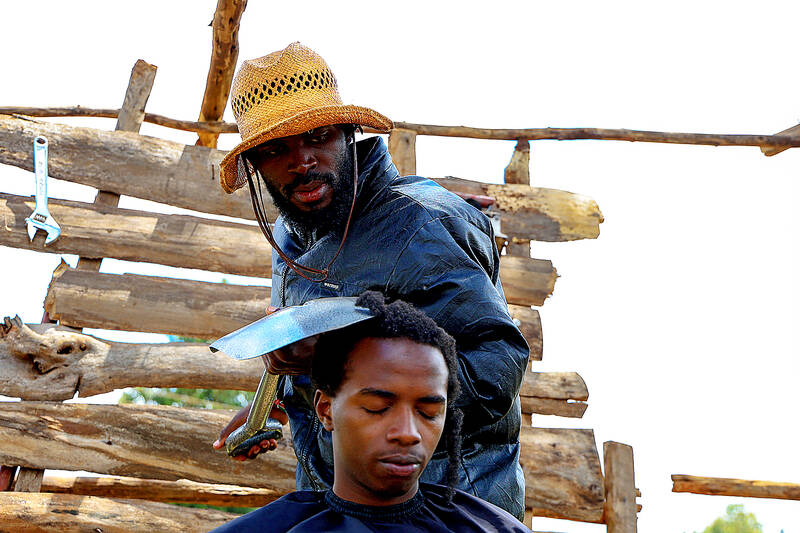
Photo: AP
As he makes precision cuts across Njenga’s head, a helper stands to the side, capturing every moment from different angles on a smartphone camera.
Influencer barbers are a new trend in Kenya, where social media usage has exploded in the past few years, and platforms such as TikTok are being used both for entertainment and as a lucrative side hustle.
Born in Rwanda and based in Nairobi, Martins got his start barbering in high school in 2018. Using borrowed clippers, he began offering trims outside classrooms and in cramped dormitories. Five years later, he added a camera and dropped a conventional trimmer — and never turned back.

Photo: AP
Martins went viral for zany barbering methods, but he has increasingly incorporated traditional African folk tales into voice-overs on his videos.
“I’m motivated by African culture, by African stories,” he said, adding that one of his tools, a sharpened iron box, was blessed by village elders.
The barber’s staying power has come from the haircuts themselves, which his customers say they love — and the chance to be featured on one of Kenya’s most magnetic social media accounts.
“If I compare him with other barbers his talent is next level,” said Njenga, who first visited Martins last year. “When I get shaved here I get very comfortable ... while walking in the streets I get very confident.”
The draw of a unique barbering experience and five minutes of social media fame is enough for customers to push past the price. Martins charges up to 1,500 Kenyan shillings (US$11.62) for one of his cuts, a hefty premium in Nairobi, where men might pay one-10th of that for a trim.
The popularity of Martins and other content creator barbers has come amid the breakneck growth of social media in Kenya. In January 2023, there were just 10.6 million social media users in the country, market research group DataReportal said.
By January last year, that number had increased almost 50 percent, to 15.1 million.
With monetization of social media content often benchmarked to Western digital advertising rates, finding success online can also bring a relative windfall to Kenyans. About 15 percent of Kenyans engaged in online content creation rely on it as their primary source of income, the Kenya Institute for Public Policy Research and Analysis, a think tank, said in a brief released in June last year.
Nevertheless, Martins complains that barbers do not reap the same rewards as other content creators, and he is right. Some of the highest-paid creators are those who make gaming, education or lifestyle content, according to Fundmates, a company that finances influencers, because of the wide applicability of brand deals in these niches.
“Barbers get viral on social media, but I feel like they are not respected,” Martins said. “You are not paid as a content creator, even though you have the views, even if you have the engagement.”

A humanoid robot that won a half-marathon race for robots in Beijing on Sunday ran faster than the human world record in a show of China’s technological leaps. The winner from Honor, a Chinese smartphone maker, completed the 21km race in 50 minutes and 26 seconds, said a WeChat post by the Beijing Economic-Technological Development Area, also known as Beijing E-Town, where the race began. That was faster than the human world record holder, Ugandan Jacob Kiplimo, who finished the same distance in about 57 minutes in March at the Lisbon road race. The performance by the robot marked a significant step forward
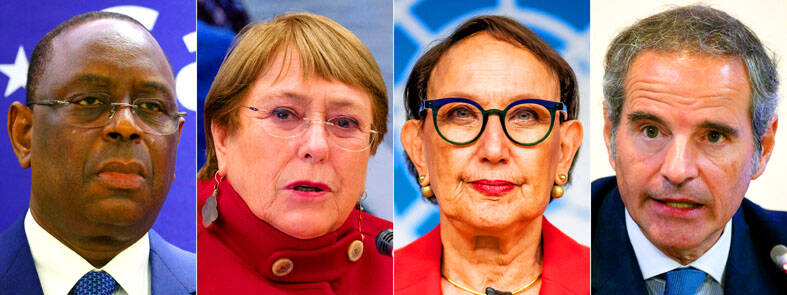
Four contenders are squaring up to succeed Antonio Guterres as secretary-general of the UN, which faces unprecedented global instability, wars and its own crushing budget crisis. Chile’s Michelle Bachelet, Argentina’s Rafael Grossi, Costa Rica’s Rebeca Grynspan and Senegal’s Macky Sall are each to face grillings by 193 member states and non-governmental organizations for three hours today and tomorrow. It is only the second time the UN has held a public question-and-answer, a format created in 2016 to boost transparency. Ultimately the five permanent members of the UN’s top body, the Security Council, hold the power, wielding vetoes over who leads the

An earthquake registering a preliminary magnitude of 7.7 off northern Japan on Monday prompted a short-lived tsunami alert and the advisory of a higher risk of a possible mega-quake for coastal areas there. The Cabinet Office and the Japan Meteorological Agency said there was a 1% chance for a mega-quake, compared to a 0.1% chance during normal times, in the next week or so following the powerful quake near the Chishima and Japan trenches. Officials said the advisory was not a quake prediction but urged residents in 182 towns along the northeastern coasts to raise their preparedness while continuing their daily lives. Prime

South Korea’s air force yesterday apologized for a 2021 midair collision involving two fighter jets, a day after auditors said the pilots were taking selfies and filming during the flight and held them responsible for the accident. “We sincerely apologize to the public for the concern caused by the accident that occurred in 2021,” an air force spokesman told a news conference, adding that one of the pilots involved had been suspended from flying duties, received severe disciplinary action and has since left the military. The apology followed a report released on Wednesday by the South Korean Board of Audit and Inspection,


 RSS
RSS